
96 – He always said that he lost his hair due to the heat in India

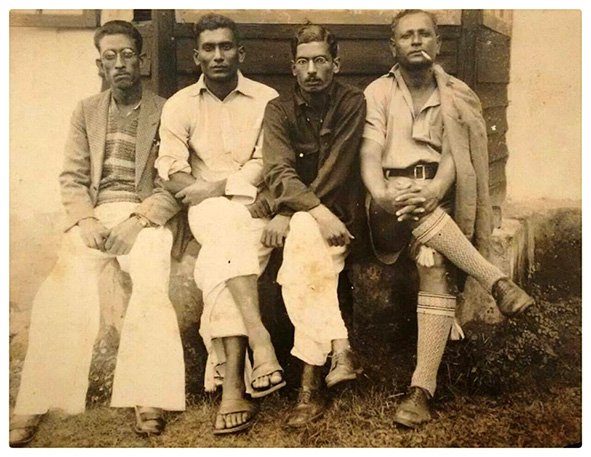
My father Sydney with his colleague at a club in India or Pakistan. Circa 1944
Image and Text contributed by Dave, Bristol, England
This is a picture of my father Sydney (Sid) and a colleague having a drink at a hotel or club somewhere in India or Pakistan during World War 2. He was was as an airplane mechanic with the RAF (Royal Air Force). He is the one with a cigarette and he would have been about 27 years old at the time.
He was also in the RAF football team and used to say that they sometimes flew 1000 miles just for a football game, this was during wartime and there must have been rationing, but it serves as an example perhaps of the british attitude at the time, towards sport.
My father Sydney was born in Liverpool, England around 1916 and had two older brothers and two older sisters. His father died when he was a child and he was brought up by his older brothers Joe and John.
He volunteered for armed service when the war (WWII) broke out in 1939 and was able to choose which service he wanted, which was the RAF. He failed his medical exam to be a pilot due to problems with his ears and became an aircraft mechanic dealing, I’d presume with air engines.
He was posted to Detling Airdrome in East Anglia, it was a coastal command airfield, but they were attacked in summer 1940 by the German airforce and about 67 RAF personel were killed. His squadron was then posted to India and I believe they went there by ship in either 1940 or 1941.
When in India, they were ‘posted’ or stationed in many different locations, he didn’t talk much about it but I do know he was in Hyderabad at some stage, and it was before partition. He always said that he lost his hair (he went partially bald) due to the heat in India. The main enemy in India during WWII were the Japanese coming through Burma, but I don’t think my father was ever on the front line. He returned to England after the war, around 1945 and never went back. He met my mother at a dance after the war, in Liverpool. He passed away died in 1979.
82 – The first time she saw a man die

My father, Anupam Kumar Shome and I. Srinagar, Kashmir. 1983
Image and Text contributed by Tillotama Shome, Actress, Bombay
In the early 80’s we lived in Rajbagh extension, near Zero Bridge in Srinagar, Kashmir.
I was four years old and on my way to school with my father Anupam Kumar Shome. He was an Airforce officer. En route to school we got stuck in traffic. Apparently, there was a ‘shoot out’ up ahead. As the police cleared the traffic and guided us, I saw through the arches of crowded human legs, a body of a dead man, drenched in blood. The contrast of the red blood against white of snow was inexplicable and I was witnessing the lifelessness of death for the first time.
My father shepherded me back home. His face was gaunt and I kept crying all the way back home. The same day he took me out for a ride in a boat and suddenly said, “You saw what happened today? It is all because of religion.”
I had no idea who religion was, the names of religion’s parents, where he or she lived, what he or she did for a living, why he or she killed that man or did not save him. I was only four. I just cried.
Because of what he may have seen and experienced, I think my father had come to a conclusion and a decision that religion brings grief, so Hindu spiritual ceremonies or references like Pujas, pundits, shradhs, kundli (astrology), and havans were never a welcome guest in our household. My religion or requirement of some faith, became the need to be aware of the consequences of my actions, my thoughts and even my memories. I think which is why, many decades later, before I became an actress, I decided to go and work at a girls orphanage in Kupwara, Kashmir despite the extremely tense situations at the border, and against the advise of many others, including my father.
My memory of that dead man, my love for Kashmir, the beautiful memories held in photographs of our time in Srinagar became the mental armor that helped me. And that armor remained intact when we were questioned by militants at gunpoint. Fear of death at that moment was fogged out, as all I felt at that moment, was that the Militant holding a gun was just a few years older than I was when I saw a man die for the first time.
I felt sad for him and lucky that I had a privileged childhood. Our memories hold a key to our future in ways that can surprise us. Luckily, it sure did surprise me.
81 – This was his last photograph

Above : My father's brother, Nagarathnam with his colleagues. Below : A Telegram announcing his death. Burma, 1938
Image and Text contributed by Meera Janakiraman, Bangalore
This image was photographed on October 26, 1938, in Burma. The person in the center is my father’s elder brother, Nagarathnam, with his colleagues from Burma.
My father T.J Raman and Nagarathnam’s parents (my grandparents) were originally from Thiruvallikeni, (now Triplicane) State of Madras. Their family business involved exporting Burmese Teak. Teak during war was “as important an ammunition of war as steel”, especially used in the construction of Warships. The family moved to Burma (formerly Myanmar) during World War I as it made better business sense.
Nagarathnam, fondly called Nagu, got married when he was 23 years old and had two sons. Leaving his family in with good care in Madras, he returned to Burma and first worked as a representative of the Prudential Life Insurance Company before he joined the Burma Railways as a clerk.
He was on his way to Mandalay, the royal capital of Burma, on a business visit by train when this photograph was taken. It is believed that during the travel he chocked on a piece of guava. Late at night, he was rushed to the Mayyo Hospital where he was declared dead due to heart failure. He died at the age of 30, the very next day after this photograph was taken. A telegram announcing his death was sent to his family in Madras via Calcutta.
80 – With props and accessories, she indulged her fantasies at a photo studio

My mother, Mohini Goklani. Pune, Maharashtra. Circa 1950
Image and Text contributed by Sunita Kripalani, Goa
In 1947, after partition, when my grandfather Nanikram Goklani and his wife Khemi migrated to India, along with their extended family from Karachi, Pakistan, they settled in Pune, Maharashtra with their 9 children. My mother Mohini, second of seven sisters, was just 16 at that time. Grandpa got a job in the Income Tax department and although times were tough, my grandfather made sure all the children received excellent education.
My mother and her older sister Sheela went to Nowrosjee Wadia College and my grandfather managed to procure admission for some of the younger children in reputed schools such as Sardar Dastur Hoshang Boys’ High School, and St. Helena’s School for Girls. The children studied well, they were voracious readers, and led a simple life.
During the 1950s, the sisters were well versed in household skills, especially the art of stitching and embroidery. They fashioned their own clothes, copying designs from magazines and the displays in the shop windows of Main Street. At home however, they maintained decorum and modesty, but ever so often, Duru, my mother’s younger sister, would coax her to go with her to a photo studio on Main Street called The Art Gallery to get their photographs taken. Duru would pack all kinds of stuff for both of them: ties and beads, scarves and skirts, hats and belts, not to forget some make-up, and the two of them would mount their bicycles and head for the studio where they indulged their fantasies, using studio props and their own accessories.
In the picture my mother is wearing “Awara pants”, a style made famous after the well known actor, Raj Kapoor’s movie by the same name. She is also very nonchalantly holding a cigarette, albeit unlit, between her fingers! The photograph is totally incongruous with her personality, for copying Nargis, the star actress of the time, was more my mom’s style whereas my aunt Duru was bolder and more tomboyish.
I don’t know if my grandfather knew what was going on, or if he approved, but he was not the kind of father who would scold any of his children. If he didn’t like something, he simply wrote a few words on a piece of paper and slipped the little note under that child’s pillow, which was enough to bring the rebellious offspring back on track… but that’s another story.
After college, my mother got a job at the Department of Cooperation, Government of Maharashtra. It was her first and last job. She retired in 1985 as Assistant Registrar of Cooperative Societies, Bombay.