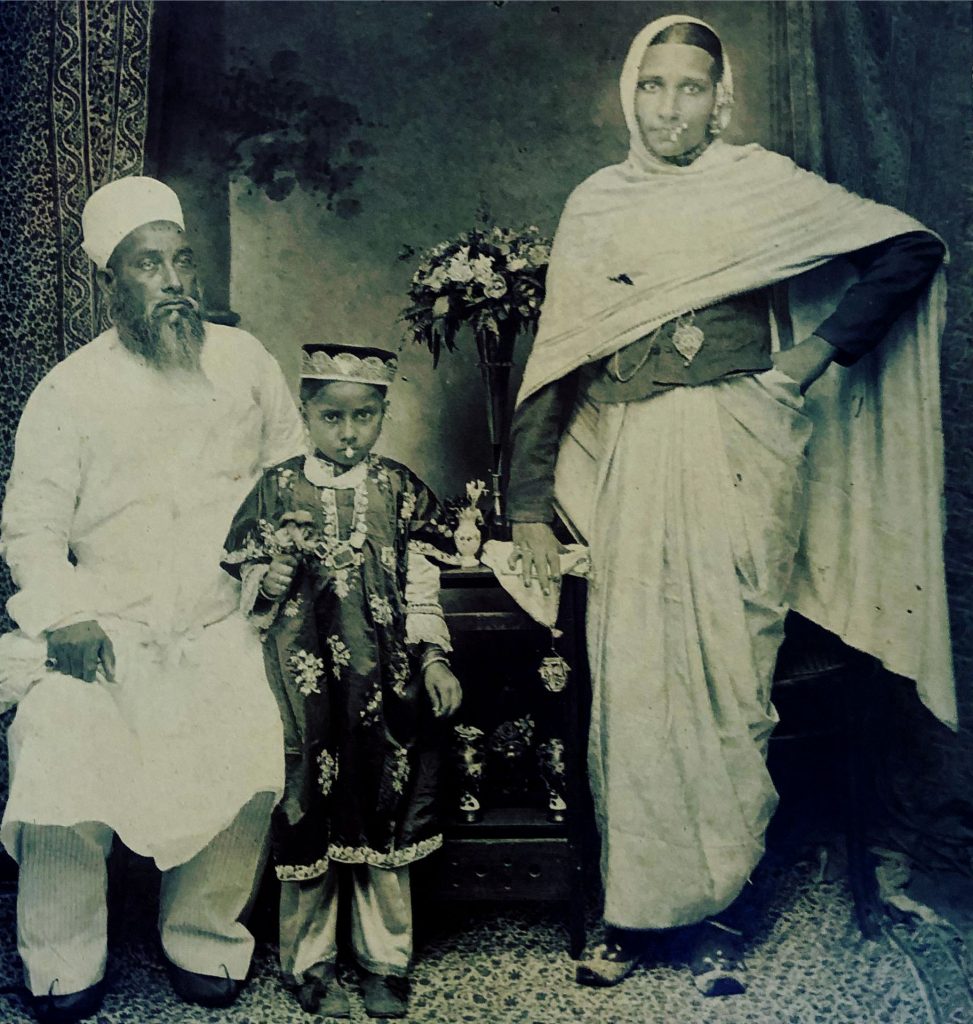
My Parents, K. M. Devaki Amma & Lt. Cdr. P.P.K. Menon. Bombay. Maharashtra. 1941
Image & Text contributed by Radha Nair, Pune
This photograph of my parents K. M. Devaki Amma & Lt. Cdr. P.P.K. Menon was taken at a Photo Studio in Bombay in 1941, soon after they were married. My father was based in the city serving the Naval Force.
My mother, K. M. Devaki Amma belonged to Feroke, a part of Kozhikode in Kerala. Her initials K. M. stood for Kalpalli Mundangad and her family originally belonged to the Anakara Vadkath lineage. The large joint family of more than 25-30 people lived in a house called Puthiyaveedu which still exists in Feroke, however the members are now settled in far flung places and my grand aunts and uncles are no more.
My mother had to give up school very early in life. She came from a large family of 14 brothers and sisters and belonged to an era where a girl’s formal education wasn’t a priority. While they grew up under the tutelage of grand uncles and aunts, they learned to cook, clean, and learnt to make do with and share whatever little they had with their siblings without ever complaining. Congee (Rice Gruel) was what they mostly had for lunch and dinner, supplemented with a little coconut chutney, and may be a side dish of some green banana, but only if they were bestowed with a ripe bunch of plantains available from the kitchen garden.
My mother and her sisters’ daily life entailed preparing food for all members of their very large family. By the light of a wick lamp, sweating by the blaze of crackling coconut fronds they would wash dishes with ash from the kitchen hearth and rinse them with water drawn from the well. My mother in personality was very self-reliant and was happy with whatever little she had.
Arranged by my paternal grandmother, when Amma married my father, a man with an aristocratic lineage and a Naval officer, my father’s cousins would scoff at her and condescendingly regard her as a ‘village girl’. They had been educated in Queen Mary’s Women’s college, Madras (now Chennai) whereas my mother had studied only up to Class IV in a local village school in Karrinkallai.
Undeterred, my father, who knew his wife was a bright and intelligent woman took her under his wing and brought out the best in her. He taught her English and bought her abridged versions of books written by Charles Dickens, Walter Scott and many other great authors. He read out passages to her and patiently explained to her what they each meant.
Thus Devaki, my mother, slowly emerged from her rural background, and became a lady endowed with great poise and charm. Not only did she steal my father’s heart, but even of those who befriended her. She became a much sought after friend by wives of both British and Indian naval officers. She taught them to cook Malayali dishes and stitch & embroider; skills, which were executed by her exquisitely. She wrote and spoke English with such assurance that she could put a present day Post Graduate in English to shame. But despite all these changes, she remained loyal to her roots, proud of her humble origins, and very attached to her siblings.
Sometimes, deep into the night I would catch whispers of my parents’ conversation as they sat and planned the monthly budget, and spoke about their dreams of providing us with the best of every thing. It was my mother who insisted that my sister and I be given the best education they could afford. She firmly refused a State Board SSC education, and insisted on us being admitted into schools which followed a Senior Cambridge syllabus. She was efficient and fiercely independent. By comparison I was a pale shadow. In fact, many times I used to feel very unsure of my self in her presence, intimidated by her indomitable spirit and the complete control she had over any situation.
When my father was suffering Cancer, she stood by him; nourishing him with love and healthy food, while my sister and I watched our father’s condition worsen by the day, helpless and often giving in to tears. My mother always remained calm, but only when he breathed his last in 1977 did she break down completely. He was her life force, and she was his guiding light. Theirs was an extraordinary relationship, always supportive of each other at all times and completely committed to each other till the end.
After I graduated, it was her dream that I put my education to good use. However, a few years after marriage when I was forced to give up my teaching post, she never forgave me till she breathed her last. To make up for it, I began to write and put together a collection of short stories, but the book never got published.
What pained me most was that I was not able to place a copy of my book in my mother’s hands and make my peace with her before she passed away in 2008.
Apr 23, 2013 | Categories: 1940s, Arranged Marriage, Attire, Bombay, Cancer, Condiments, Domestic Skills, Dressed for an Occasion, Education, English, Fashion Accessories, Food & Drink, Fruit & Vegetables, Furniture, House Wife, Illiteracy, India, Interiors, Jewellery, Kerala, Literacy, Material, Men in Uniform, Men's Clothes, Military, Photo Collection, Photo Studio, Picnics & Feasts, Pre-Independence, Previous, Prints & Stitches, Props, Rags to Riches, Royality, Sarees, Specialised Clothing, Studio Backdrops, Studio Portraits, Women Empowerment, Women's Clothes | Tags: 1940s, Anakara Vadkath, Bombay, Budget, Cambridge, Chennai, Couple, Dreams, Education, Hair Styles, House Wife, Indian Navy, Jewellery, Joint Family, K. M. Devaki Amma, Kalpalli Mundangad, Kerala, Literacy, Lt. Cdr. P.P.K. Menon, Madras, Maharashtra, Marriage, Men's Clothes, Naval force, Photo Studio, Props, Puthiyaveedu, Radha Nair, Regret, Sarees, Shoes, Studio Backdrop, Studio Portraits, Syllabus, village girl, Women Empowerment, Women's Clothes | 5 Comments »

(Left to Right) My grandfather Salil Chowdhury with my aunt Tulika, his sister Lily with my eldest aunt Aloka, and my grandmother Jyoti Chowdhury with my mother, Lipika. Bombay, Maharashta. Circa 1959
Image and Text contributed by Aurina Chatterji, Bombay/Toronto
Even though he died when I was 12, I never really knew my grandfather, the famous music Director Salil Chowdhury.
Bapi Dadu, as we called him, was an infrequent visitor at 16, Hillcrest, Perry Cross Road, Bandra. It was my grandmother, his wife’s house, the site of almost daily family congregations. I never wondered why he didn’t live in this house. Maybe it was because Bapi still occupied 16, Hill Crest like a benevolent ghost. The walls were plastered with his photographs, posters, awards. His songs drifted lazily from my grandmother’s trusty companion, the radio transistor, the sound often muffled by pillows.
I remember watching Bapi on Doordarshan, on one occasion talking to Asha Bhosle, on another – in the valorous yet invariably mangled Hindi of Bengalis – talking about Kishore Kumar. I remember numerous videos of him conducting a choir. I remember the twinkle in his eye, his proudly bald head and the way his hair always curled at his nape, begging for a hair cut.
One day, in our Bapi-bedecked hall, my older cousin told me in conspiratorial tones that Bapi had another wife and he had other children and that is why he lived in Calcutta and that is why we rarely saw him. I don’t remember being particularly affected. I do remember the puzzle pieces rapidly fitting into their places, but the complete picture, to me, was just a piece of delicious gossip. Like the happily stupid child I was, I didn’t think of our mothers’ devastation, nor the stigma of my grandmother being a single mother in 1960s India. I continued to feel a sly pride when people introduced me as Salil Chowdhury’s grand-daughter and I continued to look forward to Bapi’s rare but always joyful visits.
As I grew up, my personal memories of Bapi grew so blurry as to feel like some elaborate dream. The less I remembered, the more curious I became. This is what I learned: He was an avowed communist, a big fan of the USSR. He once accompanied Charlie Chaplin on the piano and he thought very highly of the Beatles.
I discovered his early, pre-Bollywood work – raw, angry, shamelessly political songs that were anti-colonialism, anti-zamindari, anti-war. As a teenager being gently tugged to the left by her nascent political beliefs, these songs were a revelation. I didn’t understand a lot of the lyrics – I speak Bengali like Bapi spoke Hindi, with less valour and more mangled – but what I did understand, I related to it viscerally.
Bapi’s idealistic ideas for a newly independent India, his poetic cries for justice were framed in complicated, meandering melodies, supported by beautifully feisty harmonies. I found myself in the fairly unique position of becoming musically obsessed with my own grandfather, a state that was both cool and awkward, almost narcissistic.
But for all his generosity when it came to the outside world, like so many other luminaries before and after him, Bapi was less than exemplary in his personal life. He had abandoned a devoted wife, a wife he had fallen for while he tutored her in Philosophy, a wife he had secretly married much to the chagrin of her Brahmin father, a wife who selflessly clothed and fed and mothered many of the Bollywood aspirants who followed Bapi from small-town Bengal. He abandoned his three little ones, the musically named Aloka, Tulika, Lipika, who, to my shock and eternal admiration, harbour no resentment against their deeply loving but absent father.
He knew all of this. He probably didn’t know that he also unwittingly abandoned his grandchildren. He showered us generously with love and ghost stories, but he always disappeared, leaving behind only the fragrance of his tobacco pipe.
To me, he was barely a grandfather. He was simply the reason the Bangladeshi florists by our home never charged us, the reason strangers would fawn over my grandmother, the reason some of my teachers were partial to me.
And yet, 18 years after his death, I find myself uncannily bonded to a man I never knew. I am fascinated by colonial history. I obsessively read about Russia. I sing in a choir.
I wish I could ask my grandfather the questions that pop into my mind with the certainty of sunrise when I think of him: What was it like to hide in toilet holes to escape the British? Did you really think Stalin was a good man? How about Brezhnev? Can you teach me how to create harmonies? What are your thoughts on Putin? What do you think of the CPI(M) now? Is this how you pictured independent India?
Our similarities, of course, are perfectly explainable but I prefer to believe that they are magical. I prefer to believe that the universe contrived to ensure, albeit posthumously, that I would feel the tenderness of being grandfathered. When I look at this picture – my young, beautiful grandparents with their young, beautiful daughters – I feel a forceful, almost unbearable love. And sometimes if I close my eyes, I can still smell the sweet, brown tobacco that unfailingly lingered on Bapi Dadu.
Jan 16, 2013 | Categories: 1950s, 1960s, Abandonment, Achievements, Architecture, Bandra, Bengali, Bengali, Bombay, Brahmin, Bungalow, Calcutta, Communist, First of a kind, Freedom Fighters, Furniture, Future icons from the Past, Hair Styles, House Wife, India, Indian Film Industry/Bollywood, Inter Caste, Interiors, Movies, Music, Art, Dance & Culture, Musician, Mustache, Personal Collections, Philosopher, Photo Collection, Poet, Polygamy, Previous, Sarees, Single Parent, Soviet Union (USSR), West Bengal, Western Clothes, Women Empowerment | Tags: 1960s, Abandonment, Anti-establishment, Asha Bhonsle, Aurina Chatterji, Bandra, beatles, Bollywood, Celebrity, Charlie Chaplin, Communist, CPI(M), Doordarshan, Gossip, Kishore Kumar, Music Director, Poet, Radio transistor, Russia, Salil Chowdhury, Scandal, Stalin, The Beatles, USSR | 2 Comments »

My father Sydney with his colleague at a club in India or Pakistan. Circa 1944
Image and Text contributed by Dave, Bristol, England
This is a picture of my father Sydney (Sid) and a colleague having a drink at a hotel or club somewhere in India or Pakistan during World War 2. He was was as an airplane mechanic with the RAF (Royal Air Force). He is the one with a cigarette and he would have been about 27 years old at the time.
He was also in the RAF football team and used to say that they sometimes flew 1000 miles just for a football game, this was during wartime and there must have been rationing, but it serves as an example perhaps of the british attitude at the time, towards sport.
My father Sydney was born in Liverpool, England around 1916 and had two older brothers and two older sisters. His father died when he was a child and he was brought up by his older brothers Joe and John.
He volunteered for armed service when the war (WWII) broke out in 1939 and was able to choose which service he wanted, which was the RAF. He failed his medical exam to be a pilot due to problems with his ears and became an aircraft mechanic dealing, I’d presume with air engines.
He was posted to Detling Airdrome in East Anglia, it was a coastal command airfield, but they were attacked in summer 1940 by the German airforce and about 67 RAF personel were killed. His squadron was then posted to India and I believe they went there by ship in either 1940 or 1941.
When in India, they were ‘posted’ or stationed in many different locations, he didn’t talk much about it but I do know he was in Hyderabad at some stage, and it was before partition. He always said that he lost his hair (he went partially bald) due to the heat in India. The main enemy in India during WWII were the Japanese coming through Burma, but I don’t think my father was ever on the front line. He returned to England after the war, around 1945 and never went back. He met my mother at a dance after the war, in Liverpool. He passed away died in 1979.
Nov 19, 2012 | Categories: 1940s, 1947 India Pakistan Partition, Architecture, Beer, Burma, Clubs, East India Company, English, Food & Drink, Football, Furniture, Hair Styles, Hand Painted, Head Gear, Hyderabad, Interiors, Japan, Men in Uniform, Military, Noteworthy Journeys, Pakistan, Pre-Independence, Previous, Ship, Smoking, Summers, Travel, Western Clothes, Western Dances, World War II | Tags: 1940s, Baira, Balding, Beer, Burma, Cigarette, Club, England, Football, friend, Furniture, Head Gear, Hyderabad, India, Japan, Liverpool, Mechanic, Medical exam, Partition, RAF, Royal Air Force, Sports, Sydney, Turban, Uniform, Waiter, World War II | Leave A Comment »

My paternal grandparents, Jambakalakshmi & Srinivasaraghava Iyengar. Tirubuvanam (Tanjavur District) Tamil Nadu. 1951
Image and Text contributed by K.S Raghavan, Chennai
My great grandfather, Sri Krishnaswamy Iyengar hailed from a humble Brahmin family of Kausika Gothra (clan) belonging to SamaVeda Shakha (branch) at Manalur in Tanjavur district.
The family migrated to a near by village called Tirubuvanam on the banks of River Veera Cholan looking for greener pastures. The village was very famous for its Chola period architectural splendor.
My great grandfather served a very well known temple, Sri Kothanda Ramaswamy, as a cook, which was maintained by the local business community. He and his wife Vanjulavalli had three sons and two daughters. They were Srinivasaraghavan, Veeraraghavan, Ramaswamy, Kanakavalli and Pankajavalli. All these names inspired by Lord Rama indicated his devotion to the God.
The eldest son, my grand father Srinivasaraghavan (1891-1952) was intelligent and seemed to have a flair for business. During that period the entire village community was engaged in silk cloth weaving, for the district was famous for its silk sarees. So he joined a local business outfit that manufactured and sold silk sarees as an accounts clerk, even though Brahmin families were not known to enter the business arena.
My grandfather a very pious person and his devotion to Lord Rama earned him a lot of goodwill among the village folk. His towering personality with a prominent vaishnavite insignia on his forehead along with his ever- affable smile, added a saintly aurora to him, and he was compassionate to all and they looked up to him for wise counsel.
As days passed he grew in stature. His sharp business acumen prompted him to start a business of silk cloth weaving and marketing in partnership with another weaver who was also the village chieftan, Nattanmai Ramaswamy Iyer. Their business quickly grew leaps and bounds, and they became master weavers running more than one hundred looms. The duo became very good friends. However, later even when Nattanmai Ramaswamy Iyer decided he wanted to invest in a micro finance venture and my grandfather and he parted ways, they remained close friends.
My grandfather then started his own business of silk cloth weaving and marketing along with his two brothers. The business flourished and they opened two branches, one in Chettinad and the other in Valayapatti. All the brothers and sisters had gotten married and were well settled. But as the brothers’ families grew in size, the needed to chalk out their own path to progress. The brothers split the business into three units and continued their businesses.
My grandfather Srinivasaraghava Iyengar’s business establishment was popularly known as “Peria Iyengar Kadai” He came to known as a very successful businessman of his time. He explored new business avenues by supplying cloth for the parachutes used in the armed forces. He also created a brand for “Kooraipudavai” or the Nine yard saree that is used to this day during the marriage ceremonies of Hindu Brahmin families. His products and good reputation had already reached far off places through the country. The shop cum house, was a busy picture from the morning till night. Activities like bleaching & dyeing of silk yarn, unwinding of gold threads would go on in the hindquarter of the house. He used to sit on the mat made of reed, while weavers, workmen, customers and visitors would stream in and out and transact their business.
He was so industrious, that he introduced many new methodologies in dyeing silk. He would travel into the dense forests of Orissa to buy Areca nut that was used as a dyeing pigment. Once he even risked his life to tread the dreaded forests of Berhampur. He had to spend nearly six months in those inhospitable terrains to procure his raw materials, so much so that people back home almost gave up hope of seeing him alive.
Srinivasaraghava Iyengar’s devotion to Lord Rama remained strong. He organized ‘Srimad Ramayana’ discourses and arranged for renowned scholars like Villiambur Swamy, Gaddam Sri Vardachariyar swamy to translate the verses and expound them to local folks.
He was also a connoisseur of Karnatic music and would sing songs in praise of Lord Rama. Adults and children would both be captivated. During his last days, his failing health restrained him from much of movement, but even then he did not swerve from Ramayana recitation. His last day, we hear he was in a very happy mood and that day’s discourse had gone off with much fan fare. But around midnight he complained of discomfort and suddenly passed away. The whole village bid him adieu with tears in their eyes and singing “Ragupathi Raghava Rajaram” till his mortal remains were consigned to holy flames.
Even to this day the people fondly remember him and recall their happy days with him.
Oct 22, 2012 | Categories: 1950s, Attire, Brahmin, Business-man / Business-woman, Clerk, Commerce, Conversion of Caste, Dressed for an Occasion, Friendships, Furniture, Gods, Hair Styles, India, Indian Clothes, Interiors, Jewellery, Karnataka, Men's Clothes, Migration, Music, Art, Dance & Culture, Philanthropy, Previous, Sarees, Shopkeeper, Silk, Specialised Clothing, Studio Portraits, Tamilian, Tanjavur, Textiles, Trade, Travel, Women's Clothes | Tags: 1950s, 1951, armed Forces, Brahmin, Chennai, Clan, Gotra, Jambakalakshmi, K.S Raghavan, Kausika Gothra, Kooraipudavai, Madras, Manalur, Marriage, Military, Nine Yard Saree, parachutes, Sama Veda, silk cloth weaving, silk sarees, Srimad Ramayana, Srinivasaraghava Iyengar, Tamil Nadu, Tanjavur District, Tirubuvanam, tradition, vedas, Wedding | 1 Comment »

My father, Jagdish and mother, Usha at their wedding. Old Delhi. December 12, 1954.
Image and Text contributed by Renu Shukla, Jaipur
This picture is of mom Usha Sharma and my Dad Jagdishwar Nath Sharma right after their marriage ceremony on December 12, 1954. My mother at the time was only 15 years old & my father was 23. He was the Assistant Commissioner with the Income Tax Department in Jaipur, Rajasthan and my mother was studying in 10th Standard. She completed her education after marriage.
My mother Usha was exceptionally fond of movies and so was my father. He was studying Law (LLB) in Agra at the time and on a serendipitous day decided to visit his hometown, Ajmer, Rajasthan, for holidays along with some of his friends. Young blooded, the friends and he spontaneously made a detour to Delhi for a fun day & also to watch a movie.
The latest movie at the time “Barsaat” had been running in Moti Mahal, a well known theatre at the time in Chandani Chowk, Old Delhi.
Describing that fated day, my mother would tell us, that she too, along with her cousins, had landed up to watch the same movie and she noticed ‘this strange boy in the front seat who would keep turning around to stare at her continuously!’ She was into the movie, yet was beginning to get more and more annoyed with this shameless fellow whose stares were distracting her. So much so, that ultimately and in a huff the girls left the theatre half way through the movie, cursing the boy away. What she did not know, was that the boys too left and followed the girls discreetly to my mother’s residence, which was right behind Moti Mahal theatre in Chandani Chowk.
The enterprising boys then found out all her family details and a few days later, my father’s family sent in a marriage proposal to my mom. Fortunately, there was no hitch in the proposal because both families were Brahmins and economically secure. We, consequentially were blessed by having very loving Parents. They doted on each other for the rest of their lives.
Years later, and after their passing away, I still think of that particular day, when fate and the movie ‘Barsaat’ brought my parents together. I miss them terribly. They were simply the best and most fine parents a child could ask for.
Sep 24, 2012 | Categories: 1950s, Administration, Agra, Ajmer, Brahmin, Chandani Chowk, Chandani Chowk, Chiffon, Child Marriage, Cultural Attire, Furniture, Law, LLB, Love & Romance, Men's Clothes, Moti Mahal, Movie Theatre, Movies, Previous, Specialised Clothing, Theatre, Travel, Wedding Trousseau, Weddings, Western Clothes | Tags: Barsaat, Bollywood, Brahmin, Chandani Chowk, Child Marriage, Eve Teasing, Income Tax Department, Indian Cinema, Jagdish Nath Sharma, Jaipur, LLB, Love, Marriage Proposal, Moti Mahal, Movie, Old Delhi, Rajasthan, Renu Shukla, Theatre, Usha Sharma, Wedding | Leave A Comment »

(Left) My grandfather, Dr.B. Seshachalam with his mother, Thyaramma. Bangalore, Circa 1920. (Right) A certificate proof of him as a Political prisoner. Bangalore, 1957
Image and Text contributed by Nandith Jaisimha, Bangalore
This is a photograph of my paternal grandfather Dr.B. Seshachalam (L.M.P Reg Medical Practitioner no: 1280) with his mother, Thyaramma. He was born in Bangalore on January 13, 1913 and was the son of B.Venugopal Naidu.
My grandfather was a well educated man. He attended St.Josephs school as well as Pre-University College. He then went on to join Mysore Medical College which was initially established in Bangalore, and completed the 4 year LMP course. He was married to Kamala Yadav and had one son.
In his college days he was arrested as a Political Prisoner accused of protesting during the Freedom struggle in Bangalore in 1942, and had to pay a fine of Rs. Two during his detention in the Central Jail, though the certificate and receipt was only provided in 1957. The Jail no longer exists in its original form, it has now been made-over into Freedom Park.
During the course of finding more information, I stumbled upon some incredible untold stories. For instance, I discovered my grandfather was also a member of the Free Masons and that my grandmother Kamala too was actively involved in politics since the age of 10!
My grandfather served society until the end. Even after 35 years of his demise, people in Bangalore remember the Doctor. There was an article about him in The Deccan Herald on 22nd June 2009, titled “The GP is not extinct”. The people of Bangalore East always never fail to mention their eternally gratitude to him. It was his dream to serve the underprivileged, and lived by the motto “Faith is God”.
Transcript of the Certificate
Office of the Superintendent
Central Jail, Bangalore
Dated 28th November, 1957
CERTIFICATE
This is to certify that the detenue No. 511 Sri. B. Dr.B.Seshachalam, S/O B. Venugopal Naidu, a Medical Student, was admitted to this jail on 10-9-1942 as a political prisoner, as per orders of Deputy Commissioner, Bangalore District and was released on 2nd Oct, 1942 as per orders of Deputy Commissioner, Bangalore.
[Signature]
Superintendent,
Central Jail, Bangalore
Aug 08, 2012 | Categories: 1910s, 1920s, 1950s, Bangalore, British Reign, Certificates, Doctor, Education, Freedom Fighters, Furniture, Future icons from the Past, Graduation, Hair Styles, Head Gear, Indian Politics, Inter Caste, Jewellery, Karnataka, Mysore Medical College, Police, Pre-Independence, Previous, Prisoner of War, Props, Sarees, St.Josephs School, Tamilian, Women Empowerment, Yadav | Tags: 1920s, 1940s, 1950s, Bangalore, Central Jail, Doctor, Dr.B. Seshachalam, freedom fighter, Freedom Park, Kamala Yadav, Karnataka, Nandith Jaisimha, Politics, Prisoner of War, Protest | 2 Comments »

My grand-aunt Shukla, R.D Burman and my grand-uncle Nirmal Kumar Dasgupta, on Burman’s home Terrace. Bombay, Maharashtra. March, 1975
Image and Text contributed by Anupam Mukerji, Bangalore
This picture was photographed on the terrace of R.D Burman‘s home in Bombay.
R.D Burman was one of India’s finest Music composers of the Indian Film Industry. With him are my grand-uncle Nirmal Kumar Dasgupta and his wife Shukla.
RD, whom he lovingly called Tublu, was the apple of my granduncle’s eye. RD loved him back equally calling him Moni Dadu. R.D Burman’s mother was my grand uncle’s sister, technically a niece, but since they were closer in age the relationship was like a close sibling.
In March of 1975, Moni Dadu and family were visiting R.D Burman. RD was busy recording the soundtrack for now India’s biggest box office hit film ever, Sholay. On this morning, sitting on his terrace, RD was playing back for Moni Dadu the scratch recording (rough recording) of his now exceptionally famous song Mehbooba Mehbooba. He had been recording the song through the night. RD had recorded the song in his own voice, even though the final song was to be recorded in Kishore Kumar‘s. Liking what he had just heard, Moni Dadu advised RD to keep the song in his voice.
As fate would have it, Moni Dadu’s wish was granted. Kishore Kumar was late for the recording of Mehbooba Mehbooba and RD decided to record the song himself. As we say the rest is history.
From the 1960s to the 1990s, R.D Burman composed scores for 331 movies. He served as a influence to the next generation of Indian music directors. He would have been 73 today, on June 27, 2012.
Jun 27, 2012 | Categories: 1970s, Accolades & Awards, Attire, Bengali, Bombay, Entertainment, Exteriors, Floral patterns, Furniture, Future icons from the Past, Indian Film Industry/Bollywood, Maharashtra, Movies, Musician, Previous, Sarees, Western Clothes | Tags: 1970s, Anupam Mukerji, Bollywood, Bombay, Famous, Film, Kishore Kumar, Mehbooba, Music, Music Composer, Nirmal Kumar Dasgupta, RD Burman, Recording, sholay, Siblings, Soundtrack, Terrace | 1 Comment »

The Cordeiro Siblings. Alec (Bunnu), May and Beatrice. Karachi (now Pakistan). Circa 1910
Image and Text contributed by Naresh Fernandes, Author, Bombay
The picture, photographed sometime around 1910, is the childhood image of my grand-uncle Alec Cordeiro, fondly called Bunnu. Next to him is my Grand-aunt May and my Grandmother Beatrice.
It isn’t clear when and how exactly my ancestors got to Karachi, but it seems that they’d been there for four generations. Like most Goans, they left looking for work: the Portuguese didn’t establish any industry in Goa, so hundreds and thousands had to seek work in other places. There were sharp discussions in the family about whether our ancestor Santan Vaz had made his money running a liquor distributorship or a booze joint.
My paternal great-grandfather, Xavier Cordeiro, was a postmaster general in Karachi. His son-in-law, my grandfather, Alfred Fernandes, moved to Karachi from Burma during World War II. He’d been working for the Burma Railways and had to leave when the Japanese invaded in 1941. So he and his wife, my grandmother, Beatrice (standing right), decided to return to their family’s home in Karachi. In only a few years, the entire family pulled up their roots from the city in which they’d lived for four generations to take their chances in India, a few months before Partition in 1947.
Though my father was only nine when the family left Karachi, his elder siblings had more vivid memories : trips between Bombay and Karachi were made on ferries named the Saraswati and the Sabarmati (“they were like little tubs, we all got seasick”) ; relatives having leisurely evenings at the Karachi Goan Association (KGA), “gin and lime was the favourite drink”, and the enterprising nature of the Karachi Goan community -“they even owned a flour mill!” From my grandmother’s stories, it appeared that everyone in the family had spent a lot of time at the KGA. After all, it was right opposite their bungalow in Depot Lines. That bungalow, sold months before Partition, has long been replaced by a characterless block of apartments.
When we were children, my cousins and I could have been forgiven for thinking that our great-uncle’s first name was “Poor”. That, was how my grandmother and her sisters referred to their only brother each time he came up in conversation, “Ah, poor Bunnu,” they’d sigh whenever someone mentioned their Cambridge-educated sibling who’d chosen to stay put in Karachi at Partition. The somewhat embarrassed tone in which his three sisters talked about him left Bunnu obscured by a whiff of mystery—even scandal.
If there’s one thing I knew about Uncle Bunnu, it’s that he spent a great deal of time at the bar of KGA. Friends joked that the committee of Karachi Goan Association had once made a decision to sack the chowkidar (guard). He wasn’t really needed since Bunnu Cordeiro never seemed to leave the building.
When I finally made a visit to Karachi in November 2011, I met 92-year-old Rita de Souza. She’d been in school with all three of my grand-relatives. She displayed all the discretion you’d expect of a woman of her breeding, but under my badgering, was gradually lulled into talking about my great-uncle. “Ah, poor Bunnu,” she eventually sighed. “He was quite a talker.” She let slip an anecdote relating to the time Bunnu was at Cambridge in the 1920s. “He was disappointed in love,” Rita de Souza said. “He was quite keen on a woman when he was in England, but his mother heard of it and made him exit the situation post-haste.” That’s all she remembered about him.
Others too remembered Bunnu. “He’d tell us about the libraries in Cambridge, where you’d have to maintain pin-drop silence,” a third-cousin said. “‘What would happen if you had a cough?’ we’d ask. He’d reply, ‘If you had a cough, courtesy would require that you didn’t visit the library.’”
At one recent family get-together, the conversation turned to Bunnu. It would be difficult to send mail over the border after each India Pakistan war, so Bunnu’s letters were infrequent. But sometimes, perhaps to remind everyone of his real name, Alec, he’d sign himself as “Sikander”—the sub-continental name for Alexander the Great. “He called his three sisters ‘the gangsters’,” someone recalled. “When he was in England, they sent him a childhood photo of the four of them and he said, ‘I’m not coming home. If I do, I’ll have to take care of them.’”
My aunt Margaret corroborated the story I’d been told in Karachi. Evidently, Bunnu had refused to return to Karachi because he’d fallen in love with an Englishwoman. His mother, Mary, who wanted him to marry a Goan, was horrified. She “picked up her skirts and took the next boat to England”. The conclave was divided on what happened next. Either my great-grandmother “grabbed his ear and dragged him right back home” or “he sent her right home without even allowing her a day to see the sights, but promised to return soon”. At any rate, Bunnu was back in Karachi by the mid-1930s and would remain a KGA Bar fixture for the rest of his life.
Uncle Bunnu never married, held a job for long or seen his sisters after 1947. Later he moved into an old folks home in Karachi. No one in the extended family seemed to have a recent photograph of him. I’d always held the impression that Uncle Bunnu had drunk himself to death, but considering that he was 80 when he died, he didn’t do it very efficiently. By the time he passed away in 1984, Bunnu had become more like a hazy myth to his younger Indian relatives than a real person.
The old folks home in which Bunnu had spent his last years is located in one corner of Cincinnatus Town. Cincinnatus Town was unnervingly familiar. Many of the older homes had been built in the 1930s, exactly at the time the pocket of Bandra in which I live had been constructed and with the same coastal-city architectural features. Parts of Garden East (Cincinnatus Town) resembled the now-demolished landscapes of my childhood. They were filled with the kind of teakwood furniture you find in older Bombay homes and had identical Catholic iconography. My ancestors, yes, they’d been dead for decades, but as we discussed them in Bombay, six decades and 900 kms away, they were warm, breathing presences, as real and as resolute as Karachi.
An unedited version of this narrative can be found here.
Jun 05, 2012 | Categories: 1910s, 1947 India Pakistan Partition, 1971 India Pakistan War, Addiction, Alcohol, Architecture, Arrivals & Departures, Bandra, Boat, Bombay, Bombay to Karachi, British Reign, Bungalow, Burma, Catholic iconography, Christianity, Cincinnatus Town, Colaba, Committees & Senates, Decor, Depot Line, Dressed for an Occasion, Fashion & Trends, Ferry, Furniture, Gin, Goa, Goan, Government Jobs, India, Interiors, Karachi, Karachi to Bombay, Letters, Love & Romance, Men's Clothes, Migration, Pakistan, Photo Studio, Picnics & Feasts, Pre-Independence, Previous, Prints & Stitches, Sabarmati, Saraswati, Shoes, Studio Backdrops, Studio Portraits, Teak, Travel, United Kingdom, University of Cambridge, Wartime Separation, Western Clothes, Western Clothes, Women's Clothes, World War II | Tags: 1910, 1910s, 1947, 2011, Alcohol, Alfred Fernandes, Bombay, Burma, Burma Railway, Cordeiro, Gin, India, Japanese Invasion, Karachi, Karachi Goans Association, KGA, Mumbai, Naresh Fernandes, Pakistan, Portuguese i, Post Master general, Sea sick, World War II | 2 Comments »

My maternal grandfather, Samuel John Souri, Singapore. 1942
Image and text contributed by Sandhya Rakesh, Bangalore
My maternal grandfather, Mr. Samuel John Souri was born to Mr & Mrs Rev. JJ Souri (Reverend) in Ananthapur district of Andhra Pradesh. He had two sisters & three brothers. After he completed his studies in Ananthapur he began working in the Collectorate. At the advise of his cousin’s wife, he learnt Stenography (Short Hand) and found a job with the British as Chief Clerk in Singapore in the late 1930s.
My mother, his daughter, Joyce, tells me that once when he was called out for an urgent meeting, in a hurry he forgot his footwear, but when he went back to collect it, the sentry at the gate refused to allow him in because the British might think him to be a spy.
My grandfather spent many years in Singapore working for the British, during the World War II. He also had six children, all of whom received Singaporean citizenships. After a few years, when the British were defeated at the Battle of Singapore he moved back to India, sending the family ahead by a few months.
A diabetic patient, he passed away very suddenly, failing to eat some food after an insulin shot. My mother remembers that it was when she was in college. I do regret never having the opportunity to see and spend time with this very interesting and great man.
Mar 05, 2012 | Categories: 1940s, Andhra Pradesh, Attire, Battle of Singapore, Christianity, Citizenship, Clerk, Diabetes, Furniture, Hair Styles, Intelligence and Spies, Men's Clothes, Migration, Mustache, Pre-Independence, Professional Training, Props, Singapore, Studio Backdrops, Studio Portraits, Western Clothes, World War II | Tags: 1940s, Ananthpur District, Andhra Pradesh, Attire, Backdrop, Bangalore, Banister, Barefoot, Battle of Singapore, British, Carpet, Chair, Chief Clerk, Christianity, Citizenship, Clerk, Collectorate, Diabetes, Footwear, Furniture, Grandfather, Hair Style, Hair Styles, Insulin, Intelligence and Spies, Man, Maternal, Men's fashion, Migration, Mistaken Identity, Mustache, Nationality, Pants, Pose, Pre Independence, Professional Training, Prop, Props, Samuel John Souri, Sandhya Rakesh, Sentry, Shoes, Short Hand, Singapore, Single Breasted Suit, Spy, Staircase, Stenography, Studio Backdrop, Studio Backdrops, Studio Portraits, Textiles, Tie, western attire, White Socks, World War II | Leave A Comment »

LEFT IMAGE - My great grandfather, Raja Janampally Rameshwar Rao II, the Raja of Wanaparthy with sons Krishna Dev Rao (left) and Ram Dev Rao (right) RIGHT IMAGE - Krishna Dev Rao (Left) with sister, Janamma, and brother Ram Dev Roa. Wanaparthi, Andhra Pradesh. Circa 1912
Images and Text contributed by Kamini Reddy, USA
My great grandfather Raja Rameshwar Rao II was the ruler and Raja of Wanaparthy, (seated) Hyderabad state, ruled by the Nizam. In 1866, at the request of the Nizam of Hyderabad, my great grandfather fused his army, the Bison Division Battalion with the Nizam of Hyderabad’s army, the Hyderabadi Battalion. He was appointed the Inspector of the Army. Wanaparthi‘s rulers were closely associated with the Qutub Shahi Dynasty. My great grandfather died on November 22,1922 and was survived by two sons, Krishna Dev Rao and Ram Dev Rao.
Ram Dev Rao (the younger boy in the image) was my grandfather. He was the youngest son of the Raja of Wanaparthy, He had an older sister, Janamma, and elder brother Krishna Dev. My grandfather used to say that he didn’t have much interaction with his father – it was quite a formal relationship – and he only replied to him when spoken to.
Raja Rameshwar Rao II and his family strongly believed in education. When his sons were young, they were sent to Hyderabad to attend St. George’s Grammar School (an English medium school). They stayed with a family (the Welingkars) during the school year and would go back to Wanaparthy for their holidays. His daughter Janamma married when she was very young, to the Raja of Sirnapalli. After my great grandfather passed away, his elder son Krishna Dev was still a minor, so the property was managed by the Court of Wards until he came of age. Krishna Dev though passed away when he was only 20 years old and eventually his son Rameshwar Rao III inherited the title.
After the end of the British reign in India, The Nizam wanted to be independent of the Indian government, but the government was determined to have Hyderabad succumb to acceding, with whatever means. Sure enough, the government of India in 1948 launched a police action against Hyderabad, and forced the Nizam to accede to India and surrender. Subsequent to the Hyderabad State’s merger with the Indian Union in 1948, all units of the Hyderabad State Forces were disbanded and only volunteers of the Battalion were absorbed with the Indian Army. Popularly known as the “Hyderabadis” in the Army, the unit had a unique mixed class composition with no rank structure based on class. Troops celebrated both Hindu and Muslim festivals together.
Feb 01, 2012 | Categories: 1800s, 1910s, 1940s, Andhra Pradesh, Child Marriage, Education, English Medium, Furniture, Hair Styles, Head Gear, Hyderabad, Hyderabadi, Indian Army, Indian Clothes, Indian Clothes, Indian Politics, Jewellery, Men, Men's Clothes, Mustache, Nizam of Hyderabad, Pre-1947 Indian Regions & States, Pre-Independence, Props, Royality, Shoes, Studio Portraits, Western Clothes, Women, Women's Clothes | Tags: 1800s, 1910s, 1940s, Andhra Pradesh, Bison Division Battalion, British Empire, Child Marriage, Children, Court of Wards, Education, English Medium, Family, Furniture, Hair Styles, Head Gear, Hyderabad, Hyderabadi, Hyderabadi Battalion, Indian Army, Indian Politics, Janamma Rao, Jewelry, Kamini Reddy, King, Krishnadev Rao, Men's fashion, Mustache, Nizam of Hyderabad, Pre-1947 Indian Regions & States, Prince, Princess, Props, Qutub Shahi Dynasty, Raja, Raja of Sirnapalli, Raja of Wanaparthy, Raja Rameshwar Rao II, Ram Dev Rao, Ramdev Rao, Rameshwar Rao III, Royal Family, Royalty, Shoes, St. George’s Grammar School, Studio Portraits, Welingkar, Women's Clothes | Leave A Comment »

My Paati and Thatha, Lokanayaki and RR Hariharan. My mother's parents from Ravanasamudram, Thirunelveli District, Tamil Nadu. Circa 1920.
Image and text contributed by Vani Subramanian, New Delhi
He worked with the Indian Railways, and she raised her five children between Delhi and Shimla, learning Hindi and the ways of the ‘north’ as she went along. This photograph was probably taken fairly soon after they were married. Even my mum who is now 72 years old doesn’t remember them like this at all. So in a sense, they are both familiar and strangers as they appear in the picture. But I do remember the photograph framed and hanging on the wall in the house that they retired to in the village. A house they moved in to the day I was born: 22 Jan 1965.
My favourite part of the photograph is that Paati is wearing Mary Jane shoes and white socks with her nine yards saree. I never saw her in shoes in real life. As a matter of fact, I never saw my grandfather in a coat and tie, either. Though I am told that he wore a coat, tie, shoes and pants clipped with bicycle clips as he rode to work from Park Lane to the railway boards offices.
Jul 16, 2011 | Categories: 1920s, 1960s, Bicycle, Brahmin, Delhi, Furniture, Government Jobs, Hair Styles, Himachal Pradesh, House Wife, India, Indian Clothes, Jewellery, Men, Men's Clothes, Pre-Independence, Props, Railways, Sarees, Shoes, Simla, Studio Backdrops, Studio Portraits, Tamil Nadu, Tamilian, Western Clothes, Western Clothes, Women, Women's Clothes | Tags: 1920s, 1960s, 1965, Bicycle, Brahmin, Couple, Delhi, Fashion & Trends, Furniture, Government Jobs, Grandparents, Hair Styles, Himachal Pradesh, House Wife, Housewife, Indian Railways, Jewellery, Mary Jane Shoes, Men's Clothes, Nine Yard Saree, Patti, Pre Independence, Props, Railways, Ravansamudram, retire, Sarees, Shoes, Simla, Studio Backdrops, Studio Portraits, Tamil Nadu, Tamilian, Thatha, Thirunalveli District, Traditional Attire, Vani Subramanian, Village, western attire, White Socks | 2 Comments »

These pictures of the Drawing Room, Dining Room and Lounge was home to my uncle and aunt, Nani & Mehra Moos. This is also my birthplace (1923) My parents and grandparents shared the house. It was constructed in Bandra, Bombay in 1923 and is now stands behind the Hotel Taj Lands End.
Image and Text Contributed by Feroza H Seervai
I was born in this house in 1923 and we lived there until 1941. My uncle was a barrister, then a Solicitor, (Partner in Payne and Co. Solicitors), and still later, High Court Receiver.
The most distinguished Barrister at the High Court in Bombay, Inverarity (cited with Moos), was my uncle’s friend, and often spent days in this house. At one stage he is said to have suffered losses in investment and I heard that he made a bonfire in my uncle’s garden of his investment certificates. My sister was 13 years elder to me and she had interacted with Inverarity. If I am not mistaken he died while I was an infant. Whether he died in Scotland or in India, I am not sure.
50 or 60 years ago, this bungalow, along with 8000 sq. yds. of land and a cottage on an elevated part was sold for Rs. 3 lakhs, without the furniture, which had been imported from Vienna. A lot of the furniture was then bought by Maharani Chimnabai Gaekwad of Baroda sometime in the early 1940s.
The old bungalow now houses the Father Agnel Ashram, since the Priests of the Order of Pilar purchased the property. There is a Church within it, and on the land are many educational institutions.
Apr 10, 2010 | Categories: 1920s, Architecture, Bandra, Barrister, Bombay, Bungalow, Christianity, Furniture, Investments, Landmarks, Maharashtra, Pre-Independence, Solicitor | Tags: 1920s, Architecture, Bandra, Baroda, barrister, Bombay, Bungalow, Christianity, Father Agnel Ashram, Furniture, High Court, house, Inverarity, Investments, Landmarks, Lands End, Law, Maharani Chimnabai Gaekwad, Maharashtra, moos, Order of Pilar, Parsi, Payne and Co. Solicitors, Pre Independence, Residence, solicitor, Tata | 4 Comments »

Shanta Bhandarkar, with her husband Dr. S.S. Bhandarkar, soon after they were married. Bombay, Maharashtra.1935
Image and text contributed by Usha Bhandarkar
Shanta Bhandarkar, my Mother in Law, turned 100 on February 25, 2010. On the occasion of her birthday our family gifted her an album with a collection of these old photographs. See her here as a baby.
Apr 08, 2010 | Categories: 1930s, Bombay, Doctor, Furniture, Hair Styles, Indian Clothes, Inter Caste, Inter Race, Maharashtra, Maharashtrian, Men, Men's Clothes, Mixed, Mixed Marriages, Pre-Independence, Props, Sarees, Studio Portraits, Western Clothes, Women, Women's Clothes | Tags: 1930s, Bhandarkar, Bombay, Couple, Doctor, Furniture, Hair Styles, Inter Race, Inter-caste, Maharashtra, Maharashtrian, Men, Men's Clothes, Mixed, Mixed Marriages, Pre Independence, Props, Sarees, Saris, Studio Portraits | Leave A Comment »

Shanta Bhandarkar as a baby with her English Mother Louisa Bishop, and father Dr. Vasudev Sukhtankar (with turban) and her uncle. Bombay, Maharashtra. 1910
Image and text contributed by Usha Bhandarkar
Shanta Bhandarkar, my Mother in Law, turned 100 on February 25, 2010. On the occasion of her birthday our family gifted her an album with a collection of these old photographs, one of which is this as a baby. Shanta Bhandarkar doesn’t have very good short term memory, but her long term memory is sharp. She remembers details like her mother’s Christmas Pudding and the cakes that they used to bake. She studied at Sommerville, Oxford , UK and has travelled the world extensively.
Apr 08, 2010 | Categories: 1910s, Alive at 100, Bombay, Christmas Pudding, Education, English, Furniture, Hair Styles, Head Gear, Indian Clothes, Inter Race, Maharashtra, Maharashtrian, Men, Men's Clothes, Migration, Mixed, Oxford University, Pre-Independence, Props, Shoes, Studio Portraits, United Kingdom, Western Clothes, Western Clothes, Women, Women's Clothes | Tags: 1900s, 1910s, Alive at 100, Bhandarkar, Bombay, Brahmo Samaji, British, Cake, Christmas Pudding, Education, England, English, English Parent, Family Portrait, Furniture, Hair Styles, Head Gear, Inter Race, Long Life, Maharashtra, Maharashtrian, Migration, Mixed, Oxford University, Pre Independence, Props, Shoes, Studio Portraits, United Kingdom | 4 Comments »

My maternal grandparents, Surat, Gujarat. 1925
“My Grandfather was a very progressive man. Though he married my grandmother very young, 17 or 18 I think, he decided not to have children until she was in her 20s. He understood that she was too young to have kids so early. He was a Chemistry professor in Surat. After being trained in Manchester, he and 2 other professors joined hands and found the Surat University.
The watch that my grandmother proudly wears in this photograph, was a gift bought for her in Manchester.”
Feb 26, 2010 | Categories: 1920s, Fashion Accessories, Founders, Furniture, Gujarat, Hair Styles, House Wife, Indian Clothes, Maharashtrian, Manchester, Marathi, Men, Men's Clothes, Pre-Independence, Props, Sarees, Shoes, Studio Backdrops, Studio Portraits, Surat, Surat University, Teacher, Western Clothes, Women | Tags: 1920s, Chemistry, Couple, Education, Fashion Accessories, Founders, Furniture, Gift, Gujarat, Hair Styles, House Wife, Maharashtrian, Manchester, Marathi, Men's Clothes, Pre Independence, Present, Professor, Props, Sarees, Sari, Shoes, Status Symbol, Studio Backdrop, Studio Portraits, Surat, Surat University, Teacher, watch | 1 Comment »

My maternal grandparents Ahilya & Pandurang Karapurkar with their eldest daughter, my aunt Vijayalakshmi. Allahabad, Uttar Pradesh, 1942
Image and Text contributed by Madhav Pai.
“My grandfather Pandurang Karapurkar was a banker. They belonged to Goa but immigrated to Allahabad in the 1940s. The little girl in the picture is my aunt (mother’s elder sister) and she retired a few years ago after serving as a high court judge.”
Feb 25, 2010 | Categories: 1940s, Allahabad, Banker, Cultural Attire, Furniture, Goa, Hair Styles, Indian Clothes, Judge, Maharashtrian, Men, Men's Clothes, Migration, Pre-Independence, Props, Sarees, Shoes, Uttar Pradesh, Western Clothes, Women, Women's Clothes | Tags: 1940s, Allahabad, Banker, Couple, Cultural Attire, Furniture, Goa, Hair Styles, Judge, Maharashtrian, Migration, Pre Independence, Props, Sarees, Sari, Shoes, Uttar Pradesh | Leave A Comment »

Hand painted in New York (in 2000), my maternal grandparents, Lahore, (Now Pakistan). 1923
Image and text contributed by Dinesh Khanna.
My grandparents, Balwant Goindi, a Sikh and Ram Pyari, a Hindu were married in 1923. She was re-named Mohinder Kaur after her marriage . They went on to have eight daughters and two sons, one of the daughters happens to be my mother.
Balwant Goindi owned a whiskey Shop in Lahore. He was a wealthy man and owned a Rolls Royce. During Indo-Pak Partition, he and his family migrated to Simla, without any of his precious belongings; assuming he would return after the situation had calmed down, however, that never happened. After moving around, and attempting to restart his business with other Indian trader friends, they finally settled down in Karol Bagh. The area was primarily residential with a large Muslim population until the exodus of many to Pakistan and an influx of refugees from West Punjab after partition in 1947, many of whom were traders. It must have been a very sad day when he heard that his home and his shops in Lahore were burnt down.
Feb 23, 2010 | Categories: 1920s, 1947 India Pakistan Partition, Abandonment, Delhi, Furniture, Hand Painted, Head Gear, Hinduism, Indian Clothes, Inter Caste, Lahore, Men, Men's Clothes, Migration, Mustache, Name Change, Now Pakistan, Pakistan, Pre-1947 Indian Regions & States, Pre-Independence, Props, Punjabi, Punjabi, Riots, Rolls Royce, Sarees, Shoes, Shopkeeper, Sikhism, Studio Portraits, Western Clothes, Whiskey, Women's Clothes | Tags: 1920s, 1947 India Pakistan Partition, Abandonment, Bhagwad Gita, Couple, Delhi, Furniture, Hand Painted, Head Gear, Hinduism, Inter-caste, Lahore, Men's Clothes, Mustache, Name Change, Now Pakistan, Pakistan, Pre Independence, Pre-1947 Indian Regions & States, Props, Punjabi, Riots, Rolls Royce, Sarees, Sari, Shoes, Shopkeeper, Sikh, Sikhism, Studio Portraits, Whiskey, Women's Clothes | Leave A Comment »

My grandparents Mr & Mrs H.E Chowfin on their wedding day. Lahore, (Now Pakistan). December 28, 1938.
Image and Text contributed by Madhypriya Sinha
Mr Chowfin was part Chinese and part Indian. When the strapping Pathans from the bride’s family went to the station to receive the groom, they returned empty handed claiming that the grooms family never arrived, there were however, many chinese people hanging about at the station.
Feb 23, 2010 | Categories: 1930s, Chinese, Division of States, Furniture, Hair Styles, Head Gear, Indian Clothes, Indian Clothes, Inter Race, Lahore, Men, Men's Clothes, Mustache, Pakistan, Pathans, Pre-Independence, Railways, Sarees, Shoes, Wedding Trousseau, Weddings, Western Clothes, Women, Women's Clothes | Tags: 1930s, Chinese, Division of States, Hair Styles, Head Gear, Inter Race, Lahore, Men's Clothes, Mustache, Pakistan, Pathan, Pathans, Pre Independence, Railways, Sarees, Sari, Shoes, Wedding, Wedding Trousseau, Weddings, Women's Clothes | 3 Comments »