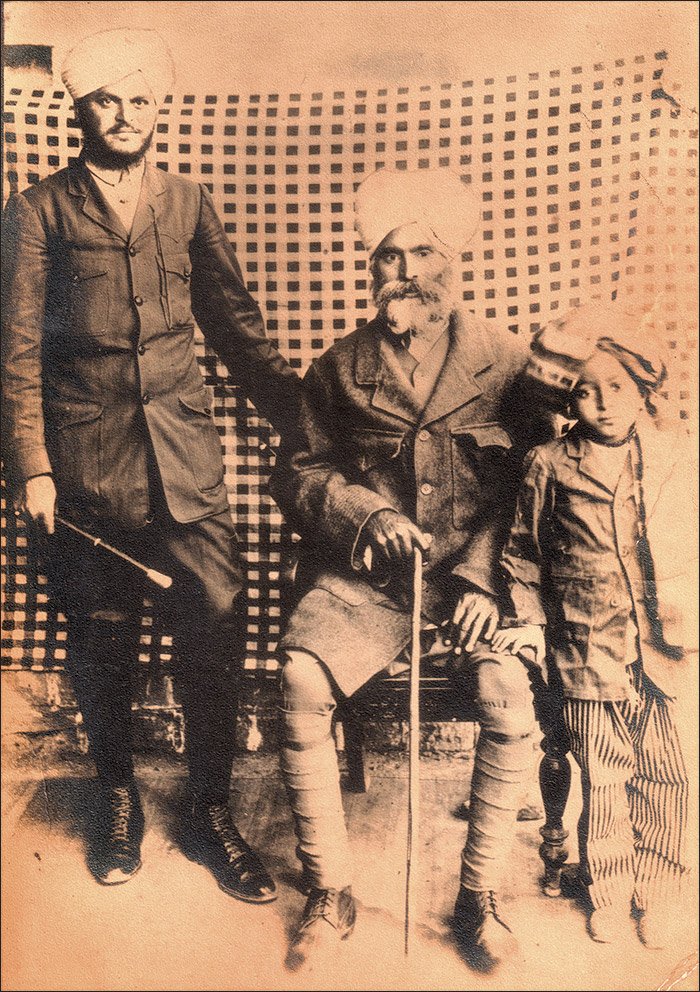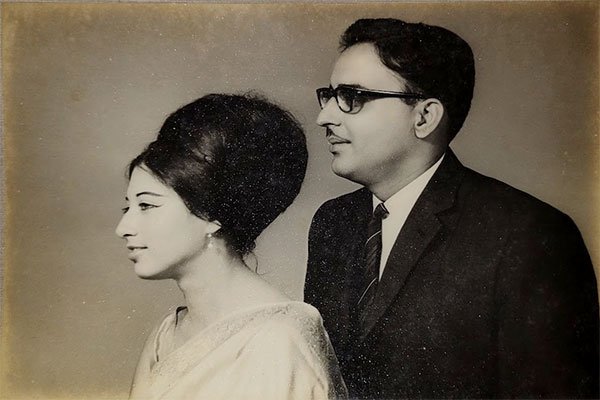
The Tiger Man, Jabalpur, Madhya Pradesh. Circa 1930
Image and Text contributed by Deborah Nixon, Australia
This image was found in my father Leslie Nixon’s private collection. He was born in Agra in 1925, was schooled in Mussoorie, and trained with the Gurkhas. Later he joined KGV’s 1st OGR (King George V’s regiment).
My Anglo Indian family has a history of having lived in India for four, or possibly five generations- they were all Railways people, and my father worked during the Partition to transport refugees in and out of the Gurkha head quarters. He archived all of the family images in India and thanks to him I have been lucky to have a ‘bird’s eye view ‘ of partition. He kept a lot of old army documents and memorabilia from the few years he served with the Gurkhas. When he migrated to Australia he went to University and became a Geologist.
There isn’t a lot to say about this image as there was nothing written behind it, but to me it is a very arresting photograph. My father says he remembers the ‘tiger men’ used to come around in Jabalpur, his family home, and dance as part of the Islamic festival Muharram and he imitated the dance himself as young children do.
There is another image and narrative on my father here that sheds some light on his life in India.
Apr 11, 2013 | Categories: 1930s, 1947 India Pakistan Partition, Anglo Indian, Attire, British Indian Army, Dressed for an Occasion, Festivals, Geologist, India, Islamic, Jabalpur, Madhya Pradesh, Migration, Mixed, Muharram, Music, Art, Dance & Culture, Pre-Independence, Previous, Railways, Relocation, Rituals & Ceremonies, Specialised Clothing, Tigers | Tags: 1930s, Anglo Indian, Australia, Deborah Nixon, Festival, Gurkha, Indian Railways, Islam, Jabalpur, Leslie Nixon, Madhya Pradesh, Migration, Muharram, Partition, Pre Independence, Railways, Refugees, Tiger | 3 Comments »

Margurite Mumford, and my Grandfather Bert Scott, Ooty & Bombay. 1930s
Image & Text contributed by Jason Scott Tilly, United Kingdom
I will never be sure if my grandfather Bert Scott, would have wanted me or anyone else to find these negatives;
They were his secrets for all of his adult life. He had after all kept them very safe, hidden from the moment he left India.
Bert Scott, (lower right) was my grandfather, and he was born in Bangalore in 1915. He was educated at Bishop Cottons school and he joined the Times of India in 1936 as a press photographer, where he worked until the outbreak of World War II.
With trouble brewing during Indo-Pak Partition, he and his family fled and he left his whole life behind; his country of birth, India, his friends and home. Travelling with minimum luggage would have been conditional so he chose to take only the necessary in just a few metal trunks.
Inside one of those trunks were several photo albums and pocket-sized blue negative holders that I came across many years later in my grandparent’s cupboard in 2006, a few years after Bert, my grandfather passed away. The little blue pocket-books held as many memories as it did negatives, about 100 precious moments of reflected light captured on film of our family and of some places where they had lived, but inside one particular folded grease proof sleeve were four negatives that were cut up into single frames and they were of one particular young lady; of a Margurite Mumford, a beautiful young Anglo Indian girl.
I remember one Sunday when he was alive, sitting with his photograph albums on my lap, my grandmother looked at me and stated, in a tone which sounded somewhat incongrously jealous for a woman in her late seventies, “those books are just full of photographs of his ex-girlfriends!”. My grandpa who was sitting across us, either didn’t hear the remark or chose to ignore it – the Snooker on television providing a timely distraction.
After he passed away, I found an extraordinary number of photographs of Margurite. The photographs of her are always infused with a certain playfulness during day trips to the beach or picnics by the river. There is something so obviously personal and intimate about the images. Margurite clearly loved to play to the camera or to be more precise she loved playing up for the photographer, flirting with both the camera and the man whose eye followed her through the lens. The books did have many photographs of other beautiful young women of the Raj too, but the intimacy I saw in Margurite’s images proved to me that only she was actually a girlfriend of my grandpa before he met my grandmother.
As time wore on, I became more intrigued as to whom Margurite really was. I wondered why their romance had ended. I spent hours scouring the internet in the faint hope that I might be able to find someone from her family with whom I could share her beautiful photographs. With not a clue in sight, eventually my hope began to wane but I never stopped wondering about her.
Only recently while pouring over the pages of the albums for the nth time, I noticed a faded scribble “Margurite ‘Lovedale’” by a photograph. Intrigued as to what the word ‘Lovedale’ meant I returned once again to the internet and within seconds I was on to something. Lovedale is the nickname of the Lawrence Memorial Military School in the town of ‘Ooty’ in the Niligiri Hills. My great-grandfather, Algernon Edwin Scott, had a summer-house in Ooty and my grandpa would spend weekends with him whilst he was studying at St Josephs College in Kannur. Ooty would have been the place where he must have met Margurite!
Perhaps, college sweethearts; They kept their relationship going from their first meeting in the south Indian Hills of the Deccan Plateau to the humid coastal city of Bombay where my grandpa had begun working for the Times of India. I know from the amount of photographs that I have found, that the couple took days out to Juhu beach and the Hanging Gardens on Malabar hill along with trips out to the Ghats outside of Bombay. What was most obvious is how much Margurite meant to my grandpa because he kept the negatives separate from all of the others that he had saved. The memories held on film, of Margurite seem different to the rest, they seem more personal, more intimate.
I immediately contacted the school in Ooty. They in turn put me in touch with ex-pupils who although now in their late eighties and nineties were still in touch with one another. My search led me to a woman in America, Moira who very kindly informed me that she was still in touch with one of Margurite’s sisters, Gladys, who also lived in America. I was soon sharing these images with Gladys and she remembered my grandpa very well. She let me know that Margurite was still alive and living in New Zealand, but she was now ninety-six years of age and living in an old people’s home. Her memory had dimmed, but she was physically quite well. I was then put in touch with Alecia, Margurite’s daughter and I began sending them pictures of the young Margurite – images I presume they had never even imagined existed.
In my eagerness and excitement at re-uniting people with a ‘more than half -a-century-ago’ memory, I also sent a photograph of my grandpa. I was told Margurite’s poignantly hopeful reaction was simply, “Is Bertie here?”. My grandpa was indeed the love of her life. But her family had to leave India during Partition, she had then married an Irishman and moved to New Zealand.
It had been obvious to me all along, by the very nature of the photographs, that they were in love, that they both meant an awful lot to each other. Proof, if it were needed, of the indelible nature of first love.
Feb 14, 2013 | Categories: 1930s, 1947 India Pakistan Partition, Anglo Indian, Bishop Cottons, Bombay, Kannur, Lawrence School/Lovedale, Love & Romance, Migration, Mixed, Personal Collections, Photo Collection, Photographer, Pre-Independence, Previous, Rivers, St. Joseph's, Swimming, Swimming Costumes, United Kingdom, Wartime Separation, Women Empowerment, World War II | Tags: 1930s, Bert Scott, Bishop Cottons, Cannanore, First Love, Jason Scott Tilly, Lawrence School, Love, Lovedale, Margurite Mumford, Migration, New Zealand, Nilgiri Hills, Ooty, Photographer, Romance, Swimming Costume, Times of India | 15 Comments »

Hasrat Jaipuri, Jaikishen, Raj Kapoor, Shankar & my father Shailendra. Bombay. Circa 1955
Image & Text contributed by Amla Shailendra Mazumdar, Dubai. U.A.E
This is a photograph of an incredible team who marked the beginning of a golden era in Hindi Cinema’s music.
Shailendra, (my father, whom we called Baba) Hasrat Jaipuri, Shankar and Jaikishen came together to create some of the most powerful and beautiful songs of the Hindi film industry, and it was none other than Raj Kapoor who discovered and brought this foursome together.
My father, Shailendra (extreme right with a cigarette in his hands) came from a very humble background. As a young boy in Rawalpindi (now in Pakistan) he used to sing Bhajans (Religious Songs) in temples but after my grandfather lost all his money, they relocated to Mathura (Uttar Pradesh). It seemed that the times were always hard on his family. By 1948 he was an apprentice at a Railway workshop in Bombay and was struggling to make ends meet. Poetry, however was his savior & first love, and he wrote about social issues of the time and would often be invited to recite his poems at small cultural events. He came from Bihar,had lived in Rawalpindi, Mathura which made him skilled in various hindi & urdu dialects and their expressions.
On one such evening at a Poetry Soiree organised by the Progressive Writers’ forum, my father’s recitation of his poem on Partition of India, titled “Jalta Hai Punjab” caught the attention of another attendee, actor and director Raj Kapoor. It was about the massacre of Hindus and Muslims alike during partition and how it left those who witnessed it scarred for life.
Raj Kapoor, who introduced himself to Baba as Prithviraj Kapoor’s son, insisted that he wanted the same poem for his then under production film Aag. Of course the firebrand poet that my father was, and barely 25 years old, he refused point blank with a terse comment “My poetry is not for sale!” Raj Kapoor then scribbled his name and address on a piece of paper and told him “If ever you change your mind, this is where you will find me”.
When my parents were expecting their first child, my brother Shailey, the hard times only got worse and Baba knew it was time for some tough decisions. He went back to Raj Kapoor who welcomed him and gave him the first break in ‘Barsaat’. The songs “Barsaat mein hum se mile tum sajan, tum se mile hum” and ” Patli kamar hai, tirchhi nazar hai” were to bear testimony to golden times ahead.
“Awara Hoon” and “Mera Joota Hai Japani” were two songs that won global acclaim and are popular even today. Both songs have been translated in several languages including Russian and Chinese. In fact the song ‘Aawara hoon’ even got a mention in Nobel laureate Aleksandr Solzhenitsyn‘s novel ‘The Cancer Ward.’
I think Baba’s genius was in his ability to express the deepest and most profound thoughts in plain and simple Hindi. His songs thus reached out to the masses but without compromising on their literary appeal.
His genius also lay in expressing a grievance without offense. In an industry where composers would recommend lyricists to producers, Shankar-Jaikishan promised Shailendra that they would recommend him around, but then forgot about it. Baba then sent them a note with the lines, “Chhoti Si Yeh Duniya, Pehchaane Raaste Hain. Kahin To Miloge, Phir Poochhenge Haal” (The world is small, the roads are known. We’ll meet sometime, and ask ‘How do you do?). Realizing the hidden meaning in the message, Shankar-Jaikishan then not only apologized but turned the lines into a popular song. The song was then featured in the film Rangoli (1962)
It was a meteoric rise for him since Barsaat, the movie that launched him. Amongst his memorable works are songs from Sangam, Sri 420, Jagte Raho, Madhumati, Guide, Kathputli, Bandini, Anarkali to name a few. He worked with each and every well known music director in the Industry, including the first ever Bhojpuri film “Ganga Maiya Tohe Piyari Chhadaibo“, with music director Chitragupta. Baba also won three Filmfare awards. “yeh mera diwana pan hai“, from Yahudi, “sub kuchh seekha humne“, from Anari and “Main gaoon tum so jao“, from Brahmachari. The last was earned posthumously.
He also produced the film Teesri Kasam based on a story by Phaneswar Nath Renu for which he was awarded the President’s Gold Medal. The film was initially considered a failure and took a toll on Baba, but ironically over time won huge critical acclaim and is now considered a huge success.
Interestingly, Barsaat was the first film for all four people in this photograph. And Baba wrote lyrics for each and every Raj Kapoor film thereafter with Mera Naam Joker as his last. He passed away on December 14, on the birthday of his mentor Raj Kapoor. I think what Hasrat Jaipuri once stated in a TV-interview was accurate “Shailendra was the best lyricist the Indian film industry ever had.” His songs would never let us and his future generations forget that.
Feb 07, 2013 | Categories: 1947 India Pakistan Partition, 1950s, Accolades & Awards, Achievements, Bengali, Bombay, Entertainment, Friendships, Future icons from the Past, India, Indian Film Industry/Bollywood, Music, Art, Dance & Culture, Poet/Writer, Previous, Rags to Riches, Railways, Relocation, Smoking, Theatre | Tags: Anarkali, Awara, Bandini, Bollywood, Bombay, Filmfare Awards, Guide, Hasrta Jaipuri, Jagte Raho, Kathputli, Madhumati, Mathura, Mera Naam Joker, Music Lyricist, Partition, Poet, Presidents Medal, Railways, Raj Kapoor, Rawalpindi, Sangam, Shailendra, Shankar-Jaikishan, Song Writer, Sri 420 | 1 Comment »

My father Sydney with his colleague at a club in India or Pakistan. Circa 1944
Image and Text contributed by Dave, Bristol, England
This is a picture of my father Sydney (Sid) and a colleague having a drink at a hotel or club somewhere in India or Pakistan during World War 2. He was was as an airplane mechanic with the RAF (Royal Air Force). He is the one with a cigarette and he would have been about 27 years old at the time.
He was also in the RAF football team and used to say that they sometimes flew 1000 miles just for a football game, this was during wartime and there must have been rationing, but it serves as an example perhaps of the british attitude at the time, towards sport.
My father Sydney was born in Liverpool, England around 1916 and had two older brothers and two older sisters. His father died when he was a child and he was brought up by his older brothers Joe and John.
He volunteered for armed service when the war (WWII) broke out in 1939 and was able to choose which service he wanted, which was the RAF. He failed his medical exam to be a pilot due to problems with his ears and became an aircraft mechanic dealing, I’d presume with air engines.
He was posted to Detling Airdrome in East Anglia, it was a coastal command airfield, but they were attacked in summer 1940 by the German airforce and about 67 RAF personel were killed. His squadron was then posted to India and I believe they went there by ship in either 1940 or 1941.
When in India, they were ‘posted’ or stationed in many different locations, he didn’t talk much about it but I do know he was in Hyderabad at some stage, and it was before partition. He always said that he lost his hair (he went partially bald) due to the heat in India. The main enemy in India during WWII were the Japanese coming through Burma, but I don’t think my father was ever on the front line. He returned to England after the war, around 1945 and never went back. He met my mother at a dance after the war, in Liverpool. He passed away died in 1979.
Nov 19, 2012 | Categories: 1940s, 1947 India Pakistan Partition, Architecture, Beer, Burma, Clubs, East India Company, English, Food & Drink, Football, Furniture, Hair Styles, Hand Painted, Head Gear, Hyderabad, Interiors, Japan, Men in Uniform, Military, Noteworthy Journeys, Pakistan, Pre-Independence, Previous, Ship, Smoking, Summers, Travel, Western Clothes, Western Dances, World War II | Tags: 1940s, Baira, Balding, Beer, Burma, Cigarette, Club, England, Football, friend, Furniture, Head Gear, Hyderabad, India, Japan, Liverpool, Mechanic, Medical exam, Partition, RAF, Royal Air Force, Sports, Sydney, Turban, Uniform, Waiter, World War II | Leave A Comment »

My grandfather, Captain Glyndon Ralph O’Leary, fondly known as Mike. Location – probably Sibi, Balochistan Province (Now Pakistan). 1941
Image and Text contributed by Shaun Waller & Oonagh Waller, United Kingdom
These are the memories of my mother, Oonagh who was born in India to my grandparents, Glyndon Ralph O’Leary (Mike) and Sheilagh Anges Mary Maguire. – Shaun
“My father, Glyndon Ralph O’Leary was fondly known as Mike. He was born in 1902 in Toronto, Canada to Winifred and Ralph O’Leary, who were of Irish descent.
At the age of Twelve, he left Canada and began his military career in the Boys service, Indian Subcontinent from 1914 – 1919 and continued in various regiments serving the British Empire on and off until 1946.
Mike was also a Practical Motor Engineer: his brothers and he owned and worked in a motorcycle workshop and showroom called the O’Leary Brothers in Dehradun, Uttar Pradesh. They also designed and built a motorcycle called the White Streak. However, it never made it to production. At one point, they bought an old motorcycle, a Brough Superior from T. E. Lawrence (The very original Lawrence of Arabia) and exhibited it in their showroom.
While in the army in Lahore, Mike manufactured scale models for Forest Research, Rural upliftment, P.W.D. and Irrigation departments and also tactical models for training of mechanised fighting vehicles. 12 such gold medal standard models manufactured by him were on display in the Forestry Department of Lahore Central Museum. I wonder if they are still there.
Mike married Sheilagh Anges Mary Maguire in October 1928 in Lahore and subsequently had three children – Michael, Oonagh and Larry. Later the children went to boarding school in Mussoorie: Wynberg Girls High School and Allen Memorial Boys School.
In between postings, and to earn more money, Mike and Sheilagh also joined a circus, I don’t remember the name of the circus anymore, but it was in Lahore and managed by a Captain.Edwards. Mike trained would ride the Drome (‘Wall of Death’ or ‘Maut ka Kuan’) on his motorbike and also climbed a high ladder (in costume): he would douse himself with Petrol, set himself on fire and dive into a tank below full of water. Sheilagh, my mother, play her part too: she stood on stage with a cigarette between her lips while Captain Edwards, trained as an ace shooter in the military, would fire a pistol at the cigarette.
In Sibi, (a Balochistan province of now Pakistan) Mike and family represented the only military presence there, amid railway workers and their families. For leisure, Mike would hire ‘beaters’ and go on a wild boar shoot – the beaters would make as much noise as they could with sticks, tins etc. to flush out the boar then Mike would shoot down a couple. Back home the meat would be shared with neighbours.
On other occasions, the family went ‘fishing’, travelling on a trolley (a bench like structure on a platform with four wheels which fitted on the railway lines). Hired help would run along the lines, bare foot and push the trolley along and when the lake was reached, a halt was called. Mike would unsportingly throw a couple of sticks of dynamite into the water and the stunned fish would rise to the surface: all the men and boys would jump in the shallow end and retrieved the fish which, again, was shared with local families. His last posting was probably in Quetta (also a Balochistan province of now Pakistan).
Mike (Capt. Glyndon Ralph O’Leary) died in September 1945 during a Diabetic Coma. My mother Sheilagh and us children then moved to Meerut, Uttar Pradesh to stay with our maternal grandparents. A year later and a few months before Partition, in September 1946 we emigrated to England.”
On the ship, a whole trunk of personal belongings was apparently lost overboard and it included most of the family photos: very few images survive today. This is one of them.
Oct 01, 2012 | Categories: 1940s, 1947 India Pakistan Partition, Allen Memorial Boys School, Arrivals & Departures, Baluchistan Province, British Reign, Circus Employee, Dehradun, Diabetes, Engineer, English, Fish, Forest, Gun, Gunned Down, Head Gear, India, Irish, Lahore, Lakes, Meerut, Men in Uniform, Migration, Military, Motorcycle, Mussoorie, Mustache, Noteworthy Journeys, Picnics & Feasts, Pre-Independence, Previous, Professional Training, Quetta, Ship, Sibi, United Kingdom, Western Clothes, Widow, Wild Boar, Wynberg Girls High School | Tags: Balochistan, Boys Service, British Reign, Brough Superior, Canada, Circus, Dehradun, Dynamite, East India Company, Engineer, England, Forestry, Glyndon Ralph O'Leary, high ladder, India, Irish, Lahore, Lahore Central Museum, Lawrence of Arabia, Maut ka Kuan, Meerut, Military, Motor Engineer, Motorbike, O’Leary Brothers, Pakistan, Pre Independence, Quetta, Regiment, Sheilagh Anges Mary Maguire, Sibi, T. E. Lawrence, United Kingdom, Wall of Death, White Streak | Leave A Comment »

My paternal grandparents, Shehr Bano & Syed Ali Naqvi. Province of Bihar. 1947
Image and Text contributed by Zinnia Naqvi, Canada
This is an image of my paternal grandparents. My grandfather, or Dada as we called him, Syed Ali Naqvi was born in Khujwa, a village located in the Siwan District, Province of Bihar, India, on May 13, 1916. He was the sixth child of his parents. His father passed away when he was about eight years old and his upbringing and education became the responsibility of his mother and his eldest brother.
Dada was educated at the well known TK Ghose School, in Patna. The school has since seen alumni like the first President of India, Dr Rajendra Prasad, and the first chief minister of Bengal, Dr Bidhan Chandra Roy. Later, Dada attended at the Patna College.
In 1942 he married Shehr Bano Naqvi, my grandmother. She was born in Khujwa too, on January 25, 1925. She was the last of seven children of her parents. Her father was a prominent police officer of the Siwan District. Dadi never attended school but was educated by private tutors at home.
After their marriage, Dada started working for the Government of Bihar. At the time of partition in 1947, he was working in the town of Midnapur, West Bengal. On August 14, 1947, when Pakistan was born, he and his family had to migrate to Dhaka (now Bangladesh) which was declared East Pakistan at the time.
In Dhaka, Dada started his own transportation business. They lived in the Lakhi Bazar neighbourhood of Dhaka and bought a big house abandoned by a Hindu family who had left for India. On May 9, 1949, my father, Afsar Naqvi was born. He was the third child of what would be eight children.
This image of my grandparents was photographed in 1947, after they were newly married. Dada is dressed in a modern suit and bow-tie, along with a Jinnah Cap, named after the founder of Pakistan, Muhammad Ali Jinnah. Dadi is wearing a traditional chiffon sari and the symbol of elegance, a pearl necklace.
The generation of my grandparents were made to travel to all parts of the Indian subcontinent due to war, economic instability, religion, and other obstacles preventing them from providing the best living conditions for their many children. Similarly, my own parents migrated from London, to Karachi, to Toronto in order to provide the best possible opportunities for my sisters and I to be strong, educated, and successful. In the process, both were forced to leave behind many loved ones and memories of the places they once called home.
Today, this photograph hangs in the living room of our family home in Toronto. Inspired by the similarities between my parents and grandparents life, I have been working on a series called Past & Present. This photographic series contains images that are an example of how generations of family history can often repeat themselves. You can view the images here.
Jun 19, 2012 | Categories: 1940s, 1947 India Bangladesh Partition, 1947 India Pakistan Partition, Abandonment, Arranged Marriage, Bangladesh, Bihar, Business-man / Business-woman, Chiffon, Dhaka, Division of States, Dressed for an Occasion, Economic Status, Education, Government Jobs, Head Gear, India, Indian Clothes, Indian Politics, Islamic, Jewellery, Karachi, Lakhi Bazar, London, Men's Clothes, Migration, Muslim, Noteworthy Journeys, Pakistan, Patna College, Pearls, Photo Collection, Photo Studio, Pre-1947 Indian Regions & States, Pre-Independence, Previous, TK Ghose School, Vehicles & Transportation, Western Clothes, Women's Clothes | Tags: Bangladesh, Bihar, Canada, Chiffon, Dhaka, economic instability, Karachi, Khujwa, Lakhi Bazar, Migration, Muhammad Ali Jinnah, necklace., Pakistan, Partition, pearl, Religion, Saree, Sari, Shehr Bano, Syed Ali Naqvi, Toronto, War, Zinnia Naqvi | 4 Comments »

The Cordeiro Siblings. Alec (Bunnu), May and Beatrice. Karachi (now Pakistan). Circa 1910
Image and Text contributed by Naresh Fernandes, Author, Bombay
The picture, photographed sometime around 1910, is the childhood image of my grand-uncle Alec Cordeiro, fondly called Bunnu. Next to him is my Grand-aunt May and my Grandmother Beatrice.
It isn’t clear when and how exactly my ancestors got to Karachi, but it seems that they’d been there for four generations. Like most Goans, they left looking for work: the Portuguese didn’t establish any industry in Goa, so hundreds and thousands had to seek work in other places. There were sharp discussions in the family about whether our ancestor Santan Vaz had made his money running a liquor distributorship or a booze joint.
My paternal great-grandfather, Xavier Cordeiro, was a postmaster general in Karachi. His son-in-law, my grandfather, Alfred Fernandes, moved to Karachi from Burma during World War II. He’d been working for the Burma Railways and had to leave when the Japanese invaded in 1941. So he and his wife, my grandmother, Beatrice (standing right), decided to return to their family’s home in Karachi. In only a few years, the entire family pulled up their roots from the city in which they’d lived for four generations to take their chances in India, a few months before Partition in 1947.
Though my father was only nine when the family left Karachi, his elder siblings had more vivid memories : trips between Bombay and Karachi were made on ferries named the Saraswati and the Sabarmati (“they were like little tubs, we all got seasick”) ; relatives having leisurely evenings at the Karachi Goan Association (KGA), “gin and lime was the favourite drink”, and the enterprising nature of the Karachi Goan community -“they even owned a flour mill!” From my grandmother’s stories, it appeared that everyone in the family had spent a lot of time at the KGA. After all, it was right opposite their bungalow in Depot Lines. That bungalow, sold months before Partition, has long been replaced by a characterless block of apartments.
When we were children, my cousins and I could have been forgiven for thinking that our great-uncle’s first name was “Poor”. That, was how my grandmother and her sisters referred to their only brother each time he came up in conversation, “Ah, poor Bunnu,” they’d sigh whenever someone mentioned their Cambridge-educated sibling who’d chosen to stay put in Karachi at Partition. The somewhat embarrassed tone in which his three sisters talked about him left Bunnu obscured by a whiff of mystery—even scandal.
If there’s one thing I knew about Uncle Bunnu, it’s that he spent a great deal of time at the bar of KGA. Friends joked that the committee of Karachi Goan Association had once made a decision to sack the chowkidar (guard). He wasn’t really needed since Bunnu Cordeiro never seemed to leave the building.
When I finally made a visit to Karachi in November 2011, I met 92-year-old Rita de Souza. She’d been in school with all three of my grand-relatives. She displayed all the discretion you’d expect of a woman of her breeding, but under my badgering, was gradually lulled into talking about my great-uncle. “Ah, poor Bunnu,” she eventually sighed. “He was quite a talker.” She let slip an anecdote relating to the time Bunnu was at Cambridge in the 1920s. “He was disappointed in love,” Rita de Souza said. “He was quite keen on a woman when he was in England, but his mother heard of it and made him exit the situation post-haste.” That’s all she remembered about him.
Others too remembered Bunnu. “He’d tell us about the libraries in Cambridge, where you’d have to maintain pin-drop silence,” a third-cousin said. “‘What would happen if you had a cough?’ we’d ask. He’d reply, ‘If you had a cough, courtesy would require that you didn’t visit the library.’”
At one recent family get-together, the conversation turned to Bunnu. It would be difficult to send mail over the border after each India Pakistan war, so Bunnu’s letters were infrequent. But sometimes, perhaps to remind everyone of his real name, Alec, he’d sign himself as “Sikander”—the sub-continental name for Alexander the Great. “He called his three sisters ‘the gangsters’,” someone recalled. “When he was in England, they sent him a childhood photo of the four of them and he said, ‘I’m not coming home. If I do, I’ll have to take care of them.’”
My aunt Margaret corroborated the story I’d been told in Karachi. Evidently, Bunnu had refused to return to Karachi because he’d fallen in love with an Englishwoman. His mother, Mary, who wanted him to marry a Goan, was horrified. She “picked up her skirts and took the next boat to England”. The conclave was divided on what happened next. Either my great-grandmother “grabbed his ear and dragged him right back home” or “he sent her right home without even allowing her a day to see the sights, but promised to return soon”. At any rate, Bunnu was back in Karachi by the mid-1930s and would remain a KGA Bar fixture for the rest of his life.
Uncle Bunnu never married, held a job for long or seen his sisters after 1947. Later he moved into an old folks home in Karachi. No one in the extended family seemed to have a recent photograph of him. I’d always held the impression that Uncle Bunnu had drunk himself to death, but considering that he was 80 when he died, he didn’t do it very efficiently. By the time he passed away in 1984, Bunnu had become more like a hazy myth to his younger Indian relatives than a real person.
The old folks home in which Bunnu had spent his last years is located in one corner of Cincinnatus Town. Cincinnatus Town was unnervingly familiar. Many of the older homes had been built in the 1930s, exactly at the time the pocket of Bandra in which I live had been constructed and with the same coastal-city architectural features. Parts of Garden East (Cincinnatus Town) resembled the now-demolished landscapes of my childhood. They were filled with the kind of teakwood furniture you find in older Bombay homes and had identical Catholic iconography. My ancestors, yes, they’d been dead for decades, but as we discussed them in Bombay, six decades and 900 kms away, they were warm, breathing presences, as real and as resolute as Karachi.
An unedited version of this narrative can be found here.
Jun 05, 2012 | Categories: 1910s, 1947 India Pakistan Partition, 1971 India Pakistan War, Addiction, Alcohol, Architecture, Arrivals & Departures, Bandra, Boat, Bombay, Bombay to Karachi, British Reign, Bungalow, Burma, Catholic iconography, Christianity, Cincinnatus Town, Colaba, Committees & Senates, Decor, Depot Line, Dressed for an Occasion, Fashion & Trends, Ferry, Furniture, Gin, Goa, Goan, Government Jobs, India, Interiors, Karachi, Karachi to Bombay, Letters, Love & Romance, Men's Clothes, Migration, Pakistan, Photo Studio, Picnics & Feasts, Pre-Independence, Previous, Prints & Stitches, Sabarmati, Saraswati, Shoes, Studio Backdrops, Studio Portraits, Teak, Travel, United Kingdom, University of Cambridge, Wartime Separation, Western Clothes, Western Clothes, Women's Clothes, World War II | Tags: 1910, 1910s, 1947, 2011, Alcohol, Alfred Fernandes, Bombay, Burma, Burma Railway, Cordeiro, Gin, India, Japanese Invasion, Karachi, Karachi Goans Association, KGA, Mumbai, Naresh Fernandes, Pakistan, Portuguese i, Post Master general, Sea sick, World War II | 2 Comments »

My mother, Mohini Goklani. Pune, Maharashtra. Circa 1950
Image and Text contributed by Sunita Kripalani, Goa
In 1947, after partition, when my grandfather Nanikram Goklani and his wife Khemi migrated to India, along with their extended family from Karachi, Pakistan, they settled in Pune, Maharashtra with their 9 children. My mother Mohini, second of seven sisters, was just 16 at that time. Grandpa got a job in the Income Tax department and although times were tough, my grandfather made sure all the children received excellent education.
My mother and her older sister Sheela went to Nowrosjee Wadia College and my grandfather managed to procure admission for some of the younger children in reputed schools such as Sardar Dastur Hoshang Boys’ High School, and St. Helena’s School for Girls. The children studied well, they were voracious readers, and led a simple life.
During the 1950s, the sisters were well versed in household skills, especially the art of stitching and embroidery. They fashioned their own clothes, copying designs from magazines and the displays in the shop windows of Main Street. At home however, they maintained decorum and modesty, but ever so often, Duru, my mother’s younger sister, would coax her to go with her to a photo studio on Main Street called The Art Gallery to get their photographs taken. Duru would pack all kinds of stuff for both of them: ties and beads, scarves and skirts, hats and belts, not to forget some make-up, and the two of them would mount their bicycles and head for the studio where they indulged their fantasies, using studio props and their own accessories.
In the picture my mother is wearing “Awara pants”, a style made famous after the well known actor, Raj Kapoor’s movie by the same name. She is also very nonchalantly holding a cigarette, albeit unlit, between her fingers! The photograph is totally incongruous with her personality, for copying Nargis, the star actress of the time, was more my mom’s style whereas my aunt Duru was bolder and more tomboyish.
I don’t know if my grandfather knew what was going on, or if he approved, but he was not the kind of father who would scold any of his children. If he didn’t like something, he simply wrote a few words on a piece of paper and slipped the little note under that child’s pillow, which was enough to bring the rebellious offspring back on track… but that’s another story.
After college, my mother got a job at the Department of Cooperation, Government of Maharashtra. It was her first and last job. She retired in 1985 as Assistant Registrar of Cooperative Societies, Bombay.
May 09, 2012 | Categories: 1947 India Pakistan Partition, 1950s, Art Direction, Bicycle, Bombay, Decor, Domestic Skills, Dressed for an Occasion, Education, English Medium, Fashion & Trends, Fashion Accessories, Floral patterns, Glamour, Government Jobs, Hair Styles, Head Gear, Karachi, Karachi to Bombay, Maharashtra, Main Street, Migration, Modeling, Movies, Nowrosjee Wadia College, Pakistan, Photo Studio, Previous, Prints & Stitches, Props, Pune, Sardar Dastur Hoshang Boys, Shoes, Sindhi, Smoking, St. Helena’s School, Studio Backdrops, Studio Portraits, The Art Gallery, Western Clothes, Women, Women Empowerment | Tags: 1950s, Awara Pants, Bicycles, Bombay, Cigarette, Domestic Skills, Fantasy, Fashion & Trends, Goklani, Government of Maharashtra, Income Tax Department, Maharashtra, Main Street, Migration, Modeling, Nargis, Nowrosjee Wadia College, Partition, Photography, Posing, Pune, Raj Kapoor, Sardar Dastur Hoshang Boys, Sindhi, Sisters, St. Helena’s School, Sunita Kripalani, Tailoring, The Art Gallery, Trends, Women | 1 Comment »

My Grandmother, Sydney Gorrie, on her wedding day. Lahore (now Pakistan). December 1923
Image and Text contributed by Janet MacLeod Trotter, United Kingdom
This is a photo of my Scottish maternal grandmother, Sydney Gorrie (nee Easterbrook) on her wedding day in December 1923. She and my grandfather, Robert Gorrie, were married in a cathedral in Lahore (now Pakistan). She looks beautiful but perhaps to me, also slightly apprehensive. This may be because she hadn’t seen her fiancé in over a year and had just travelled out by ship with her parents from Edinburgh, Scotland to get married. For some time their home was in Lahore (now Pakistan) which my grandmother enjoyed.
Robert Gorrie fondly called Bob, a veteran of the World War I and survivor of trench warfare, had secured a job with the Indian Forestry Service, as a conservator of forests. Sydney was an only child and had left behind home and extended family in Edinburgh, Scotland for an unknown future trekking around the Himalayan foothills with her new husband. Bob was enthusiastic about trees and conservation and became an expert on soil erosion. He worked all over Punjab and the remote foothills of the Himalayas, and my grandmother would have to plan and organise camping trips for a month or so at a time.
When my mother was born, she was taken along too; her pram hoisted onto poles and carried along jungle paths. According to his Work Records, Scottish Bob was “a tiger for work” but was impatient with the bureaucracy and criticised for being outspoken. My granny would sigh that she was constantly having to ‘smooth the ruffled feathers’ of the administrators. He was also based at the forestry college in Dehradun (now Uttar Pradesh) where he taught and also where their second son, my uncle, Donald was born. I think he was more popular with the students as some of them kept in touch with him until much later in life.
Before World War II broke out, granny’s father’s illness had her visit home in Edinburgh. My mother and her two brothers went to school back in Scotland, and were looked after by grandparents and lots of doting aunties! Bob stayed back in India, and did not see his family for over six years, and after Partition he worked for the new Pakistan government for a while.
In retirement in Edinburgh, my brothers and I used to love visiting their house – we would join Granddad for early morning yoga kind of exercises in the sitting-room. He would point to a picture on the wall of a grinning man in a large hat and say it was of him eating porridge in India. It was only years later I discovered it was a copy from a Degas painting of a farmer drinking from a bowl of soup!
My grandparents’ stories were the inspiration for my own trip to India. When I was 18, I went overland in a bus to Kathmandu via Pakistan and India. In Lahore I sent my granny a postcard (my grandfather has passed away by then). What I didn’t know was that she had had a stroke and was in the hospital. The last time my mother saw her alive was the day my postcard arrived. She was able to read it to Granny, and although she couldn’t speak in reply, she knew that I had got there. I, on the other hand grew up to become an author and wrote a mystery novel based on my overland trip in the 1970s, called The Vanishing of Ruth.
Apr 18, 2012 | Categories: 1920s, 1940s, 1947 India Pakistan Partition, Arrivals & Departures, Chiffon, Civil Services, Conservationist, Forest, Himalayas, India, Lahore, Letters, Migration, Mountaineering, Noteworthy Journeys, Now Pakistan, Pakistan, Pre-1947 Indian Regions & States, Pre-Independence, Previous, Punjab, Scotland, Scottish, Ship, Teacher, Travel, Trekking, Wartime Separation, Wedding Trousseau, Weddings, Western Clothes, Women, World War II, Writer | Tags: 1920s, Author, Bride, British India, Camping trips, Catherdral, Dehradun, Edinburgh, Engagement, Fiancé, Forests, Himalayas, Janet MacLeod Trotter, Jungle, Lahore, Marriage, Pakistan, Scotland, Ship, Teacher, The Vanishing of Ruth, Travel, War Veteran, Wedding Trousseau, Women, Word War II, World War I | 1 Comment »

My Father, Syed Ali Mehdi Naqvi, Hyderabad, Andhra Pradesh. 1949
Image and Text contributed by Waqar Ul Mulk Naqvi, Punjab Province, Pakistan
This is the only image of my Late father Syed Ali Mehdi Naqvi I possess. He was born in 1930 in a small district called Beed then in Hyderabad, Andhra Pradesh, India. In 1960, when new states were created on the basis of linguistics, the Marathi dominant town of Beed became a part of Maharashtra.
My father graduated from Usmania University, Hyderabad (now Osmania) in Masters of Persian when he was only 18, in 1949.
My grandfather Hassan Naqvi was a lawyer with the High Court of the Nizam of Hyderabad at the time and also owned a lot of agricultural land in Pimpalwadi (District Beed, Now in Maharashtra). Agriculture was a big part of the family income.
When Partition of India and Pakistan was announced, my grandfather was still very optimistic that Hyderabad will be declared an independent state. The Nizam of Hyderabad was very adamant about that. But the Indian Government did not comply and the Nizam had to surrender in 1948.
With a lot of sorrow, and seeing no other option in a very precarious India, my grandparents along with their children were finally forced to join thousands of others and leave India in 1955. All of our assets, a house at Muhalla Qila as well as the cultivated agricultural land were left behind, abandoned.
They migrated to Karachi via Bombay on a ship. With our roots, and legacies all left behind, my family had to go through a lot of hurt, disillusionment and suffering. Consequences of which can be felt till today. In my family’s words “we were simply plucked and sent into a dark and dangerous journey to Pakistan with no home, no job or even land to call our own.” Many people along with them, never made it to the shores of Pakistan and many were killed right after they landed.
I feel great sorrow when I think about that. Now I work in a financial institution as a manager in a Punjab province of Pakistan with my mother and two siblings. In all these years, I have never stopped thinking about what could have been.
Mar 07, 2012 | Categories: 1930s, 1940s, 1947 India Pakistan Partition, 1950s, Abandonment, Agriculture & Farming, Andhra Pradesh, Battle and Conflict, Bombay to Karachi, Certificates, Division of States, Documents, Education, Hyderabad, India, Indian Politics, Islamic, Karachi, Maharashtra, Masters, Men, Men's Clothes, Migration, Muslim, Mustache, Nizam of Hyderabad, Noteworthy Journeys, Now Pakistan, Osmania University, Pakistan, Pre-1947 Indian Regions & States, Pre-Independence, Psychological & Emotional Trauma, Punjab Province, Solicitor, Western Clothes | Tags: 1930s, 1940s, 1947, 1947 India Pakistan Partition, 1950s, Abandonment, Agriculture & Farming, Andhra Pradesh, Battle and Conflict, Beed, Bombay, Bombay Presidency, Bombay to Karachi, Certificates, Division of States, Documents, Education, Employment, Family Income, Hairstyle, High Court, Hyderabad, Indian Forces, Indian Politics, Islamic, Karachi, Land, Lawyer, Linguistics, Maharashtra, Marathi, Masters, Migration, Muslim, Mustache, Nizam of Hyderabad, Noteworthy Journeys, Now Pakistan, Osmania University, Pakistan, Partition, Passenger Ship, Passport Photograph, Persian, Pimpalwadi, Portrait, Pose, Pre Independence, Pre-1947 Indian Regions & States, Previous, Psychological & Emotional Trauma, Punjab Province, Refugees, Ship, solicitor, States, Suffering, Usmania University, Waqar Ul Mulk Naqvi | 14 Comments »

My husband, Imam Hadi Naqvi and I, a few days after our marriage. Patna, Bihar. 1958
Image and text contributed by Nazni Naqvi, Mumbai
My name is Nazni Naqvi. This picture of me and my husband Syed Imam Hadi Naqvi was taken on 11thOctober, 1958, five days after our wedding day. It was taken on the terrace of my parents’ home, Sultan Palace in Patna (now the pink painted State Transport Bhawan) by my brother, Syed Quamarul Hasan. An avid photographer, he took this photo as part of a series with his Roliflex Camera.
I came from a family with part royal lineage of Nawabs – My paternal grandfather had established the Patna University and was knighted by the British for his contribution to education. He was thereafter known as Sir Sultan Ahmed, and my grandmother as Lady Sultan Ahmed, customarily called ‘Lady Saheb’.
Hadi was raised in Amroha, Uttar Pradesh. He was a graduate of Aligarh University and then went to study Economics at LSE, London.
In 1954, a Maulana recommended Hadi to my father as a prospective son-in-law. I was 16 years old then and the only daughter in seven sons. I had other considerations for a husband- some cousins (sanctioned under Islamic law) and some other men with royal lineage. Marrying cousins was out of the question, and marrying into a royal family was not a very appealing idea even though my mother belonged to one. Photographs were exchanged and once I saw Hadi’s picture, I was in love. My father however wasn’t sure because the only thing that concerned him was Hadi had to be taller than me.
My father then travelled to London for health reasons and also met Hadi. They began to meet often and became well acquainted. To his relief Hadi turned out to be an inch taller than me, I was 5ft 3, he was 5ft 4. Everyone was happy, the families met and we were declared Engaged. Through the process of the engagement until our marriage, a 4-year gap, we never met or communicated with each other. Although I did sneak a peek from behind the curtains when he was visiting.
At the time of my engagement, at age 16, I was studying in class 9th I think. This might seem strange now but as a generation many of us didn’t have school for almost 2 years, because most educational institutions were closed due to partition issues. But in those days, loss of time in the arena of education wasn’t a big deal, especially for women. Nonetheless, I did complete my matriculation from a private school.
Three years since the Engagement and the Nikah, Hadi returned from London in 1957. Our marriage was fixed for October 1, 1958. That the dates changed is because of an interesting incident. The train that was supposed to bring the groom and his family to Patna never arrived on the date. It was pouring rain so hard in Amroha that the connection bridge from Amroha to Moradabad broke and they had to stop at Moradabad. At the time there were no mobiles, the few telephones that were around too were dead. So we had no clue where anyone was and it seemed the entire groom’s family had vanished!
Zakir Hussain, who was then Governor of Bihar and a family friend came to Hadi’s aid and with the help of the Telephone Exchange enabled a phone call to Patna two days later, informing us of what had happened. Hadi and his family finally did arrive, though four days later.
After my marriage, we left for Amroha and a few months later I moved from a 100-room palace in Patna, to Delhi with Hadi into a two bedroom government allotted flat. Hadi had begun working at the
Ministry of Agriculture as an Agricultural Economist and later joined the
Ministry of Finance. I on the other hand could not have asked for a better man in my life. He was a good man, joyful, liberal & interested in life and all that it had to offer. We were in love and had three beautiful daughters. He was the best thing that happened to me. Hadi passed away in 1991. And I now live with my daughters in Mumbai.
Nov 05, 2011 | Categories: 1947 India Pakistan Partition, 1950s, Aligarh University, Amroha, Bihar, Courting & Proposals, Delhi, Economist, Education, Fashion Accessories, Head Gear, Indian Clothes, Indian Clothes, Islamic, Jewellery, Knighthood, London, London School of Economics, Love & Romance, Matriculation, Men, Men's Clothes, Muslim, Palace, Railways, Rains / Monsoon, Royality, Specialised Clothing, Weddings, Women, Women's Clothes | Tags: 1950s, Agriculture Economist, Amroha, Bihar, British, Camera, Couple, economist, Education, Engagement, Gharara, Governor of Bihar, Green Brocade, Hina Saiyada, Imam Hadi Naqvi, Islam, Islamic Law, Knighthood, London School of Economics, Ministry of Agriculture, Ministry of Finance, Moradabad, Muslim, Nawabs, Nazni Naqvi, Nikah, Palace, Partition, Patna, Patna Univeristy, Photography, Portrait, Rain, Roliflex, Royalty, Specialised Clothing, State Transport Bhawan, Syed Najmul Hasan, Telephone, The Sultan Palace, Train, Trousseau, Uttar Pradesh, Wedding, Zakir Hussain | 11 Comments »

My Parents Ronald and Beryl Osbourne, at Kohat Pass (NW Frontier Province), Pakistan. April 1946
Image and Text contributed by John Reese-Osbourne, Australia
I first learned of the Indian Memory Project from an article in ‘The Australian’ of May 2011 (a News Ltd daily newspaper). After visiting the website, it occurred to me that others searching the pages might be interested in a brief glimpse of Indian Army life from the viewpoint of a British officer and his family in 1945-46. It may shed a personal light on that brief moment in time just before the watershed of Independence and the bloody shambles the politicians made of partition.
This images is of my parents taken on 23rd April 1946, and it show them at the top of the Kohat Pass, near Tribal Territory. My mother is wearing a revolver!. On the back of some of these photographs, she has captioned them as ‘the gateway to 30 miles of tribal territory’.
My father Ronald Osborne was born in Wales in 1910 and worked as sales manager in London for Geo. Wimpey & Co., then a large builder of houses. He volunteered for the British Army in 1939 just before universal conscription was introduced. He served initially with the Royal Engineers and fought in the abortive Norway campaign before undergoing commando training and going on the far more successful Lofoten Islands raid to destroy an oil refinery held by the German forces. Selected for officer training, he found that the pay in the Indian Army was higher than in the British forces and chose to be commissioned into the Royal Indian Army Service Corps, serving in the North African and Italian campaigns, where he rose to the rank of major, until the Indian Army was repatriated.
My mother Beryl (née Beardsley) was also born in 1910 and grew up in Derbyshire. She moved to London as a young woman where she met and married my father. I was born in 1934. When my father joined the army, we went to live with her parents in Kingston-upon-Thames, where they owned two shops. At some point in 1940 a stray German bomb destroyed the shops and my mother, grandmother and I moved to stay with relations in Derbyshire before settling in a small village called Kirk Hallam. My grandfather stayed in Kingston, continuing to run his shops from two garages.
Understandably impatient after five years of wartime separation, my mother joined the Women’s Indian Voluntary Service (WIVS) as a means of getting out to India. By coincidence, she and my father were on separate ships passing through the Suez Canal at the same time (I think in September 1945). They met briefly when their ships docked in Bombay, before travelling to their respective postings. Initially she worked in the WIVS headquarters in New Delhi, organising the postings of other British volunteers as they arrived. Seeing little point in staying in New Delhi while my father was stationed in Jalandhar, she surreptitiously posted herself there! At some time in 1946, my father’s unit was transferred to Kohat.
In 1945, I was 11 years old, attending a boarding school in Leicester in the UK Midlands and spending school holidays with my maternal grandparents in Kingston-upon-Thames or with my father’s brother’s family in Porthcawl, South Wales. Sadly I no longer have any of the letters from my parents, so the story of their time in Jalandhar and Kohat is based solely on my memory and the scribbled captions on the backs of old, fading black-and-white photographs in the album I began to compile that year.
Sep 08, 2011 | Categories: 1940s, 1947 India Pakistan Partition, British Reign, Delhi, East India Company, English, Jalandhar, Kohat Pass, Love & Romance, Now Pakistan, Revolver, Ship, Suez Canal, Travel, Voluntary Service, Wales, Wartime Separation | Tags: 1910, 1939, 1940s, 1947 India Pakistan Partition, Australia, Australian, Bombay, Britain, British, British Empire, British Officers, British Reign, Commando Training, Couple, Delhi, Derbyshire, East India Company, English, Geo. Wimpey & Co., German, German Bomb, Germany, Husband Wife, Indian Army, Italian Campaign, Jalandhar, John Reese-Osbourne, Jullundur, Kingston-on-Thames, Kohat Pass, Lofoten Islands, London, Love & Romance, Migration, New Delhi, North Africa, North West Frontier province, Norway Campaign, Now Pakistan, Osbourne, Pakistan, Parents, Paritition, Pay, Post Independence, Pre Independence, revolver, Royal Engineers, Royal Indian Army Service Corps, Sailing, salary, Ship, Ships, Suez Canal, Territory, Travel, Tribal, United Kingdom, Voluntary Service, Wales, Wartime Separation, Women's Indian Voluntary Service (WIVS) | 3 Comments »

My Grandmother Chameli Devi Jain and Grandfather Phool Chand Jain, shortly after their marriage. Delhi. Circa 1923
Image and text contributed by Sreenivasan Jain, Journalist, New Delhi
Some text is paraphrased from a recent Book – Civil Disobedience, by my father Late. Shri LC Jain, noted economist and Gandhian.
This image was photographed in Delhi, shortly after my Paternal grandparents Chameli and Phool Chand, got married. She was 14 and he was 16. It was unusual for couples in our family to be photographed, especially holding hands, which turned out to be an indication of the unconventional direction their lives would take. They were both Gandhians and Freedom fighters.
The prestigious Chameli Devi Jain award for Journalists was named after my grandmother . The only visible reminder of her brush with radical politics of the freedom movement was the milky cornea in her right eye, the result of an infection picked up in Lahore Jail where she had spent 4 months in 1943. Otherwise, she was Ammaji: gentle, almost luminous in her white saris, regular with her samaik (Jain prayer), someone who would take great pleasure, on our Sunday visits, to feed us dal chawal (rice and lentils) mixed with her own hands.
My grandmother grew up in a village called Bahadarpur in Alwar, about 4 hours south of Delhi, in a deeply conservative Jain family. The family was locally influential; they were traders in cotton turbans, woven by local Muslim weavers and sold in Indore, Madhya Pradesh. They also were moneylenders. As with much of rural Rajasthan, the women were in purdah. Within two years of their marriage, their first child, my father, LC Jain was born.
Ammaji moved with my grandfather into the family home in the teeming bylanes of Dariba in Chandni Chowk. But he had developed a growing interest in Gandhi and the nationalist movement and soon broke away from the family business to join the Delhi Congress. In 1929, soon after the call for Poorn Swaraj at the Lahore session, he was arrested for the first time.
My grandfather’s stint in jail exposed him to even more radical politics. Along with his Congress membership, he also became part of the revolutionary Hindustan Socialist Republican Association which counted Bhagat Singh and Chandrashekhar Azad amongst its members. (Azad, in an interview, acknowledged that he received his first revolver from my grandfather). He also became a reporter for the nationalist newspaper at the time, Vir Arjun, whose editor he had met in jail.
In 1932, Gandhi called for a major nationwide satyagraha against foreign goods. It was also the year a bomb was thrown at Lord Lothian,an act in which my grandfather played a role. When he told my grandmother that he was going to jail, she said this time she would go to prison first, by taking part in the swadeshi satyagraha. The household was stunned. Ammaji’s life had revolved around ritual, the kitchen and ghoonghat. Her decision led to the following heated exchange; witnessed by my father, age 7:
Babaji: “You don’t know anything about jail.”
Ammaji: “Nor did you when you were first arrested.”
Babaji: “Who will look after the children ?”
Ammaji: “You will.”
Sensing that things were getting out of hand, my great grandmother, Badi Ammaji locked both of them into a room. But my grandfather apparently fashioned an escape from the window using knotted dhotis and Ammaji, head uncovered, marched with other women pouring out of their homes towards the main bazaar. The crowd had swelled into hundreds. There were cries of ‘Mahatma Gandhi ki Jai’. As they began to move around picketing shops selling foreign goods, they were arrested, taken to Delhi Jail, and charged with 4 and half months of rigorous imprisonment.
Her arrest, not surprisingly, outraged the family in Alwar. Umrao Singhji, Ammaji’s father, came to Delhi and had a big argument with my great grandfather, accusing the in-laws of ‘ruining our princess’. But Ammaji found an ally in her in-laws, who refused to pay her bail out of respect for her satyagraha. Umrao Singhji then tried to talk his daughter out of it when she was being transferred to Lahore Jail. ‘Chameli, apologise, ask for pardon.’ But Ammaji asked him not to worry. ‘Bolo Bharat Mata ki Jai’, she said, as she was being led away in a rickshaw along with the other prisoners. ‘Bharat Mata ki Jai’, responded her father.
She returned from Lahore 4 months later, a minor heroine. But there was also loss. Lakshmi, her daughter, 5 years old, fell from the balcony of the house and died when she was in Lahore jail. And there was the milky cornea – the loss of an eye. But her world had somewhat widened. She wore her ghoonghat a few inches higher. She gave her Rajasthani ghaghra choli away, and wore only handspun. She spun on the charkha. She would attend meetings with other women on matters of community reform, like widow remarriage and also became more involved in the activities of the local sthanak, the Jain community’s prayer and meditation hall. She had, as it turns out, quietly fashioned her own blend of Jain renunciation and Gandhian abstinence.
In the years that followed, my grandfather retained his engagement with the freedom struggle. He would often go to sit in the family’s property agency in Model Town, but his real passion, which consumed most of his last 30 years was compiling a massive index of freedom fighters, a staggering 11 volume chronicle of the stories of countless ordinary men and women, who took part in protests, bomb conspiracies, went to jail, lived and died. For my grandmother, it was a gradual return to a more conventional domesticity.
But, that single action that morning in 1932 had opened up a world: a young woman from a deeply conservative family, who became the first Jain woman in her neighbourhood to go to jail, who was named on the day of her arrest in the Hindustan Times with all the other satyagrahis, who would return home to other freedoms, even if minor, like a ghoonghat that could be worn a few inches back.
And for that, she would one day have an award named after her.
Jan 22, 2011 | Categories: 1920s, 1930s, 1940s, 1947 India Pakistan Partition, Accolades & Awards, Alwar, Arranged Marriage, Assassinations & Attempts, Bomb Blasts, Books, British Reign, Business-man / Business-woman, Chandani Chowk, Child Marriage, Cotton, Cultural Attire, Decor, Delhi, East India Company, Elopement, Freedom Fighters, Future icons from the Past, Gandhian, Head Gear, Hindu, Hindustan Times, House Wife, Imprisonment, India, Indian Clothes, Indian Clothes, Indian Politics, Interiors, Jain, Jewellery, Journalism, Lahore, Love & Romance, Madhya Pradesh, Men, Men's Clothes, Model Town, Pre-Independence, Rajasthan, Research, Revolver, Sarees, Satyagraha, Vir Arjun, Wartime Separation, Women, Women Empowerment, Women's Clothes | Tags: 1920s, 1930s, 1940s, 1943, 1947 India Pakistan Partition, Accolades & Awards, Alwar, Arranged Marriage, Assassination Attempt, Assassinations & Attempts, Bahadarpur, Bhagat Singh, Bomb Blasts, bomb conspiracies, Books, British Reign, Business-man / Business-woman, Chameli Devi Jain, Chandani Chowk, Chandni Chowk, Chandrashekhar Azad, Charkha, Child Marriage, Chronicle, Civil Disobedience, Congress, Cotton, Cotton Turbans, Couple, Cultural Attire, Dariba, Decor, Delhi, Delhi Congress, East India Company, Elopement, Freedom Fighters, Future icons from the Past, Gandhian, Ghoongat, Handspun, Head Gear, Hinduism, Hindustan Socialist Republican Association, Hindustan Times, House Wife, Imprisonment, Independence Struggle, Indian Politics, Indore, Interiors, Jail, Jain, Jain Community, Jains, Jewellery, Journalisim, Journalism, Journalist, Lahore, LC Jain, Lord Lothian, Love & Romance, Madhya Pradesh, Mahatama Gandhi, Men, Men's Clothes, Model Town, Moneylenders, Muslim Weavers, Nationalist Movement, nationalist newspaper, Phool Chand Jain, Poorn Swaraj, Pre Independence, protests, Purdah, Rajasthan, Research, revolver, Rural, Samaik, Sarees, Satyagraha, Satyagriha, Spinning Wheel, Sreenivasan Jain, Traders, Veil, Vir Arjun, Wartime Separation, Widow remarriage, Women Empowerment, Women's Clothes | 8 Comments »

My Grandfather (sitting, left) Narasinhbhai Patel with family.. Anand, Kheda District, Gujarat. Circa 1940
Image and text contributed by Sandhya Mehta
My maternal grandfather, Narasinhbhai was a revolutionary man. Records of British India describe him as ‘most dangerous man in Bombay Presidency ‘. He was exiled from British India for writing proscribed books. Though the
Maharaja of Baroda clandestinely supported him. After completing his exile term in Germany and East Africa,
C.F. Andrews persuaded him to join
Ravindranath Tagore in
Shantiniketan . He taught German there for a short time and then returned to his native town Kheda to support
Gandhiji’s Salt
Satyagraha . He became a leader in Kheda district. to mobilise Satyagraha. Standing behind him, first from left is his grandson Dr. Shantibhai Patel who also actively participated in the freedom struggle and later became a successful scientist . Narsinhbhai’s daughter, Shanta Patel (my mother), sits, first from right with my father G.P.Patel, standing behind her. My father, G.P Patel supported Narasinhbhai’s views, work and philosophy. They all were followers of Gandhiji.
Jul 19, 2010 | Categories: 1940s, 1947 India Pakistan Partition, Beliefs & Causes, British Reign, East Africa, Exile, Freedom Fighters, Gandhian, German, Germany, Gujarati, Indian Clothes, Indian Clothes, Indian Politics, Men, Men's Clothes, Pre-Independence, Props, Publications, Sarees, Satyagraha, Scientist, Shantiniketan, Studio Portraits, Western Clothes, Western Clothes, Women, Women's Clothes, Writer | Tags: 1940s, 1947 India Pakistan Partition, Anand, Beliefs & Causes, Bombay Presidency, British India, British Reign, C.F Andrews, Dr. Shantibhai Patel, East Africa, Exile, Family Portrait, Freedom Fighters, Gandhi, Gandhian, German, Germany, Gujarati, Indian Politics, Kheda District, Linguistics, Maharaja of Baroda, Mahatama Gandhi, Mehta, Narasinhbhai Patel, Patel, Props, Publications, Rabindra Nath Tagore, Sarees, Satyagraha, Satyagriha, Scientist, Shantiniketan, Studio Portraits, Writer | Leave A Comment »

Hand painted in New York (in 2000), my maternal grandparents, Lahore, (Now Pakistan). 1923
Image and text contributed by Dinesh Khanna.
My grandparents, Balwant Goindi, a Sikh and Ram Pyari, a Hindu were married in 1923. She was re-named Mohinder Kaur after her marriage . They went on to have eight daughters and two sons, one of the daughters happens to be my mother.
Balwant Goindi owned a whiskey Shop in Lahore. He was a wealthy man and owned a Rolls Royce. During Indo-Pak Partition, he and his family migrated to Simla, without any of his precious belongings; assuming he would return after the situation had calmed down, however, that never happened. After moving around, and attempting to restart his business with other Indian trader friends, they finally settled down in Karol Bagh. The area was primarily residential with a large Muslim population until the exodus of many to Pakistan and an influx of refugees from West Punjab after partition in 1947, many of whom were traders. It must have been a very sad day when he heard that his home and his shops in Lahore were burnt down.
Feb 23, 2010 | Categories: 1920s, 1947 India Pakistan Partition, Abandonment, Delhi, Furniture, Hand Painted, Head Gear, Hinduism, Indian Clothes, Inter Caste, Lahore, Men, Men's Clothes, Migration, Mustache, Name Change, Now Pakistan, Pakistan, Pre-1947 Indian Regions & States, Pre-Independence, Props, Punjabi, Punjabi, Riots, Rolls Royce, Sarees, Shoes, Shopkeeper, Sikhism, Studio Portraits, Western Clothes, Whiskey, Women's Clothes | Tags: 1920s, 1947 India Pakistan Partition, Abandonment, Bhagwad Gita, Couple, Delhi, Furniture, Hand Painted, Head Gear, Hinduism, Inter-caste, Lahore, Men's Clothes, Mustache, Name Change, Now Pakistan, Pakistan, Pre Independence, Pre-1947 Indian Regions & States, Props, Punjabi, Riots, Rolls Royce, Sarees, Sari, Shoes, Shopkeeper, Sikh, Sikhism, Studio Portraits, Whiskey, Women's Clothes | Leave A Comment »