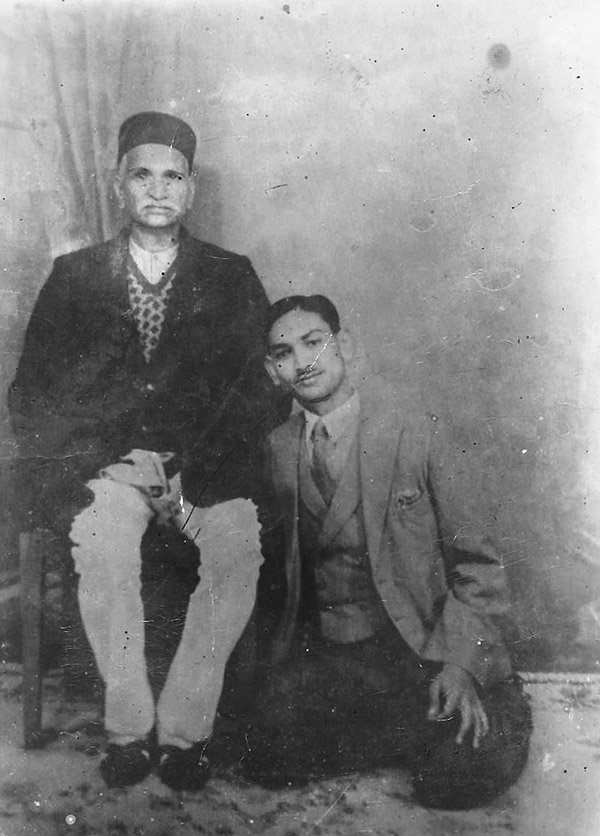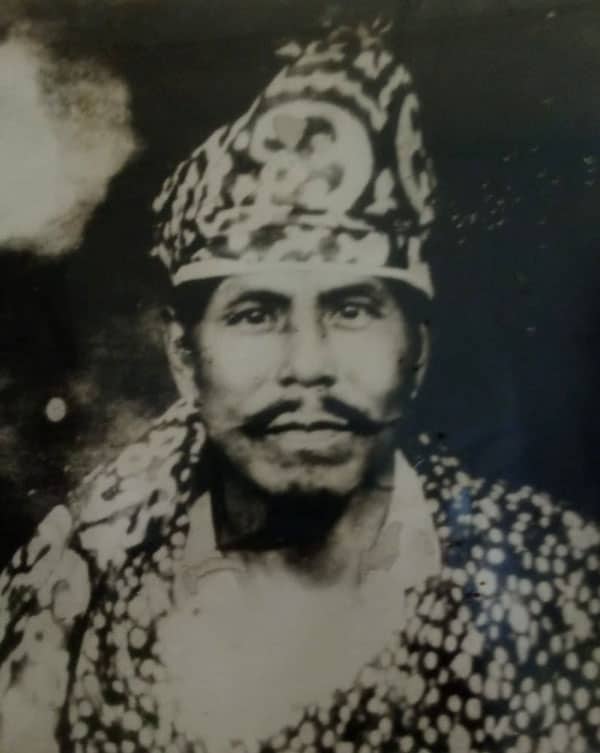
My father Sydney with his colleague at a club in India or Pakistan. Circa 1944
Image and Text contributed by Dave, Bristol, England
This is a picture of my father Sydney (Sid) and a colleague having a drink at a hotel or club somewhere in India or Pakistan during World War 2. He was was as an airplane mechanic with the RAF (Royal Air Force). He is the one with a cigarette and he would have been about 27 years old at the time.
He was also in the RAF football team and used to say that they sometimes flew 1000 miles just for a football game, this was during wartime and there must have been rationing, but it serves as an example perhaps of the british attitude at the time, towards sport.
My father Sydney was born in Liverpool, England around 1916 and had two older brothers and two older sisters. His father died when he was a child and he was brought up by his older brothers Joe and John.
He volunteered for armed service when the war (WWII) broke out in 1939 and was able to choose which service he wanted, which was the RAF. He failed his medical exam to be a pilot due to problems with his ears and became an aircraft mechanic dealing, I’d presume with air engines.
He was posted to Detling Airdrome in East Anglia, it was a coastal command airfield, but they were attacked in summer 1940 by the German airforce and about 67 RAF personel were killed. His squadron was then posted to India and I believe they went there by ship in either 1940 or 1941.
When in India, they were ‘posted’ or stationed in many different locations, he didn’t talk much about it but I do know he was in Hyderabad at some stage, and it was before partition. He always said that he lost his hair (he went partially bald) due to the heat in India. The main enemy in India during WWII were the Japanese coming through Burma, but I don’t think my father was ever on the front line. He returned to England after the war, around 1945 and never went back. He met my mother at a dance after the war, in Liverpool. He passed away died in 1979.
Nov 19, 2012 | Categories: 1940s, 1947 India Pakistan Partition, Architecture, Beer, Burma, Clubs, East India Company, English, Food & Drink, Football, Furniture, Hair Styles, Hand Painted, Head Gear, Hyderabad, Interiors, Japan, Men in Uniform, Military, Noteworthy Journeys, Pakistan, Pre-Independence, Previous, Ship, Smoking, Summers, Travel, Western Clothes, Western Dances, World War II | Tags: 1940s, Baira, Balding, Beer, Burma, Cigarette, Club, England, Football, friend, Furniture, Head Gear, Hyderabad, India, Japan, Liverpool, Mechanic, Medical exam, Partition, RAF, Royal Air Force, Sports, Sydney, Turban, Uniform, Waiter, World War II | Leave A Comment »

My Parents Ronald and Beryl Osbourne, at Kohat Pass (NW Frontier Province), Pakistan. April 1946
Image and Text contributed by John Reese-Osbourne, Australia
I first learned of the Indian Memory Project from an article in ‘The Australian’ of May 2011 (a News Ltd daily newspaper). After visiting the website, it occurred to me that others searching the pages might be interested in a brief glimpse of Indian Army life from the viewpoint of a British officer and his family in 1945-46. It may shed a personal light on that brief moment in time just before the watershed of Independence and the bloody shambles the politicians made of partition.
This images is of my parents taken on 23rd April 1946, and it show them at the top of the Kohat Pass, near Tribal Territory. My mother is wearing a revolver!. On the back of some of these photographs, she has captioned them as ‘the gateway to 30 miles of tribal territory’.
My father Ronald Osborne was born in Wales in 1910 and worked as sales manager in London for Geo. Wimpey & Co., then a large builder of houses. He volunteered for the British Army in 1939 just before universal conscription was introduced. He served initially with the Royal Engineers and fought in the abortive Norway campaign before undergoing commando training and going on the far more successful Lofoten Islands raid to destroy an oil refinery held by the German forces. Selected for officer training, he found that the pay in the Indian Army was higher than in the British forces and chose to be commissioned into the Royal Indian Army Service Corps, serving in the North African and Italian campaigns, where he rose to the rank of major, until the Indian Army was repatriated.
My mother Beryl (née Beardsley) was also born in 1910 and grew up in Derbyshire. She moved to London as a young woman where she met and married my father. I was born in 1934. When my father joined the army, we went to live with her parents in Kingston-upon-Thames, where they owned two shops. At some point in 1940 a stray German bomb destroyed the shops and my mother, grandmother and I moved to stay with relations in Derbyshire before settling in a small village called Kirk Hallam. My grandfather stayed in Kingston, continuing to run his shops from two garages.
Understandably impatient after five years of wartime separation, my mother joined the Women’s Indian Voluntary Service (WIVS) as a means of getting out to India. By coincidence, she and my father were on separate ships passing through the Suez Canal at the same time (I think in September 1945). They met briefly when their ships docked in Bombay, before travelling to their respective postings. Initially she worked in the WIVS headquarters in New Delhi, organising the postings of other British volunteers as they arrived. Seeing little point in staying in New Delhi while my father was stationed in Jalandhar, she surreptitiously posted herself there! At some time in 1946, my father’s unit was transferred to Kohat.
In 1945, I was 11 years old, attending a boarding school in Leicester in the UK Midlands and spending school holidays with my maternal grandparents in Kingston-upon-Thames or with my father’s brother’s family in Porthcawl, South Wales. Sadly I no longer have any of the letters from my parents, so the story of their time in Jalandhar and Kohat is based solely on my memory and the scribbled captions on the backs of old, fading black-and-white photographs in the album I began to compile that year.
Sep 08, 2011 | Categories: 1940s, 1947 India Pakistan Partition, British Reign, Delhi, East India Company, English, Jalandhar, Kohat Pass, Love & Romance, Now Pakistan, Revolver, Ship, Suez Canal, Travel, Voluntary Service, Wales, Wartime Separation | Tags: 1910, 1939, 1940s, 1947 India Pakistan Partition, Australia, Australian, Bombay, Britain, British, British Empire, British Officers, British Reign, Commando Training, Couple, Delhi, Derbyshire, East India Company, English, Geo. Wimpey & Co., German, German Bomb, Germany, Husband Wife, Indian Army, Italian Campaign, Jalandhar, John Reese-Osbourne, Jullundur, Kingston-on-Thames, Kohat Pass, Lofoten Islands, London, Love & Romance, Migration, New Delhi, North Africa, North West Frontier province, Norway Campaign, Now Pakistan, Osbourne, Pakistan, Parents, Paritition, Pay, Post Independence, Pre Independence, revolver, Royal Engineers, Royal Indian Army Service Corps, Sailing, salary, Ship, Ships, Suez Canal, Territory, Travel, Tribal, United Kingdom, Voluntary Service, Wales, Wartime Separation, Women's Indian Voluntary Service (WIVS) | 3 Comments »

(Left) My Great Great Grandparents Edwin Ebenezer Scott (1850-1931) & Emily Good Andre (1862-1946), Bangalore, 1915. (Right) My Great grandparents, Algernon Edwin Scott & Desiree Leferve with my Grandfather, Bert Scott as a two or three year old boy. Cannanore, Karnataka. 1919
Image and Text contributed by Jason Scott Tilley, Birmingham UK
These are two photographs from My Grandfather Bert Scott’s family photographic archive. The photograph on the left, of my Great Great Grandparents Edwin and Emily Scott was taken on Christmas day in 1925 at 3, Campbell road, Richmond Town, Bangalore, our family’s house which was one of the old British Bungalows and has sadly like many of the rest, been demolished. On the old ground now stands St Philomenas hospital, right in the very heart of Bangalore.
On the right, are my great grandparents Algernon Edwin Scott and Desiree Leferve with my Grandfather, Bert Scott as a two or three year old boy, the image was taken in 1919 in Cannanore, Karnataka. (now Kannur and in the state of Kerala)
My family came to India in 1798 when James Scott Savory joined the East India Company as a writer of the Records of state. He was the second assistant under the Collector of Krisnagearry (Krishnagiri). Edwin Ebenezer (left image) is his great great grandson. From the church death records at St. Marks Cathedral in Bangalore it states that Edwin Ebenezer was the Assistant commisioner of Salt in South India.
Bert Scott, (little boy on the right) was my Grandfather, and he was born in Bangalore in 1915. He went to Bishop Cottons school before he joined the Times of India in 1936 as a press photographer.
Son of Algernon Edwin Scott and Desiree Marie Louise Josephene Leferve, (she was the daughter of a French professor of English from Pondicherry). Algernon Scott (Bert’s father) worked for the ‘Salt and Abkeri’ before he joined the army and went to Mesopatamia region from 1916-1919. After Algernon Scott left Mesopotamia he then went to the North West Frontier province until 1921 when he was discharged as Lieutenant. In 1925 he joined Burmah Oil company until 1933 he worked at Caltex until the out break of War.
My Grandfather Bert Scott, whom I fondly call ‘Grandpa’, was mainly brought up by his Grandparents, this must have been because his parents were away much of the time. He was educated at the famous ‘Eaton of the East’, Bishop Cottons school in Bangalore and then at St. Joseph’s college in Cannanore on the way up to Ooty in the Nilgiri’s. In 1936 he took a job as a press photographer at the Times of India Newspaper in Bombay where he worked until the out break of World War II. He initially joined up as a ‘Gunner’ but soon took the Job as Head photographer for the Indian Army during the second world war where he worked out of GHQ New Delhi (Now Parliament), His duties include photographing ceremonies and Japanese positions behind enemy lines in Burma.
My grandfather married his Bride, Doll Miles at the church of redemption in New Delhi and 1943 and my Mother Anne Scott was born later that year in Amritsar, Punjab, whilst he was away on active duty during the war. He was in position on 14th August 1947 to photograph the hand over of Power and watched as the Mountbattens left Vicregal lodge (now Rashtrapati Bhavan). During the troubles of partition, because my family were Anglo Indian, they fled from Delhi to Bombay, and then took a ship to the new country of Pakistan where in November of that same year they left for a new life in the United Kingdom.
For more images via Jason please click here
May 06, 2011 | Categories: 1700s, 1800s, 1900s, 1910s, 1920s, 1930s, 1940s, Anglo Indian, Bangalore, Bishop Cottons, Bombay to Karachi, Christianity, Christmas, Delhi, East India Company, English, Government Jobs, Hair Styles, Hospitals, Indian Army, Kannur, Karnataka, Kerala, Maharashtra, Men, Men in Uniform, Men's Clothes, Migration, Noteworthy Journeys, Photographer, Pre-Independence, Punjab, Richmond Town, St. Joseph's, Tamil Nadu, Times of India, Western Clothes, Western Clothes, Women, Women's Clothes, World War II | Tags: 1700s, 1800s, 1900s, 1910s, 1920s, 1930s, 1940s, Afghanistan, Anglo Indian, archive, Assistant commisioner of Salt, Bangalore, Bert Scott, Birmingham, Bishop Cottons, Bombay, Bombay to Karachi, British, British Bungalow, Burma, Caltex, Campbell road, Canoot, Christianity, Christmas, Church, Collector of Krisnagearry, Couple, Delhi, East India Company, English, Family, Family Archive, French Professor, Government Jobs, Gunner, Hair Styles, Hospitals, Indian Army, James Scott Savory, Japanese Positions, Jason Scott Tilley, Kannur, Karnataka, Kerala, Maharashtra, Men in Uniform, Migration, Mountbatten, Newspaper, Nilgiris, North West Frontier province, Noteworthy Journeys, Ooty, Pakistan, Parliament, Partition, Photographer, Pondicherry, Pre Independence, Punjab, Richmond Town, Six generations, South India, St Philaminas hospital, St. Joseph's College, St. Joseph’s, Tamil Nadu, Times of India, United Kingdom, World War II | 14 Comments »

(Left to Right) My grandfather Bundy Nixon, Joseph, the chauffeur, my Uncle, Norman Costanzio Nixon, Rob May (an Australian Gurkha officer), my father, Leslie Nixon, and a local game hunter (sitting) Jabalpur, Madhya Pradesh, 1946
Image and Text contributed by Deborah Nixon, Sydney
My family has a history of having lived in India for four, or possibly 5 generations- they were all Railways people. Both my grandmother and great grandmother were buried in Bhusawal.
My father Leslie Nixon, was born in Agra in 1925, schooled in Mussoorie, trained with the Gurkhas and joined KGV’s 1st OGR (King George V’s regiment). He worked during the Partition to transport refugees in and out of the Gurkha head quarters in Dharmsala (then Punjab territory, now in the independent state of Himachal Pradesh) to and from Pathankot, Punjab, by train.
This photograph was taken at Jabalpur, Madhya Pradesh in 1946 . Behind them was an empty elephant stable. I like this photograph because it is at variance with the way the British in India were depicted on Shikar (Game hunting). This was an ordinary Anglo Indian life away from the metropolis and now there is very little to be seen of it. My father, aged 22 then and his friend Rob May were very young and had to take on an enormous responsibility and an almost impossible task during partition in protecting refugees. He, like millions of others, was left deeply affected by it .
My father archived all of the family images in India and thanks to him I have been lucky to have a ‘bird’s eye view ‘ of partition. He kept a lot of old army documents and memorabilia from the few years he served with the Gurkhas. When he migrated to Australia he went to University and became a Geologist. He has been very interested in my own Phd thesis which focuses on the ‘experience of domiciled Europeans and Anglo Indians up to and during the Partition‘ and sometimes the memories have been painful for him. I am planning on visiting India again later this year to do more research I think your project is absolutely remarkable I read about it in ‘The Australian‘ newspaper and thought I had to try and get a picture in although my family were not Indian they were a part of India!
May 04, 2011 | Categories: 1920s, 1940s, Agra, Anglo Indian, British Indian Army, Dharmsala, East India Company, Friendships, Geologist, Head Gear, Himachal Pradesh, Inter Race, Jabalpur, Madhya Pradesh, Men, Men's Clothes, Migration, Military, Pathankot, Ph.d., Pre-1947 Indian Regions & States, Pre-Independence, Punjab, Railways, Rifle, Shikar (Game Hunt), Uttar Pradesh, Western Clothes | Tags: 1920s, 1940s, Agra, Anglo Indian, Australia, Bearer, British, British Indian Army, Bundy Nixon, Deborah Nixon, Dharamsala, Dharmsala, domiciled Europeans, East India Company, Elephant Stable, Foreigners, Friendships, Game Hunting, Geologist, Group Photo, Gurkhas, Head Gear, Himachal Pradesh, Indian Railways, Inter Race, Jabalpur, King George Regiment, Leslie Nixon, Madhya Pradesh, Migration, Military, Mussoorie, Pagdhal, Pakistan, Partition, Pathankot, Ph.D., Pre-1947 Indian Regions & States, Punjab, Railways, Refugees, Rifle, Rob May, Shikar, Shikar (Game Hunt), Sydney, Thesis, Transport, Uttar Pradesh, Village | 6 Comments »

My Grandmother Chameli Devi Jain and Grandfather Phool Chand Jain, shortly after their marriage. Delhi. Circa 1923
Image and text contributed by Sreenivasan Jain, Journalist, New Delhi
Some text is paraphrased from a recent Book – Civil Disobedience, by my father Late. Shri LC Jain, noted economist and Gandhian.
This image was photographed in Delhi, shortly after my Paternal grandparents Chameli and Phool Chand, got married. She was 14 and he was 16. It was unusual for couples in our family to be photographed, especially holding hands, which turned out to be an indication of the unconventional direction their lives would take. They were both Gandhians and Freedom fighters.
The prestigious Chameli Devi Jain award for Journalists was named after my grandmother . The only visible reminder of her brush with radical politics of the freedom movement was the milky cornea in her right eye, the result of an infection picked up in Lahore Jail where she had spent 4 months in 1943. Otherwise, she was Ammaji: gentle, almost luminous in her white saris, regular with her samaik (Jain prayer), someone who would take great pleasure, on our Sunday visits, to feed us dal chawal (rice and lentils) mixed with her own hands.
My grandmother grew up in a village called Bahadarpur in Alwar, about 4 hours south of Delhi, in a deeply conservative Jain family. The family was locally influential; they were traders in cotton turbans, woven by local Muslim weavers and sold in Indore, Madhya Pradesh. They also were moneylenders. As with much of rural Rajasthan, the women were in purdah. Within two years of their marriage, their first child, my father, LC Jain was born.
Ammaji moved with my grandfather into the family home in the teeming bylanes of Dariba in Chandni Chowk. But he had developed a growing interest in Gandhi and the nationalist movement and soon broke away from the family business to join the Delhi Congress. In 1929, soon after the call for Poorn Swaraj at the Lahore session, he was arrested for the first time.
My grandfather’s stint in jail exposed him to even more radical politics. Along with his Congress membership, he also became part of the revolutionary Hindustan Socialist Republican Association which counted Bhagat Singh and Chandrashekhar Azad amongst its members. (Azad, in an interview, acknowledged that he received his first revolver from my grandfather). He also became a reporter for the nationalist newspaper at the time, Vir Arjun, whose editor he had met in jail.
In 1932, Gandhi called for a major nationwide satyagraha against foreign goods. It was also the year a bomb was thrown at Lord Lothian,an act in which my grandfather played a role. When he told my grandmother that he was going to jail, she said this time she would go to prison first, by taking part in the swadeshi satyagraha. The household was stunned. Ammaji’s life had revolved around ritual, the kitchen and ghoonghat. Her decision led to the following heated exchange; witnessed by my father, age 7:
Babaji: “You don’t know anything about jail.”
Ammaji: “Nor did you when you were first arrested.”
Babaji: “Who will look after the children ?”
Ammaji: “You will.”
Sensing that things were getting out of hand, my great grandmother, Badi Ammaji locked both of them into a room. But my grandfather apparently fashioned an escape from the window using knotted dhotis and Ammaji, head uncovered, marched with other women pouring out of their homes towards the main bazaar. The crowd had swelled into hundreds. There were cries of ‘Mahatma Gandhi ki Jai’. As they began to move around picketing shops selling foreign goods, they were arrested, taken to Delhi Jail, and charged with 4 and half months of rigorous imprisonment.
Her arrest, not surprisingly, outraged the family in Alwar. Umrao Singhji, Ammaji’s father, came to Delhi and had a big argument with my great grandfather, accusing the in-laws of ‘ruining our princess’. But Ammaji found an ally in her in-laws, who refused to pay her bail out of respect for her satyagraha. Umrao Singhji then tried to talk his daughter out of it when she was being transferred to Lahore Jail. ‘Chameli, apologise, ask for pardon.’ But Ammaji asked him not to worry. ‘Bolo Bharat Mata ki Jai’, she said, as she was being led away in a rickshaw along with the other prisoners. ‘Bharat Mata ki Jai’, responded her father.
She returned from Lahore 4 months later, a minor heroine. But there was also loss. Lakshmi, her daughter, 5 years old, fell from the balcony of the house and died when she was in Lahore jail. And there was the milky cornea – the loss of an eye. But her world had somewhat widened. She wore her ghoonghat a few inches higher. She gave her Rajasthani ghaghra choli away, and wore only handspun. She spun on the charkha. She would attend meetings with other women on matters of community reform, like widow remarriage and also became more involved in the activities of the local sthanak, the Jain community’s prayer and meditation hall. She had, as it turns out, quietly fashioned her own blend of Jain renunciation and Gandhian abstinence.
In the years that followed, my grandfather retained his engagement with the freedom struggle. He would often go to sit in the family’s property agency in Model Town, but his real passion, which consumed most of his last 30 years was compiling a massive index of freedom fighters, a staggering 11 volume chronicle of the stories of countless ordinary men and women, who took part in protests, bomb conspiracies, went to jail, lived and died. For my grandmother, it was a gradual return to a more conventional domesticity.
But, that single action that morning in 1932 had opened up a world: a young woman from a deeply conservative family, who became the first Jain woman in her neighbourhood to go to jail, who was named on the day of her arrest in the Hindustan Times with all the other satyagrahis, who would return home to other freedoms, even if minor, like a ghoonghat that could be worn a few inches back.
And for that, she would one day have an award named after her.
Jan 22, 2011 | Categories: 1920s, 1930s, 1940s, 1947 India Pakistan Partition, Accolades & Awards, Alwar, Arranged Marriage, Assassinations & Attempts, Bomb Blasts, Books, British Reign, Business-man / Business-woman, Chandani Chowk, Child Marriage, Cotton, Cultural Attire, Decor, Delhi, East India Company, Elopement, Freedom Fighters, Future icons from the Past, Gandhian, Head Gear, Hindu, Hindustan Times, House Wife, Imprisonment, India, Indian Clothes, Indian Clothes, Indian Politics, Interiors, Jain, Jewellery, Journalism, Lahore, Love & Romance, Madhya Pradesh, Men, Men's Clothes, Model Town, Pre-Independence, Rajasthan, Research, Revolver, Sarees, Satyagraha, Vir Arjun, Wartime Separation, Women, Women Empowerment, Women's Clothes | Tags: 1920s, 1930s, 1940s, 1943, 1947 India Pakistan Partition, Accolades & Awards, Alwar, Arranged Marriage, Assassination Attempt, Assassinations & Attempts, Bahadarpur, Bhagat Singh, Bomb Blasts, bomb conspiracies, Books, British Reign, Business-man / Business-woman, Chameli Devi Jain, Chandani Chowk, Chandni Chowk, Chandrashekhar Azad, Charkha, Child Marriage, Chronicle, Civil Disobedience, Congress, Cotton, Cotton Turbans, Couple, Cultural Attire, Dariba, Decor, Delhi, Delhi Congress, East India Company, Elopement, Freedom Fighters, Future icons from the Past, Gandhian, Ghoongat, Handspun, Head Gear, Hinduism, Hindustan Socialist Republican Association, Hindustan Times, House Wife, Imprisonment, Independence Struggle, Indian Politics, Indore, Interiors, Jail, Jain, Jain Community, Jains, Jewellery, Journalisim, Journalism, Journalist, Lahore, LC Jain, Lord Lothian, Love & Romance, Madhya Pradesh, Mahatama Gandhi, Men, Men's Clothes, Model Town, Moneylenders, Muslim Weavers, Nationalist Movement, nationalist newspaper, Phool Chand Jain, Poorn Swaraj, Pre Independence, protests, Purdah, Rajasthan, Research, revolver, Rural, Samaik, Sarees, Satyagraha, Satyagriha, Spinning Wheel, Sreenivasan Jain, Traders, Veil, Vir Arjun, Wartime Separation, Widow remarriage, Women Empowerment, Women's Clothes | 8 Comments »

My Great Grandfather M M Venugopal Reddy Yekollu (holding a Cane), with his brother M.M Rajagopal Reddy (sitting right) inspecting the freshly re-laid Jolarpet - Bangalore railway track. Circa 1930
Image and text contributed by Sanjay
In this image My great grandfather M.M Venugopal Reddy Yekollu (holding a Cane), with his brother M.M Rajagopal Reddy inspects the freshly re-laid
Jolarpet-Bangalore railway track. His father had donated the stretch of land to the British to lay tracks from Jolarpet to
Kuppam. This place hasnt changed much, it is only some 10 to 15 mins before the Kuppam station. My great Grandfather’s brother Rajagopal Reddy died from Tuberculosis.
Jul 26, 2010 | Categories: 1930s, Andhra Pradesh, East India Company, Hair Styles, Head Gear, Karnataka, Men's Clothes, Mustache, Shoes, Tamil Nadu, Tuberculosis, Western Clothes | Tags: 1930s, Andhra Pradesh, Bangalore, Donation, East India Company, Great Grandfather, Hair Styles, Head Gear, Jolarpet, Karnataka, Kuppam, Men's Clothes, Mustache, Pre Independence, Railways, Reddy, Shoes, Tamil Nadu, Tuberculosis, Yekollu | 1 Comment »