103 – “The only thing that impressed her was a good education”

My grandmother Kanwarani Danesh Kumari, Patiala, Punjab. Circa 1933
Image & Text contributed by Sawant Singh, Mumbai
This is an image of my grandmother Kanwarani Danesh Kumari photographed in Patiala, Punjab around 1933.
She would have been 20 or 21 years old at the time. It was photographed by R.R. Verma, a Photo artist from Cawnpore (Kanpur). Formally, she was addressed as ‘Rajkumari Bibiji Danesh Kumari Sahiba’. This is the only photograph I have of her in my possession, even though my memory of her is vastly different from this.
I remember her as a simply clad, dignified, exceptionally proud woman, who would spend her time gardening, shopping for groceries in the market, or chatting away with the gardener & her domestic staff or entertaining friends from out of town in Dehradun, (now in Uttarakhand); many of whom were people who belonged to royalty or influential circles. Her home “Sawant Villa”, named after my great grand father, was an open house with people constantly streaming in and out.
My grandmother was fondly called ‘Brownie’ by her family and friends. She was the wife of late Maharaja Kumar Aman Singh of Bijawar (now in Madhya Pradesh) and the daughter of Maharaja Bhupinder Singh of Patiala (Punjab) who was known as ‘the proud owner of the world famous “Patiala Necklace” ‘ manufactured by Cartier.
Brownie or as I called her, ‘Dadu‘, was brought up in the lap of great luxury but she understood and adapted to the simple life very well. A beautiful, strong, non-judgmental woman, she wouldn’t suffer fools and was known to never mince her words. The only thing that impressed her was a good education and believed that it was the only way one could change their lives for the better. She thus ensured that all her children and grandchildren would appreciate the value of literacy and education.
Dadu was a very social woman and loved going into the city to meet her friends. Everyone knew her in Dehradun. I remember her dragging me to meet her dear friend, Mrs. Vijaylaxmi Pandit and they would spend hours chatting away while she would keep tucking my hair away from my forehead and eyes. She was as comfortable in a Rolls Royce as she was in a local bus in Dehradun. The latter was how she travelled to visit me when I was studying at the Doon School. She insisted on teaching us how to walk barefoot on Bajri (pebbled) pathways and chew on a Datun (Neem twig commonly used to clean teeth), in retrospect I think it was to prepare us for the real world.
I also remember, a few of her interesting obsessions were collecting imported soaps and canvas shopping bags. Anyone who ever travelled abroad had to bring back bars of soaps, the canvas bags and chocolates. I remember one soap in particular in her bathroom was shaped like a fish. It seems that her quirky fascination with soaps may have passed on to me.
After an accidental fall in the early 90s, her health began to fail and she passed away in her sleep, peacefully in 2005.
This photograph of my grandmother is framed and hung in my dining room. While I never saw her dressed like this, the dignity and pride I see in it is alive and inspiring.
96 – He always said that he lost his hair due to the heat in India

My father Sydney with his colleague at a club in India or Pakistan. Circa 1944
Image and Text contributed by Dave, Bristol, England
This is a picture of my father Sydney (Sid) and a colleague having a drink at a hotel or club somewhere in India or Pakistan during World War 2. He was was as an airplane mechanic with the RAF (Royal Air Force). He is the one with a cigarette and he would have been about 27 years old at the time.
He was also in the RAF football team and used to say that they sometimes flew 1000 miles just for a football game, this was during wartime and there must have been rationing, but it serves as an example perhaps of the british attitude at the time, towards sport.
My father Sydney was born in Liverpool, England around 1916 and had two older brothers and two older sisters. His father died when he was a child and he was brought up by his older brothers Joe and John.
He volunteered for armed service when the war (WWII) broke out in 1939 and was able to choose which service he wanted, which was the RAF. He failed his medical exam to be a pilot due to problems with his ears and became an aircraft mechanic dealing, I’d presume with air engines.
He was posted to Detling Airdrome in East Anglia, it was a coastal command airfield, but they were attacked in summer 1940 by the German airforce and about 67 RAF personel were killed. His squadron was then posted to India and I believe they went there by ship in either 1940 or 1941.
When in India, they were ‘posted’ or stationed in many different locations, he didn’t talk much about it but I do know he was in Hyderabad at some stage, and it was before partition. He always said that he lost his hair (he went partially bald) due to the heat in India. The main enemy in India during WWII were the Japanese coming through Burma, but I don’t think my father was ever on the front line. He returned to England after the war, around 1945 and never went back. He met my mother at a dance after the war, in Liverpool. He passed away died in 1979.
95 – An avid sportswoman who managed several teams during the Asian Games 1982
Image and Text contributed by Manmeet Sahni, Maryland, USA
This picture of my mother Parveen Kaur was taken at a photo studio in Patiala, Punjab after she successfully attained a first division in M.P.ed (Masters in Physical Education) at the Government college of Physical Education in Patiala.
Parveen Kaur (Arora) was born in the small hill town of Mussoorie, India in 1952. The ‘Arora’ family originally belonged to Rawalpindi, (now Pakistan), and moved to Mussourie during the Indo-Pak partition.
My grandfather S. Chet Singh was a cloth merchant and he, as was with many others, had to abandon his business and assets when they moved to India. My grandfather tried to re-establish his business in Mussoorie but it was difficult. He then decided to move to Delhi for better prospects. The family settled in the western parts of the city. He bought a small piece of land and set up a Deli shop. The business couldn’t pick up the way it had in Rawalpindi, but they did manage to do reasonably well.
When the family moved to Delhi, Parveen Kaur was just 11. She was the youngest in a family of five sisters and two brothers. At the time, the family norm was that women should get married as soon as they turns 18 or younger if an appropriate groom was found. So all my aunts (mother’s sisters) got married early and none of them completed their graduation.
My mother, being the youngest managed to claim her right to education. An avid sportswoman at the age of 13, she went on to represent her school for Nationals in Basketball. At the Nationals she became an all-rounder best player at the Janaki Devi Mahavidyala(JDM College) at the University of Delhi. She was the only daughter of the family who went to a hostel. It was very difficult to convince my grandfather, but he finally gave in to her daughter’s want of pursuing a career of her choice. She then pursued her masters in physical education in Patiala, after which, she returned to Delhi looking for work.
In 2010, she was appointed the host manager of her college grounds which was officially selected as one of the practice venues at the Common Wealth Games. At the time she was also battling cancer, but was very excited and performed her role of a host manager with great enthusiasm.
My mother, Parveen Kaur served the college as Directorate in Physical Education until December, 2010. All through her tenure, the sports teams’ did very well and the college was reckoned in the top five colleges’ for sports at the university rankings.
She passed away, on February 4, 2011 and is fondly remembered by all the faculty, friends and family as one of the most zealous, interesting women and sports personalities of her time. The college has now instituted two yearly awards for ‘Outstanding Sports Person’ in her name.
93 – He designed motorbikes, served the British Army and worked in a circus with his wife.

My grandfather, Captain Glyndon Ralph O’Leary, fondly known as Mike. Location – probably Sibi, Balochistan Province (Now Pakistan). 1941
Image and Text contributed by Shaun Waller & Oonagh Waller, United Kingdom
These are the memories of my mother, Oonagh who was born in India to my grandparents, Glyndon Ralph O’Leary (Mike) and Sheilagh Anges Mary Maguire. – Shaun
“My father, Glyndon Ralph O’Leary was fondly known as Mike. He was born in 1902 in Toronto, Canada to Winifred and Ralph O’Leary, who were of Irish descent.
At the age of Twelve, he left Canada and began his military career in the Boys service, Indian Subcontinent from 1914 – 1919 and continued in various regiments serving the British Empire on and off until 1946.
Mike was also a Practical Motor Engineer: his brothers and he owned and worked in a motorcycle workshop and showroom called the O’Leary Brothers in Dehradun, Uttar Pradesh. They also designed and built a motorcycle called the White Streak. However, it never made it to production. At one point, they bought an old motorcycle, a Brough Superior from T. E. Lawrence (The very original Lawrence of Arabia) and exhibited it in their showroom.
While in the army in Lahore, Mike manufactured scale models for Forest Research, Rural upliftment, P.W.D. and Irrigation departments and also tactical models for training of mechanised fighting vehicles. 12 such gold medal standard models manufactured by him were on display in the Forestry Department of Lahore Central Museum. I wonder if they are still there.
Mike married Sheilagh Anges Mary Maguire in October 1928 in Lahore and subsequently had three children – Michael, Oonagh and Larry. Later the children went to boarding school in Mussoorie: Wynberg Girls High School and Allen Memorial Boys School.
In between postings, and to earn more money, Mike and Sheilagh also joined a circus, I don’t remember the name of the circus anymore, but it was in Lahore and managed by a Captain.Edwards. Mike trained would ride the Drome (‘Wall of Death’ or ‘Maut ka Kuan’) on his motorbike and also climbed a high ladder (in costume): he would douse himself with Petrol, set himself on fire and dive into a tank below full of water. Sheilagh, my mother, play her part too: she stood on stage with a cigarette between her lips while Captain Edwards, trained as an ace shooter in the military, would fire a pistol at the cigarette.
In Sibi, (a Balochistan province of now Pakistan) Mike and family represented the only military presence there, amid railway workers and their families. For leisure, Mike would hire ‘beaters’ and go on a wild boar shoot – the beaters would make as much noise as they could with sticks, tins etc. to flush out the boar then Mike would shoot down a couple. Back home the meat would be shared with neighbours.
On other occasions, the family went ‘fishing’, travelling on a trolley (a bench like structure on a platform with four wheels which fitted on the railway lines). Hired help would run along the lines, bare foot and push the trolley along and when the lake was reached, a halt was called. Mike would unsportingly throw a couple of sticks of dynamite into the water and the stunned fish would rise to the surface: all the men and boys would jump in the shallow end and retrieved the fish which, again, was shared with local families. His last posting was probably in Quetta (also a Balochistan province of now Pakistan).
Mike (Capt. Glyndon Ralph O’Leary) died in September 1945 during a Diabetic Coma. My mother Sheilagh and us children then moved to Meerut, Uttar Pradesh to stay with our maternal grandparents. A year later and a few months before Partition, in September 1946 we emigrated to England.”
On the ship, a whole trunk of personal belongings was apparently lost overboard and it included most of the family photos: very few images survive today. This is one of them.
85 – Abandoned by India, they travelled to several countries looking for a better life

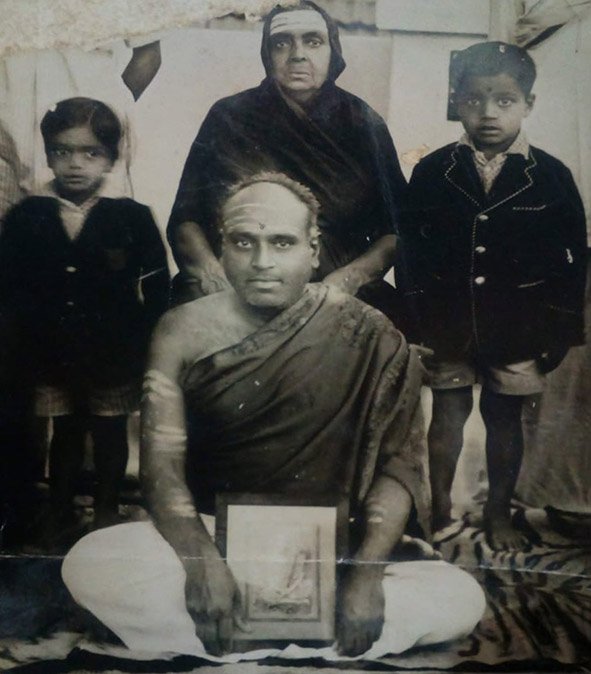
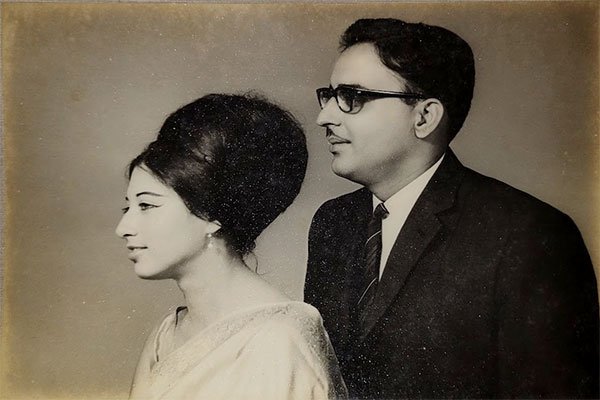
My paternal grandparents, Shehr Bano & Syed Ali Naqvi. Province of Bihar. 1947
Image and Text contributed by Zinnia Naqvi, Canada
This is an image of my paternal grandparents. My grandfather, or Dada as we called him, Syed Ali Naqvi was born in Khujwa, a village located in the Siwan District, Province of Bihar, India, on May 13, 1916. He was the sixth child of his parents. His father passed away when he was about eight years old and his upbringing and education became the responsibility of his mother and his eldest brother.
Dada was educated at the well known TK Ghose School, in Patna. The school has since seen alumni like the first President of India, Dr Rajendra Prasad, and the first chief minister of Bengal, Dr Bidhan Chandra Roy. Later, Dada attended at the Patna College.
In 1942 he married Shehr Bano Naqvi, my grandmother. She was born in Khujwa too, on January 25, 1925. She was the last of seven children of her parents. Her father was a prominent police officer of the Siwan District. Dadi never attended school but was educated by private tutors at home.
After their marriage, Dada started working for the Government of Bihar. At the time of partition in 1947, he was working in the town of Midnapur, West Bengal. On August 14, 1947, when Pakistan was born, he and his family had to migrate to Dhaka (now Bangladesh) which was declared East Pakistan at the time.
In Dhaka, Dada started his own transportation business. They lived in the Lakhi Bazar neighbourhood of Dhaka and bought a big house abandoned by a Hindu family who had left for India. On May 9, 1949, my father, Afsar Naqvi was born. He was the third child of what would be eight children.
This image of my grandparents was photographed in 1947, after they were newly married. Dada is dressed in a modern suit and bow-tie, along with a Jinnah Cap, named after the founder of Pakistan, Muhammad Ali Jinnah. Dadi is wearing a traditional chiffon sari and the symbol of elegance, a pearl necklace.
The generation of my grandparents were made to travel to all parts of the Indian subcontinent due to war, economic instability, religion, and other obstacles preventing them from providing the best living conditions for their many children. Similarly, my own parents migrated from London, to Karachi, to Toronto in order to provide the best possible opportunities for my sisters and I to be strong, educated, and successful. In the process, both were forced to leave behind many loved ones and memories of the places they once called home.
Today, this photograph hangs in the living room of our family home in Toronto. Inspired by the similarities between my parents and grandparents life, I have been working on a series called Past & Present. This photographic series contains images that are an example of how generations of family history can often repeat themselves. You can view the images here.
80 – With props and accessories, she indulged her fantasies at a photo studio

My mother, Mohini Goklani. Pune, Maharashtra. Circa 1950
Image and Text contributed by Sunita Kripalani, Goa
In 1947, after partition, when my grandfather Nanikram Goklani and his wife Khemi migrated to India, along with their extended family from Karachi, Pakistan, they settled in Pune, Maharashtra with their 9 children. My mother Mohini, second of seven sisters, was just 16 at that time. Grandpa got a job in the Income Tax department and although times were tough, my grandfather made sure all the children received excellent education.
My mother and her older sister Sheela went to Nowrosjee Wadia College and my grandfather managed to procure admission for some of the younger children in reputed schools such as Sardar Dastur Hoshang Boys’ High School, and St. Helena’s School for Girls. The children studied well, they were voracious readers, and led a simple life.
During the 1950s, the sisters were well versed in household skills, especially the art of stitching and embroidery. They fashioned their own clothes, copying designs from magazines and the displays in the shop windows of Main Street. At home however, they maintained decorum and modesty, but ever so often, Duru, my mother’s younger sister, would coax her to go with her to a photo studio on Main Street called The Art Gallery to get their photographs taken. Duru would pack all kinds of stuff for both of them: ties and beads, scarves and skirts, hats and belts, not to forget some make-up, and the two of them would mount their bicycles and head for the studio where they indulged their fantasies, using studio props and their own accessories.
In the picture my mother is wearing “Awara pants”, a style made famous after the well known actor, Raj Kapoor’s movie by the same name. She is also very nonchalantly holding a cigarette, albeit unlit, between her fingers! The photograph is totally incongruous with her personality, for copying Nargis, the star actress of the time, was more my mom’s style whereas my aunt Duru was bolder and more tomboyish.
I don’t know if my grandfather knew what was going on, or if he approved, but he was not the kind of father who would scold any of his children. If he didn’t like something, he simply wrote a few words on a piece of paper and slipped the little note under that child’s pillow, which was enough to bring the rebellious offspring back on track… but that’s another story.
After college, my mother got a job at the Department of Cooperation, Government of Maharashtra. It was her first and last job. She retired in 1985 as Assistant Registrar of Cooperative Societies, Bombay.
76 – “I lied to the Prime Minister of the country.”

A reply letter from the Sixth Prime Minister of India, Rajiv Gandhi to me. New Delhi. December 1, 1985
Letter and Text contributed by Swati Bhattacharya, Gurgaon
Blame it on my only child-ness if you must, but I love famous people loving me. I like provoking intimacy. But only from the jet-setting beau monde. I crave intimacy from people who have no business to get intimate with me. After coming back from school (Delhi Public School R.K.Puram), and doing the stuff I had to do, I’d sit down and think of writing to someone.
The first person I had written to was Hiroko Nagasaki, a Japanese 13 year old swimmer who had swept the Asian Games in 1983. She and I became pen-pals for the next two years. She’d send me paper stickers, perfumed erasers and then one day in school somebody stole my Hiroko box.
Traumatic as it was, I quickly recovered because by then I had received a flowery handmade-paper letter all the way from 22, Zaman Park, Lahore, Pakistan. Imran Khan, the famous cricketer, had written to me. The letter became my raison d’etre for a while. The fact that love does find a way, the fact that the letter had 18 red flowers printed at the back, and the fact that it had been signed as ‘Imran‘ and not ‘Imran Khan‘, to me it was a sign of a cosmic connection. We were meant to be and all that…Anyway, I lost this letter in a crowded Mudrika bus, while doing my nth show and tell.
The letter I am sharing with you is one that still lives with me. Born out of jealousy, it got written in the November of 1985, when newspapers were full of Rajiv Gandhi writing to a Sri Lankan kid. The TV cameras had gone loooking for her and captured her big 100 watt grin much to my annoyance!
I wrote a letter then and there. I lied and said it was my 3rd letter to him. I vented…and wrote that “just because I am too young to vote, my letter had not been replied to”. Next I know is this letter arrived, in a huge envelope with the PMO seal. Even though this is a letter from the Prime Minister to a girl in 10th Grade, I found everything in here. Every emotion. Every truth. Later when I made a ‘Thank You’ card for him, Sonia Gandhi, his wife, sent me a note back on that. In one month I had received 3 letters from the Gandhis.
The uncanny thing is, when I joined HTA (Hindustan Thompson Advertising, now JWT Advertising) as a copy-writer in 1992, my first assignment on PEPSI, was to write to Michael Jackson and ask him to come to India. My client delivered the letter to him personally. I was told, Michael had read it and kept it safely with him.
74 – A Partition story from Pakistan

My Father, Syed Ali Mehdi Naqvi, Hyderabad, Andhra Pradesh. 1949
Image and Text contributed by Waqar Ul Mulk Naqvi, Punjab Province, Pakistan
This is the only image of my Late father Syed Ali Mehdi Naqvi I possess. He was born in 1930 in a small district called Beed then in Hyderabad, Andhra Pradesh, India. In 1960, when new states were created on the basis of linguistics, the Marathi dominant town of Beed became a part of Maharashtra.
My father graduated from Usmania University, Hyderabad (now Osmania) in Masters of Persian when he was only 18, in 1949.
My grandfather Hassan Naqvi was a lawyer with the High Court of the Nizam of Hyderabad at the time and also owned a lot of agricultural land in Pimpalwadi (District Beed, Now in Maharashtra). Agriculture was a big part of the family income.
When Partition of India and Pakistan was announced, my grandfather was still very optimistic that Hyderabad will be declared an independent state. The Nizam of Hyderabad was very adamant about that. But the Indian Government did not comply and the Nizam had to surrender in 1948.
With a lot of sorrow, and seeing no other option in a very precarious India, my grandparents along with their children were finally forced to join thousands of others and leave India in 1955. All of our assets, a house at Muhalla Qila as well as the cultivated agricultural land were left behind, abandoned.
They migrated to Karachi via Bombay on a ship. With our roots, and legacies all left behind, my family had to go through a lot of hurt, disillusionment and suffering. Consequences of which can be felt till today. In my family’s words “we were simply plucked and sent into a dark and dangerous journey to Pakistan with no home, no job or even land to call our own.” Many people along with them, never made it to the shores of Pakistan and many were killed right after they landed.
I feel great sorrow when I think about that. Now I work in a financial institution as a manager in a Punjab province of Pakistan with my mother and two siblings. In all these years, I have never stopped thinking about what could have been.
70 – A very fashionable civil surgeon, he was awarded the “Rao Bahadur” medal by the British

My wife’s great great grandfather, Rao Bahadur Pundit Shambhu Nath Misra, Civil Surgeon. Bulandshahr, United Provinces of Agra & Oudh. Circa 1920.
Image and Text contributed by Paritosh Pathak
This image of my wife’s great great grandfather was photographed in a studio in Bulandshahr, then a part of the United Provinces in India. In those days there were only a few trained doctors in a city, and a civil surgeon was considered to be a ‘top medical practitioner’ as well as the last hope of anyone with an ailment requiring surgery.
Shambhu Nath Misra was awarded “Rao Bahadur” medal by the British government, the top civilian award of the time which was an equivalent of “Order of British Empire -OBE”. He wears that medal proudly around his neck in this picture. The medal has the British crown connecting the loop to the neck string. In the centre is a circular portion with etched words Rao Bahadur that is barely legible because of picture quality.
He graduated with a Degree in Medicine in 1899 from The University of Panjab located in Lahore of undivided India. (In 1956, the university was relocated to Chandigarh, Punjab, India). At the time of his graduation the university awarded an all-in-one degree- Medicine, Surgery and Obstetrics. Today the three are considered separate medical specialties.
A very fashionable man, in this picture, he sports a bowtie, very western for an Indian in 1920s. His ’Head Cap’, was common head gear for a man of stature, though unlike the kings and other royalty, it indicated status as a civilian. Completing his attire is a 3 piece suit, a silk vest, and I think a pocket watch which was specifically worn on the left pocket.
He was a very wealthy man, earning a salary of Rs 14,000 a month. And the ‘civil surgeon’ tag was important enough to get a letter delivered to him with only “Shambhu Nath Misra, Civil Surgeon, Bulandshahar” as the address. He supported many families of needy relatives and had significant real estate assets. He fathered 2 daughters and 3 sons, one of whom was the great grandfather of my wife. Two of his other sons emigrated to the United Kingdom. The family prestige and assets, both were gradually lost and it never regained the glory of his achievements. He suffered from diabetes and other common ailments, and passed away around the age of 70.
62 – English love in the time of War

My Parents Ronald and Beryl Osbourne, at Kohat Pass (NW Frontier Province), Pakistan. April 1946
Image and Text contributed by John Reese-Osbourne, Australia
I first learned of the Indian Memory Project from an article in ‘The Australian’ of May 2011 (a News Ltd daily newspaper). After visiting the website, it occurred to me that others searching the pages might be interested in a brief glimpse of Indian Army life from the viewpoint of a British officer and his family in 1945-46. It may shed a personal light on that brief moment in time just before the watershed of Independence and the bloody shambles the politicians made of partition.
This images is of my parents taken on 23rd April 1946, and it show them at the top of the Kohat Pass, near Tribal Territory. My mother is wearing a revolver!. On the back of some of these photographs, she has captioned them as ‘the gateway to 30 miles of tribal territory’.
My father Ronald Osborne was born in Wales in 1910 and worked as sales manager in London for Geo. Wimpey & Co., then a large builder of houses. He volunteered for the British Army in 1939 just before universal conscription was introduced. He served initially with the Royal Engineers and fought in the abortive Norway campaign before undergoing commando training and going on the far more successful Lofoten Islands raid to destroy an oil refinery held by the German forces. Selected for officer training, he found that the pay in the Indian Army was higher than in the British forces and chose to be commissioned into the Royal Indian Army Service Corps, serving in the North African and Italian campaigns, where he rose to the rank of major, until the Indian Army was repatriated.
My mother Beryl (née Beardsley) was also born in 1910 and grew up in Derbyshire. She moved to London as a young woman where she met and married my father. I was born in 1934. When my father joined the army, we went to live with her parents in Kingston-upon-Thames, where they owned two shops. At some point in 1940 a stray German bomb destroyed the shops and my mother, grandmother and I moved to stay with relations in Derbyshire before settling in a small village called Kirk Hallam. My grandfather stayed in Kingston, continuing to run his shops from two garages.
Understandably impatient after five years of wartime separation, my mother joined the Women’s Indian Voluntary Service (WIVS) as a means of getting out to India. By coincidence, she and my father were on separate ships passing through the Suez Canal at the same time (I think in September 1945). They met briefly when their ships docked in Bombay, before travelling to their respective postings. Initially she worked in the WIVS headquarters in New Delhi, organising the postings of other British volunteers as they arrived. Seeing little point in staying in New Delhi while my father was stationed in Jalandhar, she surreptitiously posted herself there! At some time in 1946, my father’s unit was transferred to Kohat.
In 1945, I was 11 years old, attending a boarding school in Leicester in the UK Midlands and spending school holidays with my maternal grandparents in Kingston-upon-Thames or with my father’s brother’s family in Porthcawl, South Wales. Sadly I no longer have any of the letters from my parents, so the story of their time in Jalandhar and Kohat is based solely on my memory and the scribbled captions on the backs of old, fading black-and-white photographs in the album I began to compile that year.
59 – He played the same role as Tagore

My father Prof. RR Kripalani (far right) in Tagore's play "Dak Ghar" (Post Office) staged by the teaching staff of DJ Sind College, Karachi. 1937
Image and text contributed by Mrs. Shamlu Kripalani Dudeja, Kolkata (www.calcuttafoundation.com)
I am a Sindhi and I was born in Karachi in 1938.
This is an image of my father on 20 Jan, 1937, in DJ Sind College, Karachi. The photograph is courtesy the College (which now stands in Pakistan) where my father was a Professor of Mathematics till 1945. It shows a scene from Rabindra Nath Tagore‘s play “Dak Ghar” (Post Office) which was staged by the teaching staff of the College in Karachi in 1937 during their 20 year celebrations. Here my father is in the role of Gaffar. I presume the play was translated in English, because the cast was all non-Bengali, in fact, most of them are Sindhis. In 1930s, Tagore had himself acted in ‘Dak Ghar‘ as Gaffar, the same role that my father played.
My father and his wife, Sushila moved from Karachi to Delhi via Bombay, in September 1947 during partition, with me, my younger sister Indu and youngest brother Gul. We lived there for 10 years. My father got a job in the Ministry of Commerce & Industry due to his mastery in Statistics as in those days Statistics was not a very commonly studied subject. I studied Math, got married, taught Math, and by a string of happenstances got involved in the Kantha revival, 25 years ago. In 2009/2010 I began depicting scenes from Tagore’s pictures through the medium of Kantha, where I sat with my women aritsans and artists from the villages of Bengal. I am now 73 and have lived in Kolkata since 1962.
22 – She was the epitome of style and sophistication

My mother (center) Maya Shivdasani, with her parents, Dr Manghanmal Kripalani, an eminent physician and Sarsati Kripalani, Hyderabad Sind, 1939
Image and text contributed by Usha Bhandarkar
My mother Maya Shivdasani is now 90 year old of age. She was born in Hyderabad Sind in 1919 and came to Bombay after her marriage in 1937. After her marriage in 1937 Maya moved to Bombay but would visit her parents in Hyderabad Sind (Now Pakistan) at least twice a year. This photograph was taken on one of her visits to Hyderabad where she was the epitome of style and sophistication: sleeveless sari blouse, short hair, long, painted fingernails.
She has lived in Cuffe Parade all these 73 years, read the Times of India every single day and visits the Cricket Club of India once a week. One of her favourite haunts is the Sea Lounge at the Taj Mahal Hotel. She was truly saddened to see it damaged in the Mumbai attacks of 2008. On the day the Sea Lounge reopened she was there sitting at a window table, sipping their wonderful Viennoise Coffee.
4 – Later they heard, their home and assets were all burnt down

Hand painted in New York (in 2000), my maternal grandparents, Lahore, (Now Pakistan). 1923
Image and text contributed by Dinesh Khanna.
My grandparents, Balwant Goindi, a Sikh and Ram Pyari, a Hindu were married in 1923. She was re-named Mohinder Kaur after her marriage . They went on to have eight daughters and two sons, one of the daughters happens to be my mother.
Balwant Goindi owned a whiskey Shop in Lahore. He was a wealthy man and owned a Rolls Royce. During Indo-Pak Partition, he and his family migrated to Simla, without any of his precious belongings; assuming he would return after the situation had calmed down, however, that never happened. After moving around, and attempting to restart his business with other Indian trader friends, they finally settled down in Karol Bagh. The area was primarily residential with a large Muslim population until the exodus of many to Pakistan and an influx of refugees from West Punjab after partition in 1947, many of whom were traders. It must have been a very sad day when he heard that his home and his shops in Lahore were burnt down.
1 – They went to receive the groom, but returned empty handed

My grandparents Mr & Mrs H.E Chowfin on their wedding day. Lahore, (Now Pakistan). December 28, 1938.
Image and Text contributed by Madhypriya Sinha
Mr Chowfin was part Chinese and part Indian. When the strapping Pathans from the bride’s family went to the station to receive the groom, they returned empty handed claiming that the grooms family never arrived, there were however, many chinese people hanging about at the station.