logo image Visual & Oral history of the Indian Subcontinent via family archives

Pre-Independence

109 – The cockerel-fighter from Punjab who became one of Africa’s greatest cameramen

Sir Mohinder Dhillon, pictured on the deck of British Navy ship. Kenya. 1967

Sir Mohinder Dhillon, pictured on the deck of British Navy ship. Kenya. 1967

Image and Text contributed by Sir Mohinder Dhillon, Kenya

The following text is a summarised and edited version of excerpts from an unpublished Autobiography of the contributor.

Looking back over the 80 years, I wonder how, as a simple village boy from Punjab who never even finished school, did I end up in Africa, dodging bullets to make a living from shooting hundreds of kilometres of film in some of the world’s most dangerous regions.

I come from the proud martial family of the Sikhs. I do not know the exact date of my birth, although my passport says 25 October 1931, Baburpur, Punjab. At the time, births were not registered, and parents habitually exaggerated the ages of their children in order to get them into school early and so have their own hands free during the day. Baburpur, formerly called Retla (the place of sand), was renamed after Mughal Emperor Babur who had reportedly camped near our village for a few weeks.

My father, Tek Singh-

My father, Tek Singh, was the first person in our village to get an education. He was an adventurous man, and in 1918 at the age of 17, he responded with enthusiasm to the recruiting posters for workers on the Uganda Railway in British East Africa. Believing that there was safety in numbers, he was joined by friends and former classmates from nearby villages and the determined young men collectively took up the challenge of seeking a better life abroad.

This grandiose project of Uganda Railways would change the lives of the tens of thousands of Indians who left home for a new life in an unknown land, most of them never to return. The so-called Lunatic Line laid between 1896 and 1901 from Mombasa into the interior of then-British East Africa to Lake Victoria and subsequently extended into what is now Uganda, opened up the East African hinterland to the outside world. The founding of towns, and their later development into cities, would go on to transform the economies of the region.

When Tek Singh announced his decision to go to East Africa, it upset my grandparents immensely. Their only son was going to ‘darkest Africa’, the prevalent view of Africa at the time (still the perception of many people today). The money for my father’s first train ticket to Bombay, and for the dhow that would carry him from there to Mombasa, was borrowed from a moneylender in the village at a steep interest rate.

For the young Tek Singh leaving the village was more than just an adventure. A great deal rested on how he would fare in distant East Africa. Back at home in India, his family would be depending on him for remittances. He also had young wife to think of. His marriage had taken place six years earlier, when Tek was just 11, and his betrothed, Kartar Kaur, was nine years old.

The railway journey from Babarpur to Bombay took two days and one night. And then it took another two days to find the Uganda Railway’s recruiting agent. His shopping list for the journey – then the cheapest way of crossing the Indian Ocean – included a charcoal stove, two bags of charcoal, all the rations needed for the journey, a sleeping mat, blankets, washing powder, bath soap, tea leaves, and fresh water.

Tek Singh – or Bau Ji, as he was fondly called at home – arrived in Mombasa with almost no money in his pockets. He found refuge at a nearby Sikh temple (Gurudwara), where he slept on the veranda braving the ravenous mosquitoes, exactly like how the thousands freshly arrived on the coast spent their first few nights. After a week, Bau Ji was provided a bachelor accommodation by the Uganda Railways. Later, he and two other young Sikhs shared a small railway house that had the luxury of a tiny garden. The trio of bachelors remained life-long friends.

Bau Ji had promptly written home, informing his parents of his safe arrival. The mail though travelled first by sea, and then by rail and horse-drawn carriage and by foot, and took as long as 12 weeks to arrive. By then, his parents had feared the worst. His wife, Kartar Kaur, for her part, was obliged to don widow’s attire (the customary white dress), and was forbidden to use cosmetics. She complied for form’s sake but Kartar refused to believe that her husband was not alive. Amid the uncertainty of my father’s absence, my grandfather Natha Singh lived long enough to hear that his son had indeed reached East Africa safely, but the suspense evidently proved too much for his health. When Bau Ji’s letter finally arrived, the family was overjoyed and distributed sweets to everybody, but my grandfather died shortly after that.

Bau Ji found himself working for a soon-to-be expanded colonial rail (and shipping) network, one that would come to be known, first as Kenya & Uganda Railways and Harbours, and then eventually (in 1948) as the East African Railways and Harbours Corporation. Almost 30 years would elapse before he felt he was ready to bring the rest of his family over to Kenya. Through the 30 years, Bau Ji had to be content with getting to see his family during periods of extended overseas leave. He was entitled, once in every five years, a ‘six month home leave’ in India. All but one of the rest of us seven siblings were conceived during successive home-leave visits from our father. My youngest brother Balbir was born in Kenya. Bau Ji was able to save money for the education of all six of his sons, including me. Later, Bau Ji sent money to build a primary school in our home village.

Although the India Bau Ji had left behind was riven by class divisions, the world to which he now belonged bore even sharper lines of demarcation. The less educated Sikhs, those who were good with their hands, became mechanics, masons and carpenters. Only well-educated Sikhs could expect to land responsible office jobs. Most of the Railway accountants and clerks were Goans, who also ran the catering department. The people from Goa, who had lived under Portuguese rule for more than 500 years, did not mix much with other Indians. They classified themselves as Portuguese. And they already had their own sports club, known as the Railway Goan Institute. There were very few Gujarati-speaking Indians working on the Railway. Some Sikhs left the Railways to venture into business, but it was rare.

Bau Ji, for his part, had very little time for any kind of life beyond the Railway. He would walk the 10 kms to work from his Railway quarters. He and his two friends Kishen Mangat and Basant Bindra were encouraged by the British Administration to form a Sikh hockey team so a hockey field and a modest clubhouse were duly built. It went on to become the Railway Asian Institute Sports Club. After work, he would walk back home, have his tea, then change into his running-shorts and pick up his Indian-made hockey stick to hone his hockey playing skills.

Our lives in Baburpur -

I spent my early childhood in much the same way as my father. We never travelled outside our district in Punjab. There were no road or rail connections nearby. The Television was yet to be invented and I did not even know that radios existed. I first saw a camera when we all travelled to Ludhiana in 1947 to have our passport pictures taken. The camera was one of those contraptions with a black shroud underneath which the photographer’s head would momentarily disappear. There were no newspapers or magazines from which to learn about the world outside Babarpur. While in India, I had never heard of Mahatma Gandhi. Not until 1948, when I was in Kenya, would I hear about Gandhi for the first time – and that was only because he had just been assassinated.

Some of my friends are shocked when I tell them that my main hobby in the village was cock-fighting. I was the proud owner of a champion white cockerel named Raja, or ‘king’. Raja was fed on almonds and garlic, which made him a formidable fighter. We couldn’t afford the luxury of eating almonds. But for Raja, I would settle for nothing less. Before Raja went into battle, I would fit needle-sharp steel caps over his fighting-spurs – the talons on the inner side of a cock’s leg. In their natural state, a cock’s spurs are sharp enough. But kitted out in steel spikes, Raja could strike deep into an opponent’s belly, killing that poor bird almost instantly. Talking about this makes me wonder how I could have been so cruel. Back then, however, as a 12-year-old, I got a great kick out of all this. Raja slept next to my bed, I was so proud of him. My other passion was kite-flying. Together, brother Joginder and I won the championship for both of our last two years in the village.

Leaving India -

Things began to change for us in April 1947 the announcement of our impending departure had come in a letter from Bau Ji, received in September 1946. Leaving for Africa just weeks before India got its independence did at least spare us the carnage of Partition. When we left, India was still a peaceful place. Yet, within just a few months of our departure, some two million Indians were to lose their lives.

The first time I stepped on to a train was in 1947, at the age of 16, when we were leaving India. It was in the same year that I first travelled by bus. This was a time when, for the first time ever, Indian national election campaigns were canvassing the villages. The year 1947 was thus a significant one in my life. Until then, I had passed my entire childhood without ever having seen either a car or a motorcycle. I saw a flush toilet for the first time only after we travelled to a nearby town to be immunised against smallpox and to receive our yellow-fever vaccinations.

First, we travelled by ox-cart to Malaudh, the small town nearest to Babarpur where I had been going to school. With Partition looming, electioneering was under way in earnest, new buses were being used to mobilise political support among rural populations. From Malaudh, we took a bus to Ludhiana. This was only the second bus I had ever travelled in..From there, we boarded the train for Bombay.

In Bombay, we found a cheap hotel, where – in order to cut costs – the whole family shared one large room, with the males in one corner and the women in another. In the floor of the room there were holes through which, peeping down, we could see parts of the room beneath. Like all Indian travellers in those days, we carried all our own bedding in a sturdy canvas roll, complete with thick leather straps, a leather handle and a special pillow compartment. The bustle of Bombay – the first big city I had ever seen – was overwhelming. On reaching a street, I’d just stand there, transfixed, sometimes for at least three minutes, not daring to cross if there were a car approaching, even from afar. Bombay was simply awe-inspiring.

In India, there were – even then – bribe agents or ‘facilitators’ everywhere to smooth your passage through the formalities of customs and immigration and to find suitable accommodation for you. At the Bombay seaport, a bribe had to be paid for every service that was rendered. We even had to bribe someone in order to establish who else needed to be bribed. Our bribe agent then made sure that we bribed all the right officials.

The ship, named the Khandala, was dirty and worn. Originally a coal carrier, it had been converted to service as a passenger liner. The journey took 14 days. We docked briefly at two ports along the way, Porbunder in Gujarat and Mahe in the Seychelles. Then one day we saw the lighthouse of Mombasa. A tugboat came out to meet us and escorted our ship through a narrow bay into the port. The Africa I arrived in was green and lush. Palm trees swayed in the breeze against a clear blue sky. What a marked contrast this was to the flat and dusty Punjab we had left behind.

As we approached the shore, I knew I had come to a wondrous land. There were large engineering cranes at work in the harbour. The first human beings who caught my eye on the shore – two white men wearing shorts and a white woman in a loose skirt – were doing something curious. They were swinging sticks up and down. Later I found out it was golf. There were Africans, Arabs, Swahilis and even a few Indians and Europeans. We were astonished by how cheerful and laid-back everybody seemed to be. Most of the people we had seen on the streets of Bombay, by contrast, had looked tense and miserable, as they rushed about from place to place.

After Babarpur, our modest Railway house in Nairobi had the look of a palace. Gurdev, my elder brother soon found a job as a Railway fireman. For two years, he fed coal into the burners of the steam-engines and he would come home with soot all over his face and on his overalls. After a two-year apprenticeship, he became a locomotive driver.

In India, we had been punished for everything in school – for poor grades, for failing to complete our homework, for showing up a few minutes late, even for laughing aloud in class. For a village boy used to squatting on a coarse jute mat on a hard, uneven cement floor, this was a luxurious learning environment. Most of the teachers in Nairobi were surprisingly lenient, moreover, they did not punish for failure, or for lagging behind, but only for behaving badly in class.

Outside of school, life was filled with excitement. We drank sticky soda pop and we begged for turns to ride the bicycles of our friends. I played billiards, snooker and skittles at the Railway Club. At school, we played hockey and table-tennis. Indeed, we became such dab hands at table-tennis that my brother Manjeet and I went on, in 1954 and again in 1955, to contest the final of the Kenya National Table Tennis Championship. I won the first encounter, but Manjeet took the second.

Bau Ji was himself an avid sportsman. His love of hockey in particular was to infect my younger brother, Joginder (Jindi), who went on to be selected as part of the national hockey team that represented Kenya at the 1956 Olympics in Melbourne, Australia.

Joginder was sent to the prestigious St Thomas’s Teaching Hospital in London, where he eventually qualified as a doctor. Having then just represented Kenya at the Olympics, Joginder had easily found a place at the teaching hospital. Inderjeet went back to India, to a boarding college in Ludhiana, as Bau Ji could not afford to send him to a school in England. Later, upon returning to Kenya, Inderjeet became a popular radio and TV personality with the Kenya Broadcasting Corporation, and was for a while a heartthrob among the teenage set in Nairobi. Manjeet initially took up a job in Nairobi as a clerk in the Kenya Ministry of Works, before going into business. While at school, he received a shield from Queen Elizabeth’s sister, Princess Margaret. He was also awarded the Lord Mountbatten Boy Scouts’ Belt. All five of my brothers passed their ‘O’ level examinations. I was the sole exception, failing the exam.

A career in images -

One day Bau Ji gave me a basic, second-hand Box Brownie camera. Bought at a stock-clearance sale, it had cost him 25 shillings – the equivalent, then, of about US$ 3.50. This was the ‘poor man’s Rolleiflex’, with a fixed speed and fixed aperture. Neither he nor I knew it at the time, but this simple gift marked the beginning of a 60-year-long career in photography.
In the 1950s, in a prestigious international photographic magazine, I came across a photo essay by the Indian photographer, I.S Johar. His were pictures taken with a Box Brownie of landscapes featuring dramatic skies. Of course, all Johar’s images were in black-and-white, as colour film had yet to appear. His images, though, were a revelation to me. Taking my cue from Johar, I started using a yellow filter for all my outdoor pictures, and an orange one at times, for special effects.

My first photographs were of the Indian hockey team’s first to visit Kenya, early in 1948. In the team was the maestro Dhyan Chand, winner of three Olympic gold medals. Other great players I remember from that team were K S Babu, Manna Singh, the barefooted Peerumal and the South Indian Raju, as well as the two Anglo-Indians, R S Gentle and Claudius. For players with such an awesome reputation, all were astonishingly unassuming and gracious. None so much as batted an eyelid on being ambushed by me before a match with requests for their portraits. “Dhyan Chand,” I’d say, “Just stand there a minute, would you?” And the great man would duly oblige.

I could not afford to take my film off to a photographic studio for processing, so I learned to process film myself, in a small, makeshift dark room that I improvised in the windowless storeroom at our Railways house. I purchased developer powder and other chemicals from a studio in town. From that studio, I also borrowed a thin handbook, published I think by Britain’s Royal Photographic Society, entitled Photography Made Easy for Learners, which had detailed instructions on how to set up a home-processing lab.

I did not have an enlarger, so the photographs I produced were tiny, measuring just 2.25 by 3.25 inches. With no electric drum-dryer either, I would dry the wet pictures by slapping them on to the window panes in the kitchen, after washing down the glass with Lifebuoy soap. “Mohindri, that’s expensive soap,’ my mother or my sister would chide me. There was some friction, in that kitchen, between the cooks in the family and me, over my encroaching photographic activities. “A kitchen,” I was roundly informed, “is for cooking in – not for making pictures.”

My new-found joy at having discovered the wonders of photography did little to calm the guilt feelings that by now were haunting me. Here I was, a grown man of 20 without a job, still sponging off his parents at home. Having flunked my ‘O’ Level exams, I was beginning to feel anxious I might never find a meaningful job.

So one morning I plucked up enough courage to respond to one of the newspaper advertisements. The vacancy in question was for ‘a junior accounts clerk in an established pharmacy practice’. To my surprise, I received a notification that I was to come in for an interview. At the appointed time, I was shown into the office of the proprietor, an elderly Jewish woman called Edith Haller. I had heard of Ms. Haller, as she also owned one of the photographic studios in the town. Indeed, in those days most retail chemists operated a photographic service as well –where customers could hand in their exposed film and later collect the developed prints.

My formal interview with Ms Haller was mercifully brief. In short, my candidacy for the post of accounts clerk at the pharmacy was rejected almost at once. “What we need is a qualified bookkeeper,” Ms Haller explained. I was not unduly surprised but this time my frustration got the better of me and I nearly broke down in tears. In the doorway, as I was leaving Ms Haller’s office, I spun around suddenly. “Halle Studio,” I blurted out. “What about Halle Studio? Isn’t there something I can do there?” I told her about the little dark room I had established at home. I offered to bring in and to show her some of my photographs. I pleaded with Ms. Haller to be given a chance. She must have been utterly taken aback by my torrent of broken English, by my gangly appearance, by my ill-fitting, lop-sided turban. This was the first time I had ever addressed a white person at any length.

Ms Haller’s eyes lit up while I was talking. There and then, once I had said my piece, she told me she would put me on one month’s probation, starting immediately. From the moment I reported for duty, I was determined to show I was both capable and eager to learn. That job meant everything to me. My trainer Peter Howlett, although he did not say so, left me in no doubt that my brown skin might present a bit of a problem. Ms. Haller nevertheless confirmed me in my post at the end of the month-long probation period, for which I was paid 150 shillings (the equivalent, then, of about US$ 21). She also raised my monthly salary to 250 shillings (roughly US$ 35). I was mightily relieved and grateful; for now, at last, I had a proper job.

At the time, Kenya’s only daily newspaper, the East African Standard, did not have any staff photographers of its own. Instead, the paper relied on photographers hired from Halle Studio for its pictures of all events. Peter Howlett, the man who had been given the responsibility of training me – was Halle’s principal photographer and handled most of the commissions.
One line of work that kept Halle Studio very busy was photographing babies at their parents’ homes. Peter specialised in taking informal portraits of the babies using a single flash and it was my job to hold the flash unit. The unit was a very large, heavy box, separate from but wired up to the camera. I had to lug this box around, directing the flash at different angles so as to avoid casting an ugly shadow while Peter clicked away. Peter and I made a very successful team. We got many requests from proud young parents, while also going from door to door around some of the more affluent Nairobi suburbs, promoting our ‘Home Photography’. The response we received was generally enthusiastic, and before long we had an extensive customer base – and an impressive album of sample baby pictures.

We were also hired to take pictures of horse races, dog shows and other social events. As a colonial newspaper, the East African Standard – which commissioned most of these photographs – catered exclusively to the tastes of Kenya’s ruling British elite. One day, while Peter was away on holiday, the newspaper’s social editor, Lesley Clay, rang the Studio, requesting the services of a photographer. I took the call and offered to stand in for Peter. Ms Clay readily agreed to take a chance on me. “In a worst-case scenario,” she added, encouragingly, “we can probably do without a picture.” It turned out that Lesley wanted me to cover a horse show.

Ms. Clay was delighted with my photographs. Even I, when I processed and developed the pictures, was pleasantly surprised by how well they came out. This time the picture taken by Rolleiflex camera, and a 8×10 inch size was a magical thrill. This was the beginning of a long relationship with the Standard newspaper. Two dynamic white women – Ms. Haller and Ms. Clay – were thus responsible for both of the early breakthroughs in my career as a professional photographer.
With Lesley  I attended countless society functions at which she would introduce her paper’s turbaned Sikh photographer to individual party guests. All were white, of course, and many would simply turn away on being introduced to me, shunning my presence.

The newspaper work kept me busy for years, until eventually the Standard employed a staff photographer, John Parry from England. In those days, the paper paid us peanuts for our photographs. The going rate was just five ten shillings (the equivalent at the time of about $ 1.20 60 US cents) per column-inch.

When the British declared a State of Emergency in Kenya in 1952, the Mau Mau struggle became the big news story. We took photographs of the brutal ‘screening’ of Africans in the streets; of detainees in the Manyani Camp; of British troops and supplies arriving at the Eastleigh Airport. I was not mature enough then to take in fully what was going on around me, even though this period was one of the most politically charged in the country’s history. The awakening of my political consciousness would come later, when I took photographs of the Hola Camp Massacre in 1959. It was when the real horrors of this conflict start to hit me.

Halle Studio -

In 1954, Ms. Halle fell ill, and her brother Arthur Haller, who was then the Government Maize Controller, persuaded me to buy the business from her. He even went so far as to find me a partner, in the person of Oded Katzler, a wholesaler of cardboard packaging. Katzler raised all the capital – amounting to the then formidable sum of 20,000 shillings. At first, Oded remained a sleeping partner in the business, but after 10 months I was able to buy him out. Upon acquiring Halle Studio, I immediately relocated the company to a rented first-floor office suite in central Nairobi. This was in Nairobi House, the historic building then located on the corner of Delamere Avenue and Government Road (now Kenyatta Avenue and Moi Avenue). The work was exciting, and although it did not pay well I was happy enough at the time, as I had developed a taste for photo journalism and news reporting. As time went by, my professional photographic assignments started taking me further afield. Increasingly, I was called upon to cover safaris and expeditions in remote parts of the country.

Ambi - 

One evening in May 1958, my father – after coming home from work as usual – told me that he had some “wonderful news” for me. “Mohinder,” he said, “you are getting married.” Just like that.

Amarjeet Kaur Sandhu, known throughout her life as Ambi , was born in Kisumu, on the Kenyan shores of Lake Victoria, on September 20, 1940. She was educated at Kisumu Girls School, although, like me, she did not progress beyond ‘O’ Level. Bau Ji, for his part, was pleased to learn that Ambi had played tennis at school – at a time when Sikh girls were, for the first time, being allowed to play sports – was a strong point in her favour.

After our marriage, Ambi was not only conversant with all the studio’s day-to-day functions; she was also taking most of the passport, driver’s licence and ID photographs herself. This left me free to take on newspaper assignments at a moment’s notice. The result was that business at the studio picked up dramatically.

In those pre-Independence days, our bread-and-butter income came from a deal we had with the British Army to take ID photographs of its soldiers serving in Kenya, many of them then trying to suppress the Mau Mau uprising.  On at least six days every month, whole lorry-loads of British soldiers would be dropped off to have their pictures taken. Sometimes, the queue would extend down the stairs on to the ground floor of Nairobi House and out into the street. Ambi would sometimes take pictures of more than 300 British soldiers in a single day.

Ambi loved working at the studio. She loved the busy days especially, when streams of people would walk in to have their pictures taken or to collect their prints. She made friends with other tenants in the building, whom she spoilt with her home-made samosas, earning her the nickname ‘Samosa Lady’. The work set Ambi apart from former school friends of hers, some of whom were now also newly married and living in Nairobi, but who – as housewives, most of them – had only limited interaction with the wider Nairobi public. Ambi never criticised her married former school friends openly, but she did, in private, after meeting up with them at weekends, “I am far too busy,” she used to say, “for all this idle chatter” finding the closed world of their incessant society gossip exasperating.

With Ambi at the studio, I could devote myself almost exclusively to news photography, initially for the East African Standard, and then – increasingly – for UPI and other international press agencies as well. Come 1959, I was spending less and less of my time in the studio, as assignments would call on me to leave Nairobi to cover events elsewhere in Kenya and throughout East Africa. When, in 1960, I began covering events across the whole of Africa, I would be away for lengthy periods, leaving Ambi to ‘hold the fort’ at Halle Studio. Having acquired a passion for photo-journalism, I had become ambitious. So, in 1959, I wrote to Planet News Photos (subsequently taken over by United Press International, UPI) asking if this international agency might consider taking my pictures. The reply I received was surprisingly short and to the point: ‘Yes, Please’ – just the two words; no further explanation required; no demands; no doubts even over whether I could deliver photographs of the desired standard. This stunning breakthrough would prove the making of my company Africapix Media Limited.

Mohinder Dhillon (Founder and CEO of Africapix Media Ltd.) was the first photo and TV journalist to capture the plight of Iranian Kurds behind Khomeini’s lines. His first pictures shocked the world generating a lot for sympathy of Kurdish sufferance. He was knighted by the Order of Saint Mary of Zion during a ceremony at the Royal Artillery Headquarters in Woolwich, U.K. on November 12th 2005. “The honors were conferred upon those who had made significant contribution to the society. 

His films of Ethiopian famine finally moved the world into action resulting in one of the biggest famine relief operations in history. Relief planes from dozens of countries descended on little dirt air strips of Ethiopian countryside round the clock as if they were Heathrow or JFK airports. The very first pictures of the terrible Ethiopian famine was the combined effort of Mohinder Dhillon and Michael Buerk of BBC TV to gain entry into tightly controlled military ruled Ethiopia in 1984 opening the door for rest of the media and rest of the world.  


107 – She emerged from a rural home and became a lady endowed with knowledge & charm

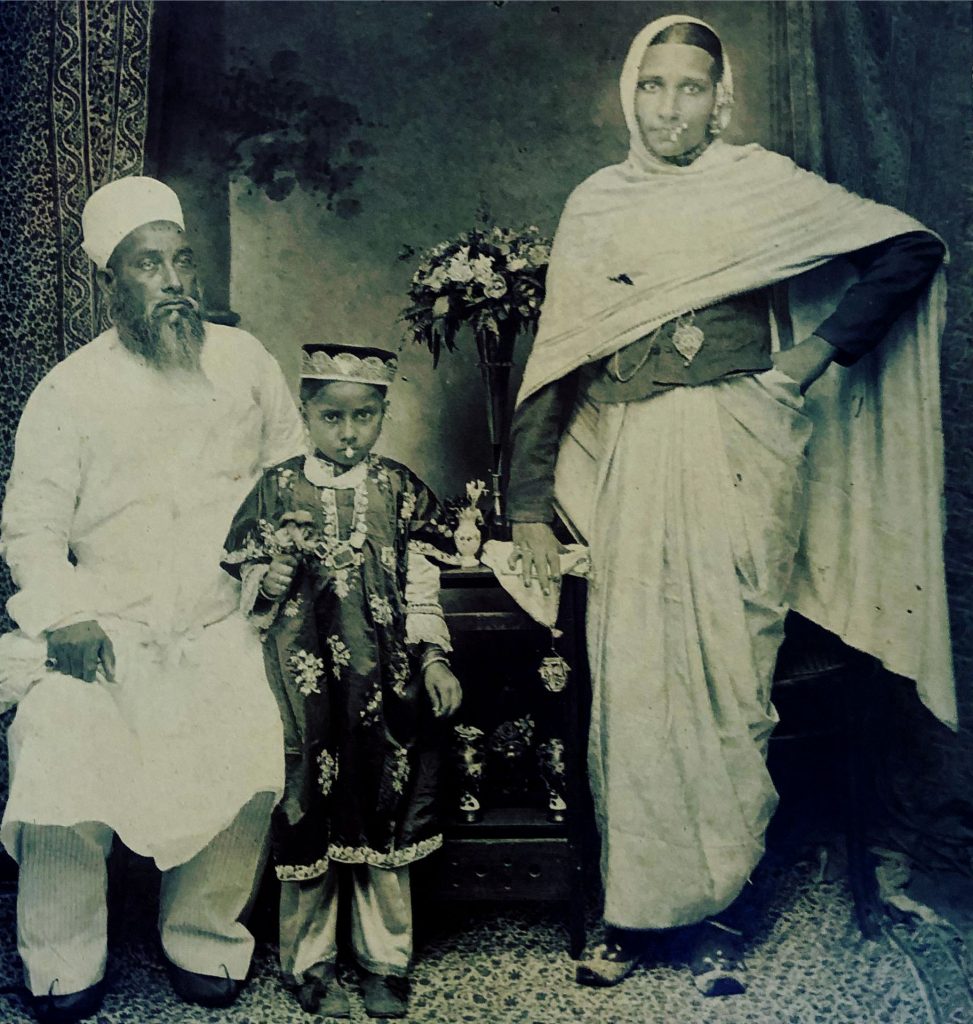
My Parents, K. M. Devaki Amma & Lt. Cdr. P.P.K. Menon. Bombay. 1941

My Parents, K. M. Devaki Amma & Lt. Cdr. P.P.K. Menon. Bombay. Maharashtra. 1941

Image & Text contributed by Radha Nair, Pune

This photograph of my parents K. M. Devaki AmmaLt. Cdr. P.P.K. Menon was taken at a Photo Studio in Bombay in 1941, soon after they were married. My father was based in the city serving the Naval Force.

My mother, K. M. Devaki Amma belonged to Feroke, a part of Kozhikode in Kerala. Her initials K. M. stood for Kalpalli Mundangad and her family originally belonged to the Anakara Vadkath lineage. The large joint family of more than 25-30 people lived in a house called Puthiyaveedu which still exists in Feroke, however the members are now settled in far flung places and my grand aunts and uncles are no more.

My mother had to give up school very early in life. She came from a large family of 14 brothers and sisters and belonged to an era where a girl’s formal education wasn’t a priority. While they grew up under the tutelage of grand uncles and aunts, they learned to cook, clean, and learnt to make do with and share whatever little they had with their siblings without ever complaining. Congee (Rice Gruel) was what they mostly had for lunch and dinner, supplemented with a little coconut chutney, and may be a side dish of some green banana, but only if they were bestowed with a ripe bunch of plantains available from the kitchen garden.

My mother and her sisters’ daily life entailed preparing food for all members of their very large family. By the light of a wick lamp, sweating by the blaze of crackling coconut fronds they would wash dishes with ash from the kitchen hearth and rinse them with water drawn from the well. My mother in personality was very self-reliant and was happy with whatever little she had.

Arranged by my paternal grandmother, when Amma married my father, a man with an aristocratic lineage and a Naval officer, my father’s cousins would scoff at her and condescendingly regard her as a ‘village girl’. They had been educated in Queen Mary’s Women’s college, Madras (now Chennai) whereas my mother had studied only up to Class IV in a local village school in Karrinkallai.

Undeterred, my father, who knew his wife was a bright and intelligent woman took her under his wing and brought out the best in her. He taught her English and bought her abridged versions of books written by Charles Dickens, Walter Scott and many other great authors. He read out passages to her and patiently explained to her what they each meant.

Thus Devaki, my mother, slowly emerged from her rural background, and became a lady endowed with great poise and charm. Not only did she steal my father’s heart, but even of those who befriended her. She became a much sought after friend by wives of both British and Indian naval officers. She taught them to cook Malayali dishes and stitch & embroider; skills, which were executed by her exquisitely. She wrote and spoke English with such assurance that she could put a present day Post Graduate in English to shame. But despite all these changes, she remained loyal to her roots, proud of her humble origins, and very attached to her siblings.

Sometimes, deep into the night I would catch whispers of my parents’ conversation as they sat and planned the monthly budget, and spoke about their dreams of providing us with the best of every thing. It was my mother who insisted that my sister and I be given the best education they could afford. She firmly refused a State Board SSC education, and insisted on us being admitted into schools which followed a Senior Cambridge syllabus. She was efficient and fiercely independent. By comparison I was a pale shadow. In fact, many times I used to feel very unsure of my self in her presence, intimidated by her indomitable spirit and the complete control she had over any situation.

When my father was suffering Cancer, she stood by him; nourishing him with love and healthy food, while my sister and I watched our father’s condition worsen by the day, helpless and often giving in to tears. My mother always remained calm, but only when he breathed his last in 1977 did she break down completely. He was her life force, and she was his guiding light. Theirs was an extraordinary relationship, always supportive of each other at all times and completely committed to each other till the end.

After I graduated, it was her dream that I put my education to good use. However, a few years after marriage when I was forced to give up my teaching post, she never forgave me till she breathed her last. To make up for it, I began to write and put together a collection of short stories, but the book never got published.
What pained me most was that I was not able to place a copy of my book in my mother’s hands and make my peace with her before she passed away in 2008.


106 – The Tiger man of Jabalpur

The Tiger Man, Jabalpur, Madhya Pradesh. Circa 1930

The Tiger Man, Jabalpur, Madhya Pradesh. Circa 1930

Image and Text contributed by Deborah Nixon, Australia

This image was found in my father Leslie Nixon’s private collection. He was born in Agra in 1925, was schooled in Mussoorie, and trained with the Gurkhas. Later he joined KGV’s 1st OGR (King George V’s regiment).

My Anglo Indian family has a history of having lived in India for four, or possibly five generations- they were all Railways people, and my father worked during the Partition to transport refugees in and out of the Gurkha head quarters. He archived all of the family images in India and thanks to him I have been lucky to have a ‘bird’s eye view ‘ of partition. He kept a lot of old army documents and memorabilia from the few years he served with the Gurkhas. When he migrated to Australia he went to University and became a Geologist.

There isn’t a lot to say about this image as there was nothing written behind it, but to me it is a very arresting photograph. My father says he remembers the ‘tiger men’ used to come around in Jabalpur, his family home, and dance as part of the Islamic festival Muharram and he imitated the dance himself as young children do.

There is another image and narrative on my father here that sheds some light on his life in India.


104 – The surgeon who saved hundreds from the Plague

Nellie, Mabel & Dr. Bharat Chandra Ghosh. Kashmir. 1928

Nellie, Mabel & Dr. Bharat Chandra Ghosh. Kashmir. 1928

Image & Text contributed by Alison Henderson Ghosh, U.K

This is an image of my great cousin Nellie Ghosh, great aunt Mabel Henderson and her husband Dr. Bharat Chandra Ghosh. Nellie was Mabel & Bharat’s daughter – and they lived somewhere in India and their house was called “Homelands”. The photograph of the house surrounded by Palm and Coconut trees suggests a coastal area. I have been researching the Ghosh family for years but haven’t yet found much information on the family after 1929.

I do know that Mabel’s father was a tea/general provisional merchant based in Edinburgh, U.K.– Mabel had three brothers, John, William and Daniel. William was a well known Scottish composer/musician and he wrote music for church organs and also recorded to vinyl, Daniel became a smuggler and was last heard of in the Caribbean. And there were three sisters; Kate & Bunty who both migrated to New Zealand, and Helen, my great grandmother, to Ireland – they were all very musically and artistically gifted. About Bharat’s family I found out that his father, Ishan Chandra Ghosh was a Professor of Mathematics and his mother’s name was Anorndomohi Ghosh – her maiden name was Sarkar.

I am unsure about how they met, but Bharat and Mabel were married in Scotland in 1905 in the district of St. Giles. Bharat qualified as a doctor in the Royal College of Surgeons of Edinburgh and at the time of their marriage they must have moved to India because he worked for the Punjab Medical Department, and then he subsequently joined the Indian Medical Services. According to the India papers in the National Library of Great Britain, Bharat was based in Ambala, Punjab as an Assistant Surgeon where he inoculated hundreds of people against the Plague in 1901-02. He was also a member of the India Medical Service at the Theatre of War in World War I.

His name appears in the quarterly Indian Army list from January 1918 to July 1922.

Date of Appointment:  6th October 1917
Rank :   Temporary Lieutenant
Promotion:   6th October 1918 to Temporary Captain

I am on the lookout for leads on the Ghosh family whereabouts after 1929, and would be happy to hear from people who may know more.


103 – “The only thing that impressed her was a good education”

My grandmother Kanwarani Danesh Kumari, Circa 1933

My grandmother Kanwarani Danesh Kumari, Patiala, Punjab. Circa 1933

Image & Text  contributed by Sawant Singh, Mumbai

This is an image of my grandmother Kanwarani Danesh Kumari photographed in Patiala, Punjab around 1933.

She would have been 20 or 21 years old at the time. It was photographed by R.R. Verma, a Photo artist from Cawnpore (Kanpur). Formally, she was addressed as ‘Rajkumari Bibiji Danesh Kumari Sahiba’. This is the only photograph I have of her in my possession, even though my memory of her is vastly different from this.

I remember her as a simply clad, dignified, exceptionally proud woman, who would spend her time gardening, shopping for groceries in the market, or chatting away with the gardener & her domestic staff or entertaining friends from out of town in Dehradun, (now in Uttarakhand); many of whom were people who belonged to royalty or influential circles. Her home “Sawant Villa”, named after my great grand father, was an open house with people constantly streaming in and out.

My grandmother was fondly called ‘Brownie’ by her family and friends. She was the wife of late Maharaja Kumar Aman Singh of Bijawar (now in Madhya Pradesh) and the daughter of Maharaja Bhupinder Singh of Patiala (Punjab) who was known as ‘the proud owner of the world famous “Patiala Necklace” ‘ manufactured by Cartier.

Brownie or as I called her, ‘Dadu‘, was brought up in the lap of great luxury but she understood and adapted to the simple life very well. A beautiful, strong, non-judgmental woman, she wouldn’t suffer fools and was known to never mince her words. The only thing that impressed her was a good education and believed that it was the only way one could change their lives for the better. She thus ensured that all her children and grandchildren would appreciate the value of literacy and education.

Dadu was a very social woman and loved going into the city to meet her friends. Everyone knew her in Dehradun. I remember her dragging me to meet her dear friend, Mrs. Vijaylaxmi Pandit and they would spend hours chatting away while she would keep tucking my hair away from my forehead and eyes. She was as comfortable in a Rolls Royce as she was in a local bus in Dehradun. The latter was how she travelled to visit me when I was studying at the Doon School. She insisted on teaching us how to walk barefoot on Bajri (pebbled) pathways and chew on a Datun (Neem twig commonly used to clean teeth), in retrospect I think it was to prepare us for the real world.

I also remember, a few of her interesting obsessions were collecting imported soaps and canvas shopping bags. Anyone who ever travelled abroad had to bring back bars of soaps, the canvas bags and chocolates. I remember one soap in particular in her bathroom was shaped like a fish. It seems that her quirky fascination with soaps may have passed on to me.

After an accidental fall in the early 90s, her health began to fail and she passed away in her sleep, peacefully in 2005.

This photograph of my grandmother is framed and hung in my dining room. While I never saw her dressed like this, the dignity and pride I see in it is alive and inspiring.


102 – My grandfather’s secrets

Margurite Mumford, and my Grandfather Albert Scott, Ooty & Bombay. 1930s

Margurite Mumford, and my Grandfather Bert Scott, Ooty & Bombay. 1930s

Image & Text contributed by Jason Scott Tilly, United Kingdom

I will never be sure if my grandfather Bert Scott, would have wanted me or anyone else to find these negatives;
They were his secrets for all of his adult life. He had after all kept them very safe, hidden from the moment he left India.

Bert Scott, (lower right) was my grandfather, and he was born in Bangalore in 1915. He was educated at Bishop Cottons school and he joined the Times of India in 1936 as a press photographer, where he worked until the outbreak of World War II.

With trouble brewing during Indo-Pak Partition, he and his family fled and he left his whole life behind; his country of birth, India, his friends and home. Travelling with minimum luggage would have been conditional so he chose to take only the necessary in just a few metal trunks.

Inside one of those trunks were several photo albums and pocket-sized blue negative holders that I came across many years later in my grandparent’s cupboard in 2006, a few years after Bert, my grandfather passed away. The little blue pocket-books held as many memories as it did negatives, about 100 precious moments of reflected light captured on film of our family and of some places where they had lived, but inside one particular folded grease proof sleeve were four negatives that were cut up into single frames and they were of one particular young lady; of a Margurite Mumford, a beautiful young Anglo Indian girl.

I remember one Sunday when he was alive, sitting with his photograph albums on my lap, my grandmother looked at me and stated, in a tone which sounded somewhat incongrously jealous for a woman in her late seventies, “those books are just full of photographs of his ex-girlfriends!”. My grandpa who was sitting across us, either didn’t hear the remark or chose to ignore it – the Snooker on television providing a timely distraction.

After he passed away, I found an extraordinary number of photographs of Margurite. The photographs of her are always infused with a certain playfulness during day trips to the beach or picnics by the river. There is something so obviously personal and intimate about the images. Margurite clearly loved to play to the camera or to be more precise she loved playing up for the photographer, flirting with both the camera and the man whose eye followed her through the lens. The books did have many photographs of other beautiful young women of the Raj too, but the intimacy I saw in Margurite’s images proved to me that only she was actually a girlfriend of my grandpa before he met my grandmother.

As time wore on, I became more intrigued as to whom Margurite really was. I wondered why their romance had ended. I spent hours scouring the internet in the faint hope that I might be able to find someone from her family with whom I could share her beautiful photographs. With not a clue in sight, eventually my hope began to wane but I never stopped wondering about her.

Only recently while pouring over the pages of the albums for the nth time, I noticed a faded scribble “Margurite ‘Lovedale’” by a photograph. Intrigued as to what the word ‘Lovedale’ meant I returned once again to the internet and within seconds I was on to something. Lovedale is the nickname of the Lawrence Memorial Military School in the town of ‘Ooty’ in the Niligiri Hills. My great-grandfather, Algernon Edwin Scott, had a summer-house in Ooty and my grandpa would spend weekends with him whilst he was studying at St Josephs College in Kannur. Ooty would have been the place where he must have met Margurite!

Perhaps, college sweethearts; They kept their relationship going from their first meeting in the south Indian Hills of the Deccan Plateau to the humid coastal city of Bombay where my grandpa had begun working for the Times of India. I know from the amount of photographs that I have found, that the couple took days out to Juhu beach and the Hanging Gardens on Malabar hill along with trips out to the Ghats outside of Bombay. What was most obvious is how much Margurite meant to my grandpa because he kept the negatives separate from all of the others that he had saved. The memories held on film, of Margurite seem different to the rest, they seem more personal, more intimate.

I immediately contacted the school in Ooty. They in turn put me in touch with ex-pupils who although now in their late eighties and nineties were still in touch with one another. My search led me to a woman in America, Moira who very kindly informed me that she was still in touch with one of Margurite’s sisters, Gladys, who also lived in America. I was soon sharing these images with Gladys and she remembered my grandpa very well. She let me know that Margurite was still alive and living in New Zealand, but she was now ninety-six years of age and living in an old people’s home. Her memory had dimmed, but she was physically quite well. I was then put in touch with Alecia, Margurite’s daughter and I began sending them pictures of the young Margurite – images I presume they had never even imagined existed.

In my eagerness and excitement at re-uniting people with a ‘more than half -a-century-ago’ memory, I also sent a photograph of my grandpa. I was told Margurite’s poignantly hopeful reaction was simply, “Is Bertie here?”. My grandpa was indeed the love of her life. But her family had to leave India during Partition, she had then married an Irishman and moved to New Zealand.

It had been obvious to me all along, by the very nature of the photographs, that they were in love, that they both meant an awful lot to each other. Proof, if it were needed, of the indelible nature of first love.


96 – He always said that he lost his hair due to the heat in India

My father Sydney with his colleague at a club in India or Pakistan. Circa 1944

Image and Text contributed by Dave, Bristol, England

This is a picture of my father Sydney (Sid) and a colleague having a drink at a hotel or club somewhere in India or Pakistan during World War 2. He was was as an airplane mechanic with the RAF (Royal Air Force). He is the one with a cigarette and he would have been about 27 years old at the time.

He was also in the RAF football team and used to say that they sometimes flew 1000 miles just for a football game, this was during wartime and there must have been rationing, but it serves as an example perhaps of the british attitude at the time, towards sport.

My father Sydney was born in Liverpool, England around 1916 and had two older brothers and two older sisters. His father died when he was a child and he was brought up by his older brothers Joe and John.

He volunteered  for armed service when the war (WWII)  broke out in 1939 and was able to choose  which service  he wanted, which was the RAF. He failed his medical exam to be a pilot due to problems with his ears and became an aircraft mechanic dealing, I’d presume with air engines.

He was posted to Detling Airdrome in East Anglia, it was a coastal command airfield, but they were attacked in summer 1940 by the German airforce and about 67 RAF personel were killed. His squadron was then posted to India and I believe they went there by ship in either 1940 or 1941.

When in India, they were ‘posted’ or stationed in many different locations, he didn’t talk much about it  but I do know he was in Hyderabad at some stage, and it was before partition. He always said that he lost his hair (he went partially bald) due to the heat in India. The main enemy in India during WWII were the Japanese coming through Burma, but I don’t think my father was ever on the front line. He returned to England after the war, around 1945 and never went back. He met my mother at a dance after the war, in Liverpool. He passed away died in 1979.


93 – He designed motorbikes, served the British Army and worked in a circus with his wife.

My grandfather, Captain Glyndon Ralph O’Leary, fondly known as Mike. Location – probably Sibi, Balochistan Province (Now Pakistan). 1941


Image and Text contributed by Shaun Waller & Oonagh Waller, United Kingdom

These are the memories of my mother, Oonagh who was born in India to my grandparents, Glyndon Ralph O’Leary (Mike) and Sheilagh Anges Mary Maguire. – Shaun

“My father, Glyndon Ralph O’Leary was fondly known as Mike. He was born in 1902 in Toronto, Canada to Winifred and Ralph O’Leary, who were of Irish descent.

At the age of Twelve, he left Canada and began his military career in the Boys service, Indian Subcontinent from 1914 – 1919 and continued in various regiments serving the British Empire on and off until 1946.

Mike was also a Practical Motor Engineer: his brothers and he owned and worked in a motorcycle workshop and showroom called the O’Leary Brothers in Dehradun, Uttar Pradesh. They also designed and built a motorcycle called the White Streak. However, it never made it to production. At one point, they bought an old motorcycle, a Brough Superior from T. E. Lawrence (The very original Lawrence of Arabia) and exhibited it in their showroom.

While in the army in Lahore, Mike manufactured scale models for Forest Research, Rural upliftment, P.W.D. and Irrigation departments and also tactical models for training of mechanised fighting vehicles. 12 such gold medal standard models manufactured by him were on display in the Forestry Department of Lahore Central Museum. I wonder if they are still there.

Mike married Sheilagh Anges Mary Maguire in October 1928 in Lahore and subsequently had three children – Michael, Oonagh and Larry. Later the children went to boarding school in Mussoorie: Wynberg Girls High School and Allen Memorial Boys School.

In between postings, and to earn more money, Mike and Sheilagh also joined a circus, I don’t remember the name of the circus anymore, but it was in Lahore and managed by a Captain.Edwards. Mike trained would ride the Drome (‘Wall of Death’ or ‘Maut ka Kuan’) on his motorbike and also climbed a high ladder (in costume): he would douse himself with Petrol, set himself on fire and dive into a tank below full of water. Sheilagh, my mother, play her part too: she stood on stage with a cigarette between her lips while Captain Edwards, trained as an ace shooter in the military, would fire a pistol at the cigarette.

In Sibi, (a Balochistan province of now Pakistan) Mike and family represented the only military presence there, amid railway workers and their families. For leisure, Mike would hire ‘beaters’ and go on a wild boar shoot – the beaters would make as much noise as they could with sticks, tins etc. to flush out the boar then Mike would shoot down a couple. Back home the meat would be shared with neighbours.

On other occasions, the family went ‘fishing’, travelling on a trolley (a bench like structure on a platform with four wheels which fitted on the railway lines). Hired help would run along the lines, bare foot and push the trolley along and when the lake was reached, a halt was called. Mike would unsportingly throw a couple of sticks of dynamite into the water and the stunned fish would rise to the surface: all the men and boys would jump in the shallow end and retrieved the fish which, again, was shared with local families. His last posting was probably in Quetta (also a Balochistan province of now Pakistan).

Mike (Capt. Glyndon Ralph O’Leary) died in September 1945 during a Diabetic Coma. My mother Sheilagh and us children then moved to Meerut, Uttar Pradesh to stay with our maternal grandparents. A year later and a few months before Partition, in September 1946 we emigrated to England.”

On the ship, a whole trunk of personal belongings was apparently lost overboard and it included most of the family photos: very few images survive today. This is one of them.


89 – A Medical Doctor, a Free Mason and a Political Prisoner

(Left) My grandfather, Dr.B. Seshachalam with his mother, Thyaramma. Bangalore, Circa 1920. (Right) A certificate proof of him as a Political prisoner. Bangalore, 1957

Image and Text contributed by Nandith Jaisimha, Bangalore

This is a photograph of my paternal grandfather Dr.B. Seshachalam (L.M.P Reg Medical Practitioner no: 1280) with his mother, Thyaramma. He was born in Bangalore on January 13, 1913 and was the son of B.Venugopal Naidu.

My grandfather was a well educated man. He attended St.Josephs school as well as Pre-University College. He then went on to join Mysore Medical College which was initially established in Bangalore, and completed the 4 year LMP course. He was married to Kamala Yadav and had one son.

In his college days he was arrested as a Political Prisoner accused of protesting during the Freedom struggle in Bangalore in 1942, and had to pay a fine of Rs. Two during his detention in the Central Jail, though the certificate and receipt was only provided in 1957. The Jail no longer exists in its original form, it has now been made-over into Freedom Park.

During the course of finding more information, I stumbled upon some incredible untold stories. For instance, I discovered my grandfather was also a member of the Free Masons and that my grandmother Kamala too was actively involved in politics since the age of 10!

My grandfather served society until the end. Even after 35 years of his demise, people in Bangalore remember the Doctor. There was an article about him in The Deccan Herald on 22nd June 2009, titled “The GP is not extinct”. The people of Bangalore East always never fail to mention their eternally gratitude to him. It was his dream to serve the underprivileged, and lived by the motto “Faith is God”.

Transcript of the Certificate

Office of the Superintendent
Central Jail, Bangalore
Dated 28th November, 1957

CERTIFICATE

This is to certify that the detenue No. 511 Sri. B. Dr.B.Seshachalam, S/O B. Venugopal Naidu, a Medical Student, was admitted to this jail on 10-9-1942 as a political prisoner, as per orders of Deputy Commissioner, Bangalore District and was released on 2nd Oct, 1942 as per orders of Deputy Commissioner, Bangalore.

[Signature]

Superintendent,
Central Jail, Bangalore


87 – The First Olympic swimmer of British India was an unacknowledged man

Nalin Malik with my father and me. Calcutta, West Bengal. December, 1950

Image and Text contributed by Abhijit Das Gupta, Kolkata

This image was photographed in Calcutta (Now Kolkata) in 1950. I was about four years old. My Father used to take me to the swimming club in Dhakuria lake (now Rabindra Sarovar). The pool in the club doesn’t exist any more.

Our trainer at the time was a man called Nalin Malik. What is not known well is that Nalin Malik represented the British India in the 1932 Olympics held in Los Angeles, USA . He never had any formal training, in fact he was so poor that he could not even afford full meals.

From what I know, my uncle, Pankaj Gupta, also a sports legend spotted Nalin Da swimming in the Ganges. Pankaj Gupta was a sports administrator and he too began his career with the 1932 Summer Olympics in Los Angeles. He was a manager and coach to the Indian contingent and managed several sports events across Europe and the USA. Nalin Malik stood fourth in the 400 Meters Swimming Heat 4. He swam without even a proper swimming costume.

People used to say Nalin Malik did not swim – he mowed the water apart. The unfortunate part is that he remained an unacknowledged, secluded, and a very lonely man whom no one remembered or paid tribute to. I however, have fond memories of him. He was a very tough trainer. On this day in a cold December in 1950, he made me cross the lake. The return was on his back.

In the picture, Nalin Malik is on the left. Behind us swims my father.


85 – Abandoned by India, they travelled to several countries looking for a better life

My paternal grandparents, Shehr Bano & Syed Ali Naqvi. Province of Bihar. 1947

Image and Text contributed by Zinnia Naqvi, Canada

This is an image of my paternal grandparents. My grandfather, or Dada as we called him, Syed Ali Naqvi was born in Khujwa, a village located in the Siwan District, Province of Bihar, India, on May 13, 1916. He was the sixth child of his parents. His father passed away when he was about eight years old and his upbringing and education became the responsibility of his mother and his eldest brother.

Dada was educated at the well known TK Ghose School, in Patna. The school has since seen alumni like the first President of India, Dr Rajendra Prasad, and the first chief minister of Bengal, Dr Bidhan Chandra Roy. Later, Dada attended at the Patna College.
In 1942 he married Shehr Bano Naqvi, my grandmother. She was born in Khujwa too, on January 25, 1925. She was the last of seven children of her parents. Her father was a prominent police officer of the Siwan District. Dadi never attended school but was educated by private tutors at home.

After their marriage, Dada started working for the Government of Bihar. At the time of partition in 1947, he was working in the town of Midnapur, West Bengal. On August 14, 1947, when Pakistan was born, he and his family had to migrate to Dhaka (now Bangladesh) which was declared East Pakistan at the time.

In Dhaka, Dada started his own transportation business. They lived in the Lakhi Bazar neighbourhood of Dhaka and bought a big house abandoned by a Hindu family who had left for India. On May 9, 1949, my father, Afsar Naqvi was born. He was the third child of what would be eight children.

This image of my grandparents was photographed in 1947, after they were newly married. Dada is dressed in a modern suit and bow-tie, along with a Jinnah Cap, named after the founder of Pakistan, Muhammad Ali Jinnah. Dadi is wearing a traditional chiffon sari and the symbol of elegance, a pearl necklace.

The generation of my grandparents were made to travel to all parts of the Indian subcontinent due to war, economic instability, religion, and other obstacles preventing them from providing the best living conditions for their many children. Similarly, my own parents migrated from London, to Karachi, to Toronto in order to provide the best possible opportunities for my sisters and I to be strong, educated, and successful. In the process, both were forced to leave behind many loved ones and memories of the places they once called home.

Today, this photograph hangs in the living room of our family home in Toronto. Inspired by the similarities between my parents and grandparents life, I have been working on a series called Past & Present. This photographic series contains images that are an example of how generations of family history can often repeat themselves. You can view the images here.


84 – The untouchable Brahmin who saved Mahatma Gandhi’s life

My Great-grandfather, Krishnaswamy Iyer with Mahatma Gandhi. Palghat (now Palakkad), Kerala. June 1935

Image and text contributed by Govind Mohandas, Bangalore

This image of my great grandfather Krishnaswamy Iyer with Mahatma Gandhi, was photographed at the Sabari Ashram in Palakkad, Kerala.  Although an ignored statue with a broken nose stands in a park in Kerala and a book has chronicled him as the Untouchable Brahmin, my Great-grand father Krishnaswamy Iyer is a forgotten hero.

Born in 1890, he was brought up in a very orthodox Brahmin family and he soon found himself in the epicenter of the freedom struggle from British rule. He courageously started displaying his social responsibility by educating and initiating Dalits (untouchables) into Brahminhood much to the fury of the elders in the community. When he showed no signs of listening to their advice, Krishna was ostracized from his community. It was a huge deal, but Krishna was undeterred.

He continued his service for the untouchables through the Sabari Ashram that stands even today, which is committed to the cause of educating Dalits. Mahatma Gandhi knew and adored Krishna and always paid him a visit during each of his tours to southern India. There are anecdotes which mention an incident when Krishna saved Gandhiji from riots by stopping a train and taking Gandhiji to a safe place before the train reached the station.

He was the ’untouchable Brahmin’ yet he garnered a lot of respect from few members of the Brahmin community, among them being my mother’s family. Once the alliance between my mother and father was recommended to my maternal great-grandfather, there was no doubt that she had to be married to Krishnaswamy Iyer’s grandson.

Krishnaswamy Iyer passed away in 1935, the same year this image was photographed. He continues to be one among countless unsung heroes who contributed all of their energy, money and status for the cause of freedom.


83 – The mythical Uncle Bunnu.

The Cordeiro Siblings. Alec (Bunnu), May and Beatrice. Karachi (now Pakistan). Circa 1910

Image and Text contributed by Naresh Fernandes, Author, Bombay

The picture, photographed sometime around 1910, is the childhood image of my grand-uncle Alec Cordeiro, fondly called Bunnu. Next to him is my Grand-aunt May and my Grandmother Beatrice.

It isn’t clear when and how exactly my ancestors got to Karachi, but it seems that they’d been there for four generations. Like most Goans, they left looking for work: the Portuguese didn’t establish any industry in Goa, so hundreds and thousands had to seek work in other places. There were sharp discussions in the family about whether our ancestor Santan Vaz had made his money running a liquor distributorship or a booze joint.

My paternal great-grandfather, Xavier Cordeiro, was a postmaster general in Karachi. His son-in-law, my grandfather, Alfred Fernandes, moved to Karachi from Burma during World War II. He’d been working for the Burma Railways and had to leave when the Japanese invaded in 1941. So he and his wife, my grandmother, Beatrice (standing right), decided to return to their family’s home in Karachi. In only a few years, the entire family pulled up their roots from the city in which they’d lived for four generations to take their chances in India, a few months before Partition in 1947.

Though my father was only nine when the family left Karachi, his elder siblings had more vivid memories : trips between Bombay and Karachi were made on ferries named the Saraswati and the Sabarmati (“they were like little tubs, we all got seasick”) ; relatives having leisurely evenings at the Karachi Goan Association (KGA), “gin and lime was the favourite drink”, and the enterprising nature of the Karachi Goan community -“they even owned a flour mill!” From my grandmother’s stories, it appeared that everyone in the family had spent a lot of time at the KGA. After all, it was right opposite their bungalow in Depot Lines. That bungalow, sold months before Partition, has long been replaced by a characterless block of apartments.

When we were children, my cousins and I could have been forgiven for thinking that our great-uncle’s first name was “Poor”. That, was how my grandmother and her sisters referred to their only brother each time he came up in conversation, “Ah, poor Bunnu,” they’d sigh whenever someone mentioned their Cambridge-educated sibling who’d chosen to stay put in Karachi at Partition. The somewhat embarrassed tone in which his three sisters talked about him left Bunnu obscured by a whiff of mystery—even scandal.

If there’s one thing I knew about Uncle Bunnu, it’s that he spent a great deal of time at the bar of KGA. Friends joked that the committee of Karachi Goan Association had once made a decision to sack the chowkidar (guard). He wasn’t really needed since Bunnu Cordeiro never seemed to leave the building.

When I finally made a visit to Karachi in November 2011, I met 92-year-old Rita de Souza. She’d been in school with all three of my grand-relatives. She displayed all the discretion you’d expect of a woman of her breeding, but under my badgering, was gradually lulled into talking about my great-uncle. “Ah, poor Bunnu,” she eventually sighed. “He was quite a talker.” She let slip an anecdote relating to the time Bunnu was at Cambridge in the 1920s. “He was disappointed in love,” Rita de Souza said. “He was quite keen on a woman when he was in England, but his mother heard of it and made him exit the situation post-haste.” That’s all she remembered about him.

Others too remembered Bunnu. “He’d tell us about the libraries in Cambridge, where you’d have to maintain pin-drop silence,” a third-cousin said. “‘What would happen if you had a cough?’ we’d ask. He’d reply, ‘If you had a cough, courtesy would require that you didn’t visit the library.’”

At one recent family get-together, the conversation turned to Bunnu. It would be difficult to send mail over the border after each India Pakistan war, so Bunnu’s letters were infrequent. But sometimes, perhaps to remind everyone of his real name, Alec, he’d sign himself as “Sikander”—the sub-continental name for Alexander the Great. “He called his three sisters ‘the gangsters’,” someone recalled. “When he was in England, they sent him a childhood photo of the four of them and he said, ‘I’m not coming home. If I do, I’ll have to take care of them.’”

My aunt Margaret corroborated the story I’d been told in Karachi. Evidently, Bunnu had refused to return to Karachi because he’d fallen in love with an Englishwoman. His mother, Mary, who wanted him to marry a Goan, was horrified. She “picked up her skirts and took the next boat to England”. The conclave was divided on what happened next. Either my great-grandmother “grabbed his ear and dragged him right back home” or “he sent her right home without even allowing her a day to see the sights, but promised to return soon”. At any rate, Bunnu was back in Karachi by the mid-1930s and would remain a KGA Bar fixture for the rest of his life.

Uncle Bunnu never married, held a job for long or seen his sisters after 1947. Later he moved into an old folks home in Karachi. No one in the extended family seemed to have a recent photograph of him. I’d always held the impression that Uncle Bunnu had drunk himself to death, but considering that he was 80 when he died, he didn’t do it very efficiently. By the time he passed away in 1984, Bunnu had become more like a hazy myth to his younger Indian relatives than a real person.

The old folks home in which Bunnu had spent his last years is located in one corner of Cincinnatus Town. Cincinnatus Town was unnervingly familiar. Many of the older homes had been built in the 1930s, exactly at the time the pocket of Bandra in which I live had been constructed and with the same coastal-city architectural features. Parts of Garden East (Cincinnatus Town) resembled the now-demolished landscapes of my childhood. They were filled with the kind of teakwood furniture you find in older Bombay homes and had identical Catholic iconography. My ancestors, yes, they’d been dead for decades, but as we discussed them in Bombay, six decades and 900 kms away, they were warm, breathing presences, as real and as resolute as Karachi.

An unedited version of this narrative can be found here.


81 – This was his last photograph

Above : My father's brother, Nagarathnam with his colleagues. Below : A Telegram announcing his death. Burma, 1938

Image and Text contributed by Meera Janakiraman, Bangalore

This image was photographed on October 26, 1938, in Burma. The person in the center is my father’s elder brother, Nagarathnam, with his colleagues from Burma.

My father T.J Raman and Nagarathnam’s parents (my grandparents) were originally from Thiruvallikeni, (now Triplicane) State of Madras. Their family business involved exporting Burmese Teak. Teak during war was “as important an ammunition of war as steel”, especially used in the construction of Warships. The family moved to Burma (formerly Myanmar) during World War I as it made better business sense.

Nagarathnam, fondly called Nagu, got married when he was 23 years old and had two sons. Leaving his family in with good care in Madras, he returned to Burma and first worked as a representative of the Prudential Life Insurance Company before he joined the Burma Railways as a clerk.

He was on his way to Mandalay, the royal capital of Burma, on a business visit by train when this photograph was taken. It is believed that during the travel he chocked on a piece of guava. Late at night, he was rushed to the Mayyo Hospital where he was declared dead due to heart failure. He died at the age of 30, the very next day after this photograph was taken. A telegram announcing his death was sent to his family in Madras via Calcutta.


79 – A 100 years ago, she stepped into a world where no widow had dared tread

My great grand parents (right most) with the Chennagiri Family. Tumkur, Mysore State (now in Karnataka). Circa 1901

Image and Text contributed by Laxmi Murthy, Bangalore

This picture is thought to have been taken in Tumkur, State of Mysore, immediately after the marriage of my great grand parents Chennagiri Amba Bai, 12 years old (standing top right) with Sreenivasa Rao, then 18 (middle row, sitting right most), with Amba Bai’s paternal family, the Chennagiris. I must thank my aunt Prabhamani Rao for all the help in identifying the people of my ancestral family found in this image.

Born in 1889 into an orthodox Brahmin family in the erstwhile Mysore State (now in Karnataka), she was widowed at the age of 24 with three children. Sreenivasa Rao, Ambi’s husband was in the Police. He was also a wrestler and a champion swimmer. He died suddenly in 1913, caught in a whirlpool while swimming in Kempambudi Lake (now a sewerage collection tank) in Bangalore.

Amba Bai whom we fondly called Ambi, triumphed over her tragic destiny by empowering herself with education. She defied conservative society to educate herself through college, become economically independent, and went on to become the principal of Vani Vilas Girls School in Bangalore. Nothing short of a saga of grit and determination, Ambi’s story serves as an inspiration to women who face oppression till today. In her determination to break away from the shackles of social customs, which heaped on a widow the most inhuman treatment, she had the support of her enlightened father, C Krishna Rao, fondly called Rayaru, and his colleagues. With their encouragement she managed to step into a world where no widow had dared to tread.

Ambi’s father Rayaru (middle row, third from left) was the head of the Chennagiri family and a Director of Public Instruction. He was much respected and loved for his vision, intelligence and belief in women’s education. He fathered 14 children, the one on his lap being the 11th, C Padmanabha Rao.

Ambi died in 1971 at the grand old age of 82, leaving behind a legacy of love, courage and strong values, which are cherished to this day by three generations of women after her. The story of Amba Bai, Ambi, has been reconstructed by her granddaughter Vimala Murthy, my mother, with inputs from surviving members of her family.

Chronicling the extraordinary grit and courage of this woman of nearly 100 years ago, the book is not just a tribute from two generations of progeny but also a very valuable record of a vanished socio-cultural-familial scenarios. The book, self published in 2007, in addition to being an account of life in Karnataka in the early 20th century, also contains rare photographs more than a century old, reproductions of Amba Bai’s diaries, letters, accounts books and notations – a unique addition to any archive on women. For copies of the book you can write to me here.


78 – She left everything behind in Scotland to an unknown future in India

My Grandmother, Sydney Gorrie, on her wedding day. Lahore (now Pakistan). December 1923


Image and Text contributed by Janet MacLeod Trotter, United Kingdom

This is a photo of my Scottish maternal grandmother, Sydney Gorrie (nee Easterbrook) on her wedding day in December 1923. She and my grandfather, Robert Gorrie, were married in a cathedral in Lahore (now Pakistan). She looks beautiful but perhaps to me, also slightly apprehensive. This may be because she hadn’t seen her fiancé in over a year and had just travelled out by ship with her parents from Edinburgh, Scotland to get married. For some time their home was in Lahore (now Pakistan) which my grandmother enjoyed.

Robert Gorrie fondly called Bob, a veteran of the World War I and survivor of trench warfare, had secured a job with the Indian Forestry Service, as a conservator of forests. Sydney was an only child and had left behind home and extended family in Edinburgh, Scotland for an unknown future trekking around the Himalayan foothills with her new husband. Bob was enthusiastic about trees and conservation and became an expert on soil erosion. He worked all over Punjab and the remote foothills of the Himalayas, and my grandmother would have to plan and organise camping trips for a month or so at a time.

When my mother was born, she was taken along too; her pram hoisted onto poles and carried along jungle paths. According to his Work Records, Scottish Bob was “a tiger for work” but was impatient with the bureaucracy and criticised for being outspoken. My granny would sigh that she was constantly having to ‘smooth the ruffled feathers’ of the administrators. He was also based at the forestry college in Dehradun (now Uttar Pradesh) where he taught and also where their second son, my uncle, Donald was born. I think he was more popular with the students as some of them kept in touch with him until much later in life.

Before World War II broke out, granny’s father’s illness had her visit home in Edinburgh. My mother and her two brothers went to school back in Scotland, and were looked after by grandparents and lots of doting aunties! Bob stayed back in India, and did not see his family for over six years, and after Partition he worked for the new Pakistan government for a while.

In retirement in Edinburgh, my brothers and I used to love visiting their house – we would join Granddad for early morning yoga kind of exercises in the sitting-room. He would point to a picture on the wall of a grinning man in a large hat and say it was of him eating porridge in India. It was only years later I discovered it was a copy from a Degas painting of a farmer drinking from a bowl of soup!

My grandparents’ stories were the inspiration for my own trip to India. When I was 18, I went overland in a bus to Kathmandu via Pakistan and India. In Lahore I sent my granny a postcard (my grandfather has passed away by then). What I didn’t know was that she had had a stroke and was in the hospital. The last time my mother saw her alive was the day my postcard arrived. She was able to read it to Granny, and although she couldn’t speak in reply, she knew that I had got there. I, on the other hand grew up to become an author and wrote a mystery novel based on my overland trip in the 1970s, called The Vanishing of Ruth.


77 – The Forest Ranger of Jeypore, Orissa

My father, Shankar Alva (right) with Game, a Bison. Jeypore, Koraput (now Orissa) 1928

Image and Text contributed by Jayakar Alva, Bangalore

My father Shankar Alva graduated in B.Sc from the University of Edinburgh, Scotland, in 1923. He then returned to India and took on the role of the Chief Forest Officer and Assistant to the Dewan of Koraput, from 1928-1941. He was based at the outskirts of Jeypore, a city south of Vishakhapatnam (now Vizag) in Orissa.

This image of my father hunting for Game, with his staff was probably taken in 1929. The Bison was shot by my father, as there was permissions at the time to hunt wild animals, albeit selectively, and especially if they were on a rampage. Animals would roam around freely and you can even see a wild elephant in the background of the image. I was a little boy then, and I lived in the forest with my father for only about 5 years.

After the death of one brother due to a cerebral malaria epidemic in the village in 1941, my father quit his job. He then returned and retired to his native place, Shiruvagim, a village he owned.

My mother Kamla Alva was a well known social worker and worked with many institutions, in Mangalore as well as Jeypore, with organisations focusing on women’s health care and rights. I worked in marketing & research industry for the defense sector for many years and then I became a teacher. I now live in a senior citizen’s home in Bangalore.


74 – A Partition story from Pakistan


My Father, Syed Ali Mehdi Naqvi, Hyderabad, Andhra Pradesh. 1949

Image and Text contributed by Waqar Ul Mulk Naqvi, Punjab Province, Pakistan

This is the only image of my Late father Syed Ali Mehdi Naqvi I possess. He was born in 1930 in a small district called Beed then in Hyderabad, Andhra Pradesh, India. In 1960, when new states were created on the basis of linguistics, the Marathi dominant town of Beed became a part of Maharashtra.

My father graduated from Usmania University, Hyderabad (now Osmania) in Masters of Persian when he was only 18, in 1949.

My grandfather Hassan Naqvi was a lawyer with the High Court of the Nizam of Hyderabad at the time and also owned a lot of agricultural land in Pimpalwadi (District Beed, Now in Maharashtra). Agriculture was a big part of the family income.

When Partition of India and Pakistan was announced, my grandfather was still very optimistic that Hyderabad will be declared an independent state. The Nizam of Hyderabad was very adamant about that. But the Indian Government did not comply and the Nizam had to surrender in 1948.

With a lot of sorrow, and seeing no other option in a very precarious India, my grandparents along with their children were finally forced to join thousands of others and leave India in 1955. All of our assets, a house at Muhalla Qila as well as the cultivated agricultural land were left behind, abandoned.

They migrated to Karachi via Bombay on a ship. With our roots, and legacies all left behind, my family had to go through a lot of hurt, disillusionment and suffering. Consequences of which can be felt till today. In my family’s words “we were simply plucked and sent into a dark and dangerous journey to Pakistan with no home, no job or even land to call our own.” Many people along with them, never made it to the shores of Pakistan and many were killed right after they landed.

I feel great sorrow when I think about that. Now I work in a financial institution as a manager in a Punjab province of Pakistan with my mother and two siblings. In all these years, I have never stopped thinking about what could have been.


72 – The man who was mistaken for a spy

My maternal grandfather, Samuel John Souri, Singapore. 1942

Image and text contributed by Sandhya Rakesh, Bangalore

My maternal grandfather, Mr. Samuel John Souri was born to Mr & Mrs Rev. JJ Souri (Reverend) in Ananthapur district of Andhra Pradesh. He had two sisters & three brothers. After he completed his studies in Ananthapur he began working in the Collectorate. At the advise of his cousin’s wife, he learnt Stenography (Short Hand) and found a job with the British as Chief Clerk in Singapore in the late 1930s.

My mother, his daughter, Joyce, tells me that once when he was called out for an urgent meeting, in a hurry he forgot his footwear, but when he went back to collect it, the sentry at the gate refused to allow him in because the British might think him to be a spy.

My grandfather spent many years in Singapore working for the British, during the World War II. He also had six children, all of whom received Singaporean citizenships. After a few years, when the British were defeated at the Battle of Singapore he moved back to India, sending the family ahead by a few months.

A diabetic patient, he passed away very suddenly, failing to eat some food after an insulin shot. My mother remembers that it was when she was in college. I do regret never having the opportunity to see and spend time with this very interesting and great man.


70 – A very fashionable civil surgeon, he was awarded the “Rao Bahadur” medal by the British

My wife’s great great grandfather, Rao Bahadur Pundit Shambhu Nath Misra, Civil Surgeon. Bulandshahr, United Provinces of Agra & Oudh. Circa 1920.

Image and Text contributed by Paritosh Pathak

This image of my wife’s great great grandfather was photographed in a studio in Bulandshahr, then a part of the United Provinces in India. In those days there were only a few trained doctors in a city, and a civil surgeon was considered to be a ‘top medical practitioner’ as well as the last hope of anyone with an ailment requiring surgery.

Shambhu Nath Misra was awarded “Rao Bahadur” medal by the British government, the top civilian award of the time which was an equivalent of “Order of British Empire -OBE”. He wears that  medal proudly around his neck in this picture. The medal has the British crown connecting the loop to the neck string. In the centre is a circular portion with etched words Rao Bahadur that is barely legible because of picture quality.

He graduated with a Degree in Medicine in 1899 from The University of Panjab located in Lahore of undivided India. (In 1956, the university was relocated to Chandigarh, Punjab, India). At the time of his graduation the university awarded an all-in-one degree- Medicine, Surgery and Obstetrics. Today the three are considered separate medical specialties.

A very fashionable man, in this picture, he sports a bowtie, very western for an Indian in 1920s. His ’Head Cap’, was common head gear for a man of stature, though unlike the kings and other royalty, it indicated status as a civilian. Completing his attire is a 3 piece suit, a silk vest, and I think a pocket watch which was specifically worn on the left pocket.

He was a very wealthy man, earning a salary of Rs 14,000 a month. And the ‘civil surgeon’ tag was important enough to get a letter delivered to him with only “Shambhu Nath Misra, Civil Surgeon, Bulandshahar” as the address. He supported many families of needy relatives and had significant real estate assets. He fathered 2 daughters and 3 sons, one of whom was the great grandfather of my wife. Two of his other sons emigrated to the United Kingdom. The family prestige and assets, both were gradually lost and it never regained the glory of his achievements. He suffered from diabetes and other common ailments, and passed away around the age of 70.


69 – The Princes and Princess of Wanaparthi, Andhra Pradesh

LEFT IMAGE - My great grandfather, Raja Janampally Rameshwar Rao II, the Raja of Wanaparthy with sons Krishna Dev Rao (left) and Ram Dev Rao (right) RIGHT IMAGE - Krishna Dev Rao (Left) with sister, Janamma, and brother Ram Dev Roa. Wanaparthi, Andhra Pradesh. Circa 1912

Images and Text contributed by Kamini Reddy, USA

My great grandfather Raja Rameshwar Rao II was the ruler and Raja of Wanaparthy, (seated) Hyderabad state, ruled by the Nizam. In 1866, at the request of the Nizam of Hyderabad, my great grandfather fused his army, the Bison Division Battalion with the Nizam of Hyderabad’s army, the Hyderabadi Battalion. He was appointed the Inspector of the Army. Wanaparthi‘s rulers were closely associated with the Qutub Shahi Dynasty. My great grandfather died on November 22,1922 and was survived by two sons, Krishna Dev Rao and Ram Dev Rao.

Ram Dev Rao (the younger boy in the image) was my grandfather. He was the youngest son of the Raja of Wanaparthy, He had an older sister, Janamma, and elder brother Krishna Dev. My grandfather used to say that he didn’t have much interaction with his father – it was quite a formal relationship – and he only replied to him when spoken to.

Raja Rameshwar Rao II and his family strongly believed in education. When his sons were young, they were sent to Hyderabad to attend St. George’s Grammar School (an English medium school). They stayed with a family (the Welingkars) during the school year and would go back to Wanaparthy for their holidays. His daughter Janamma married when she was very young, to the Raja of Sirnapalli. After my great grandfather passed away, his elder son Krishna Dev was still a minor, so the property was managed by the Court of Wards until he came of age. Krishna Dev though passed away when he was only 20 years old and eventually his son Rameshwar Rao III inherited the title.

After the end of the British reign in India, The Nizam wanted to be independent of the Indian government, but the government was determined to have Hyderabad succumb to acceding, with whatever means. Sure enough, the government of India in 1948 launched a police action against Hyderabad, and forced the Nizam to accede to India and surrender. Subsequent to the Hyderabad State’s merger with the Indian Union in 1948, all units of the Hyderabad State Forces were disbanded and only volunteers of the Battalion were absorbed with the Indian Army. Popularly known as the “Hyderabadis” in the Army, the unit had a unique mixed class composition with no rank structure based on class. Troops celebrated both Hindu and Muslim festivals together.


63 – A beauty icon, she later became Governor to two states of India

My mother's classmate, Sharda Pandit (later Mukherjee), Bombay, Maharashtra. 1935

Image and text contributed by  Mrudula Prabhuram Joshi, Bombay

The beautiful woman seen here is Sharda Pandit, a scion of a Maharashtrian aristocratic family in the earlier half of the 20th century. She was born in Rajkot, Gujarat. She was hailed as the ‘Beauty Queen’ of Elphinstone College of Bombay, in fact of all collegians of the city; because Bombay (now Mumbai) had only three colleges at that time – Elphinstone, Wilson and St. Xavier’s.  She possessed a kind of serene beauty, singular charm and grace. Her contemporaries from other colleges would drop by just to have a glimpse of this icon of beauty. Not only was she beautiful to look at, she possessed a beautiful heart, too.

At that time, there were only a handful of women students in the colleges, most of whom were from middle class families. Sharda would get along amicably with everyone despite her wealthy family background. She acted as the heroine of several plays during the college years, for the Annual College Day functions.

Sharda and my mother, Kamini Vijaykar were classmates and that is how I came to know about her.

Later on, Sharda married Subroto Mukherjee, the first Air Chief Marshal of the Indian Air Force in 1939. After his untimely death in 1960, she devoted herself to social service and political activism. For some time, she was also the Governor of Andhra Pradesh from 1977-1978 and then the Governor of Gujarat from 1978 to 1983. She kept herself busy with several constructive activities. She was beyond 90 years of age when she passed away, but preserved her inner and outer beauty till the very last.


59 – He played the same role as Tagore

My father Prof. RR Kripalani (far right) in Tagore's play "Dak Ghar" (Post Office) staged by the teaching staff of DJ Sind College, Karachi. 1937

Image and text contributed by Mrs. Shamlu Kripalani Dudeja, Kolkata (www.calcuttafoundation.com)

I am a Sindhi and I was born in Karachi in 1938.

This is an image of my father on 20 Jan, 1937, in DJ Sind College, Karachi. The photograph is courtesy the College (which now stands in Pakistan) where my father was a Professor of Mathematics till 1945. It shows a scene from Rabindra Nath Tagore‘s play “Dak Ghar” (Post Office) which was staged by the teaching staff of the College in Karachi in 1937 during their 20 year celebrations. Here my father  is in the role of Gaffar. I presume the play was translated in English, because the cast was all non-Bengali, in fact, most of them are Sindhis. In 1930s, Tagore had himself acted in ‘Dak Ghar‘ as Gaffar, the same role that my father played.

My father and his wife, Sushila moved from Karachi to Delhi via Bombay, in September 1947 during partition, with me, my younger sister Indu and youngest brother Gul. We lived there for 10 years. My father got a job in the Ministry of Commerce & Industry due to his mastery in Statistics as in those days Statistics was not a very commonly studied subject. I studied Math, got married, taught Math, and by a string of happenstances got involved in the Kantha revival, 25 years ago. In 2009/2010 I began depicting scenes from Tagore’s pictures through the medium of Kantha, where I sat with my women aritsans and artists from the villages of Bengal. I am now 73 and  have lived in Kolkata since 1962.


58 – Mary Jane shoes with a nine yards saree

My Paati and Thatha, Lokanayaki and RR Hariharan. My mother's parents from Ravanasamudram, Thirunelveli District, Tamil Nadu. Circa 1920.

Image and text contributed by Vani Subramanian, New Delhi

He worked with the Indian Railways, and she raised her five children between Delhi and Shimla, learning Hindi and the ways of the ‘north’ as she went along. This photograph was probably taken fairly soon after they were married. Even my mum who is now 72 years old doesn’t remember them like this at all. So in a sense, they are both familiar and strangers as they appear in the picture. But I do remember the photograph framed and hanging on the wall in the house that they retired to in the village. A house they moved in to the day I was born: 22 Jan 1965.

My favourite part of the photograph is that Paati is wearing Mary Jane shoes and white socks with her nine yards saree. I never saw her in shoes in real life. As a matter of fact, I never saw my grandfather in a coat and tie, either. Though I am told that he wore a coat, tie, shoes and pants clipped with bicycle clips as he rode to work from Park Lane to the railway boards offices.