
logo image Visual & Oral history of the Indian Subcontinent via family archives

Love & Romance

102 – My grandfather’s secrets

Margurite Mumford, and my Grandfather Albert Scott, Ooty & Bombay. 1930s

Margurite Mumford, and my Grandfather Bert Scott, Ooty & Bombay. 1930s

Image & Text contributed by Jason Scott Tilly, United Kingdom

I will never be sure if my grandfather Bert Scott, would have wanted me or anyone else to find these negatives;
They were his secrets for all of his adult life. He had after all kept them very safe, hidden from the moment he left India.

Bert Scott, (lower right) was my grandfather, and he was born in Bangalore in 1915. He was educated at Bishop Cottons school and he joined the Times of India in 1936 as a press photographer, where he worked until the outbreak of World War II.

With trouble brewing during Indo-Pak Partition, he and his family fled and he left his whole life behind; his country of birth, India, his friends and home. Travelling with minimum luggage would have been conditional so he chose to take only the necessary in just a few metal trunks.

Inside one of those trunks were several photo albums and pocket-sized blue negative holders that I came across many years later in my grandparent’s cupboard in 2006, a few years after Bert, my grandfather passed away. The little blue pocket-books held as many memories as it did negatives, about 100 precious moments of reflected light captured on film of our family and of some places where they had lived, but inside one particular folded grease proof sleeve were four negatives that were cut up into single frames and they were of one particular young lady; of a Margurite Mumford, a beautiful young Anglo Indian girl.

I remember one Sunday when he was alive, sitting with his photograph albums on my lap, my grandmother looked at me and stated, in a tone which sounded somewhat incongrously jealous for a woman in her late seventies, “those books are just full of photographs of his ex-girlfriends!”. My grandpa who was sitting across us, either didn’t hear the remark or chose to ignore it – the Snooker on television providing a timely distraction.

After he passed away, I found an extraordinary number of photographs of Margurite. The photographs of her are always infused with a certain playfulness during day trips to the beach or picnics by the river. There is something so obviously personal and intimate about the images. Margurite clearly loved to play to the camera or to be more precise she loved playing up for the photographer, flirting with both the camera and the man whose eye followed her through the lens. The books did have many photographs of other beautiful young women of the Raj too, but the intimacy I saw in Margurite’s images proved to me that only she was actually a girlfriend of my grandpa before he met my grandmother.

As time wore on, I became more intrigued as to whom Margurite really was. I wondered why their romance had ended. I spent hours scouring the internet in the faint hope that I might be able to find someone from her family with whom I could share her beautiful photographs. With not a clue in sight, eventually my hope began to wane but I never stopped wondering about her.

Only recently while pouring over the pages of the albums for the nth time, I noticed a faded scribble “Margurite ‘Lovedale’” by a photograph. Intrigued as to what the word ‘Lovedale’ meant I returned once again to the internet and within seconds I was on to something. Lovedale is the nickname of the Lawrence Memorial Military School in the town of ‘Ooty’ in the Niligiri Hills. My great-grandfather, Algernon Edwin Scott, had a summer-house in Ooty and my grandpa would spend weekends with him whilst he was studying at St Josephs College in Kannur. Ooty would have been the place where he must have met Margurite!

Perhaps, college sweethearts; They kept their relationship going from their first meeting in the south Indian Hills of the Deccan Plateau to the humid coastal city of Bombay where my grandpa had begun working for the Times of India. I know from the amount of photographs that I have found, that the couple took days out to Juhu beach and the Hanging Gardens on Malabar hill along with trips out to the Ghats outside of Bombay. What was most obvious is how much Margurite meant to my grandpa because he kept the negatives separate from all of the others that he had saved. The memories held on film, of Margurite seem different to the rest, they seem more personal, more intimate.

I immediately contacted the school in Ooty. They in turn put me in touch with ex-pupils who although now in their late eighties and nineties were still in touch with one another. My search led me to a woman in America, Moira who very kindly informed me that she was still in touch with one of Margurite’s sisters, Gladys, who also lived in America. I was soon sharing these images with Gladys and she remembered my grandpa very well. She let me know that Margurite was still alive and living in New Zealand, but she was now ninety-six years of age and living in an old people’s home. Her memory had dimmed, but she was physically quite well. I was then put in touch with Alecia, Margurite’s daughter and I began sending them pictures of the young Margurite – images I presume they had never even imagined existed.

In my eagerness and excitement at re-uniting people with a ‘more than half -a-century-ago’ memory, I also sent a photograph of my grandpa. I was told Margurite’s poignantly hopeful reaction was simply, “Is Bertie here?”. My grandpa was indeed the love of her life. But her family had to leave India during Partition, she had then married an Irishman and moved to New Zealand.

It had been obvious to me all along, by the very nature of the photographs, that they were in love, that they both meant an awful lot to each other. Proof, if it were needed, of the indelible nature of first love.


98 – A spring in our lives

Soni and I. Faridabad. 1975

Soni and I. Faridabad. 1982

Image and Text contributed by Adit Dave, Delhi

In 1975 my family and I moved to Delhi from Assam. After college I began working with the Government of India in various departments of administration. I called myself a Sarkari Naukar, a government Servant, because it really did feel like that. However, I had a passion for Motor Bikes and Rock Music, and it always made everything better.

This image was taken in the spring of 1982, and as I call it, also the spring of our lives. I had met my girlfriend Soni just a few months ago, at a New Year’s party; she was introduced to me by her sister. She used to work with a well known home accessories store called, The Shop at Connaught place, near Regal Cinema in Delhi.

I remember this day clearly. Delhi weather in spring was just wonderful and it was also great for a motorcycle ride into the wilderness. I had donned my usual old hand-me-down army great coat, pulled on my helmet and tooled on over on my trusty Royal Enfield bike (a third hand purchase for Rs. 3000) to pick up my new girlfriend Soni for a short adventure outside the city.
The air was cold and crisp, and with good friends along on the ride we were the right ingredients for a joyous time ahead. We headed out onto the Faridabad Highway. without a plan, and soon found ourselves riding a narrow dirt road to Surajkund. The “Kund” or lake, existed then and I think we even went for a boat ride.

Simple pleasures like Paranthas and Andaa bhurji at a dhaba (road side restaurant) were what we at the time used to really looked forward to, and finally, like good boys and girls we were home before dark. I think it was on the way back that we saw the little puppy on the road and wanted to take it home. But as the ride back got uncomfortable with a very nervous and restless pup, we had no choice but to leave it behind. When Soni and I got married, dogs became a part of our lives and we have never been without them.

In my life I took many risks and achieved many things, including taking on a franchise for Bhutan Board (furniture products) and became one of their foremost dealers in Delhi. I also fulfilled a life long dream and organised a music festival called the Naukuchiyatal Lake Side Jam near Nainital. Later in my life, my passion for motorbikes only increased and I would participate in all conversations and plans about Rallys and adventure sports. I indulged all my passions and even own two motorbikes - an Enfield with a side car, and a BMW GS 1200.

I also began to help in organizing motor sports and expeditions events across the country and South Asian territories like Desert Storm. Soni and I also ran a very popular home accessories shop called the EM 1 Hauz Khas, right below our lovely home in Delhi. Passionate about pottery, Soni trained herself to become a full time potter. She was also my biggest support when I was diagnosed with Cancer. And I can gladly say I survived it because of her love and constant infusion for zest for life. A trait we have always had in common.

It’s been 31 blessed years, loving dogs, and two amazing children since that first bike ride with Soni. She and I are still on a wonderful road together.


92 – A love story borne out of love for cinema

My father, Jagdish and mother, Usha at their wedding. Old Delhi. December 12, 1954.

Image and Text contributed by Renu Shukla, Jaipur

This picture is of mom Usha Sharma and my Dad Jagdishwar Nath Sharma right after their marriage ceremony on December 12, 1954. My mother at the time was only 15 years old & my father was 23.  He was the Assistant Commissioner with the Income Tax Department in Jaipur, Rajasthan and my mother was studying in 10th Standard. She completed her education after marriage.

My mother Usha was exceptionally fond of movies and so was my father. He was studying Law (LLB) in Agra at the time and on a serendipitous day decided to visit his hometown, Ajmer, Rajasthan, for holidays along with some of his friends. Young blooded, the friends and he spontaneously made a detour to Delhi for a fun day & also to watch a movie.

The latest movie at the time “Barsaat” had been running in Moti Mahal, a well known theatre at the time in Chandani Chowk, Old Delhi.

Describing that fated day, my mother would tell us, that she too, along with her cousins, had landed up to watch the same movie and she noticed ‘this strange boy in the front seat who would keep turning around to stare at her continuously!’ She was into the movie, yet was beginning to get more and more annoyed with this shameless fellow whose stares were distracting her. So much so, that ultimately and in a huff the girls left  the theatre half way through the movie, cursing the boy away. What she did not know, was that the boys too left and followed the girls discreetly to my mother’s residence, which was right behind Moti Mahal theatre in Chandani Chowk.

The enterprising boys then found out all her family details and a few days later, my father’s family sent in a marriage proposal to my mom. Fortunately, there was no hitch in the proposal because both families were Brahmins and economically secure. We, consequentially were blessed by having very loving Parents. They doted on each other for the rest of their lives.

Years later, and after their passing away, I still think of that particular day, when fate and the movie ‘Barsaat’  brought my parents together. I miss them terribly. They were simply the best and most fine parents a child could ask for.


83 – The mythical Uncle Bunnu.

The Cordeiro Siblings. Alec (Bunnu), May and Beatrice. Karachi (now Pakistan). Circa 1910

Image and Text contributed by Naresh Fernandes, Author, Bombay

The picture, photographed sometime around 1910, is the childhood image of my grand-uncle Alec Cordeiro, fondly called Bunnu. Next to him is my Grand-aunt May and my Grandmother Beatrice.

It isn’t clear when and how exactly my ancestors got to Karachi, but it seems that they’d been there for four generations. Like most Goans, they left looking for work: the Portuguese didn’t establish any industry in Goa, so hundreds and thousands had to seek work in other places. There were sharp discussions in the family about whether our ancestor Santan Vaz had made his money running a liquor distributorship or a booze joint.

My paternal great-grandfather, Xavier Cordeiro, was a postmaster general in Karachi. His son-in-law, my grandfather, Alfred Fernandes, moved to Karachi from Burma during World War II. He’d been working for the Burma Railways and had to leave when the Japanese invaded in 1941. So he and his wife, my grandmother, Beatrice (standing right), decided to return to their family’s home in Karachi. In only a few years, the entire family pulled up their roots from the city in which they’d lived for four generations to take their chances in India, a few months before Partition in 1947.

Though my father was only nine when the family left Karachi, his elder siblings had more vivid memories : trips between Bombay and Karachi were made on ferries named the Saraswati and the Sabarmati (“they were like little tubs, we all got seasick”) ; relatives having leisurely evenings at the Karachi Goan Association (KGA), “gin and lime was the favourite drink”, and the enterprising nature of the Karachi Goan community -“they even owned a flour mill!” From my grandmother’s stories, it appeared that everyone in the family had spent a lot of time at the KGA. After all, it was right opposite their bungalow in Depot Lines. That bungalow, sold months before Partition, has long been replaced by a characterless block of apartments.

When we were children, my cousins and I could have been forgiven for thinking that our great-uncle’s first name was “Poor”. That, was how my grandmother and her sisters referred to their only brother each time he came up in conversation, “Ah, poor Bunnu,” they’d sigh whenever someone mentioned their Cambridge-educated sibling who’d chosen to stay put in Karachi at Partition. The somewhat embarrassed tone in which his three sisters talked about him left Bunnu obscured by a whiff of mystery—even scandal.

If there’s one thing I knew about Uncle Bunnu, it’s that he spent a great deal of time at the bar of KGA. Friends joked that the committee of Karachi Goan Association had once made a decision to sack the chowkidar (guard). He wasn’t really needed since Bunnu Cordeiro never seemed to leave the building.

When I finally made a visit to Karachi in November 2011, I met 92-year-old Rita de Souza. She’d been in school with all three of my grand-relatives. She displayed all the discretion you’d expect of a woman of her breeding, but under my badgering, was gradually lulled into talking about my great-uncle. “Ah, poor Bunnu,” she eventually sighed. “He was quite a talker.” She let slip an anecdote relating to the time Bunnu was at Cambridge in the 1920s. “He was disappointed in love,” Rita de Souza said. “He was quite keen on a woman when he was in England, but his mother heard of it and made him exit the situation post-haste.” That’s all she remembered about him.

Others too remembered Bunnu. “He’d tell us about the libraries in Cambridge, where you’d have to maintain pin-drop silence,” a third-cousin said. “‘What would happen if you had a cough?’ we’d ask. He’d reply, ‘If you had a cough, courtesy would require that you didn’t visit the library.’”

At one recent family get-together, the conversation turned to Bunnu. It would be difficult to send mail over the border after each India Pakistan war, so Bunnu’s letters were infrequent. But sometimes, perhaps to remind everyone of his real name, Alec, he’d sign himself as “Sikander”—the sub-continental name for Alexander the Great. “He called his three sisters ‘the gangsters’,” someone recalled. “When he was in England, they sent him a childhood photo of the four of them and he said, ‘I’m not coming home. If I do, I’ll have to take care of them.’”

My aunt Margaret corroborated the story I’d been told in Karachi. Evidently, Bunnu had refused to return to Karachi because he’d fallen in love with an Englishwoman. His mother, Mary, who wanted him to marry a Goan, was horrified. She “picked up her skirts and took the next boat to England”. The conclave was divided on what happened next. Either my great-grandmother “grabbed his ear and dragged him right back home” or “he sent her right home without even allowing her a day to see the sights, but promised to return soon”. At any rate, Bunnu was back in Karachi by the mid-1930s and would remain a KGA Bar fixture for the rest of his life.

Uncle Bunnu never married, held a job for long or seen his sisters after 1947. Later he moved into an old folks home in Karachi. No one in the extended family seemed to have a recent photograph of him. I’d always held the impression that Uncle Bunnu had drunk himself to death, but considering that he was 80 when he died, he didn’t do it very efficiently. By the time he passed away in 1984, Bunnu had become more like a hazy myth to his younger Indian relatives than a real person.

The old folks home in which Bunnu had spent his last years is located in one corner of Cincinnatus Town. Cincinnatus Town was unnervingly familiar. Many of the older homes had been built in the 1930s, exactly at the time the pocket of Bandra in which I live had been constructed and with the same coastal-city architectural features. Parts of Garden East (Cincinnatus Town) resembled the now-demolished landscapes of my childhood. They were filled with the kind of teakwood furniture you find in older Bombay homes and had identical Catholic iconography. My ancestors, yes, they’d been dead for decades, but as we discussed them in Bombay, six decades and 900 kms away, they were warm, breathing presences, as real and as resolute as Karachi.

An unedited version of this narrative can be found here.


75 – In love till their last day, they passed away within three months of each other

My maternal grandparents, Kali Pada & Sukriti Chakrabertti with their daughters, son and several nephews & nieces. Calcutta, West Bengal. 1970

Image and Text contributed by Anupam Mukerji

This picture was photographed on March 9, 1970 on the occasion of my maternal grandparents Kali Pada and Sukriti Chakrabertti’s 25th marriage anniversary (seated middle), at their home, 63, PG Hossain Shah Road, Jadavpur, Calcutta (now Kolkata). Here, they are with their daughters Sarbari, Bansari and Kajori, their son Sovan, and several nephews and nieces.

After graduating from school with a gold medal in East Bengal‘s Dhaka Bickrampore Bhagyakul district, the young teenager, Kali Pada Chakraberti moved to Calcutta. He began working while continuing his education in an evening college. The office he worked at was also his shelter for the night. Desperate for money to pay his college examination fees, he went to a pawn-shop in Calcutta’s Bow Bazaar to sell his gold medal.

The pawn broker at the shop however was a gentle and generous elderly man. He lent my grandfather the money without mortgaging the gold medal. Years later when my grandfather went back to the shop to return the money, he found that his benefactor had passed away and his son refused to accept the money stating he couldn’t, because his father had left no records of that loan. My grandfather then established  a Trust with that money to help underprivileged students with their education.

Bhai, as all his grandchildren fondly called him, graduated from college with distinction and built a successful career in the field of Insurance. He rose to a senior position in a public sector insurance company. He also bought a plot of land in Jadavpur and built the house of his dreams where this photograph was taken. Post partition of Bengal, many of his family members moved to Calcutta and everyone found food on the table and a roof over their heads at his house. Over time, many of them moved out and made their own homes, but 63 PGHS remained the place where everyone congregated for festivals and special occasions.

Sukriti Chakrabertti, my grandmother, was fondly known as Hashu Di. She was raised in Shanti Niketan and learnt Arts & Dance under the guidance of Gurudev Rabindra Nath Tagore and Nandlal Bose. She was part of the first batch of students of Shanti Niketan’s Kala Bhavan and went on to make a name for herself in various classical dance forms.

In love with each other till their last day, they passed away in 2000 and 2001, within three months of each other.


65 – They committed to exchanged photographs, and were married four years later

My husband, Imam Hadi Naqvi and I, a few days after our marriage. Patna, Bihar. 1958

Image and text contributed by Nazni Naqvi, Mumbai

My name is Nazni Naqvi. This picture of me and my husband Syed Imam Hadi Naqvi was taken on 11thOctober, 1958, five days after our wedding day. It was taken on the terrace of my parents’ home, Sultan Palace in Patna (now the pink painted State Transport Bhawan) by my brother, Syed Quamarul Hasan. An avid photographer, he took this photo as part of a series with his Roliflex Camera.

I came from a family with part royal lineage of Nawabs – My paternal grandfather had established the Patna University and was knighted by the British for his contribution to education. He was thereafter known as Sir Sultan Ahmed, and my grandmother as Lady Sultan Ahmed, customarily called ‘Lady Saheb’.

Hadi was raised in Amroha, Uttar Pradesh. He was a graduate of Aligarh University and then went to study Economics at LSE, London.

In 1954, a Maulana recommended Hadi to my father as a prospective son-in-law. I was 16 years old then and the only daughter in seven sons. I had other considerations for a husband- some cousins (sanctioned under Islamic law) and some other men with royal lineage. Marrying cousins was out of the question, and marrying into a royal family was not a very appealing idea even though my mother belonged to one. Photographs were exchanged and once I saw Hadi’s picture, I was in love. My father however wasn’t sure because the only thing that concerned him was Hadi had to be taller than me.

My father then travelled to London for health reasons and also met Hadi. They began to meet often and became well acquainted. To his relief Hadi turned out to be an inch taller than me, I was 5ft 3, he was 5ft 4. Everyone was happy, the families met and we were declared Engaged. Through the process of the engagement until our marriage, a 4-year gap, we never met or communicated with each other. Although I did sneak a peek from behind the curtains when he was visiting.

At the time of my engagement, at age 16, I was studying in class 9th I think. This might seem strange now but as a generation many of us didn’t have school for almost 2 years, because most educational institutions were closed due to partition issues. But in those days, loss of time in the arena of education wasn’t a big deal, especially for women. Nonetheless, I did complete my matriculation from a private school.

Three years since the Engagement and the Nikah, Hadi returned from London in 1957. Our marriage was fixed for October 1, 1958. That the dates changed is because of an interesting incident. The train that was supposed to bring the groom and his family to Patna never arrived on the date. It was pouring rain so hard in Amroha that the connection bridge from Amroha to Moradabad broke and they had to stop at Moradabad. At the time there were no mobiles, the few telephones that were around too were dead. So we had no clue where anyone was and it seemed the entire groom’s family had vanished!

Zakir Hussain, who was then Governor of Bihar and a family friend came to Hadi’s aid and with the help of the Telephone Exchange enabled a phone call to Patna two days later, informing us of what had happened. Hadi and his family finally did arrive, though four days later.

After my marriage, we left for Amroha and a few months later I moved from a 100-room palace in Patna, to Delhi with Hadi into a two bedroom government allotted flat. Hadi had begun working at the Ministry of Agriculture as an Agricultural Economist and later joined the Ministry of Finance. I on the other hand could not have asked for a better man in my life.  He was a good man, joyful, liberal & interested in life and all that it had to offer. We were in love and had three beautiful daughters. He was the best thing that happened to me. Hadi passed away in 1991. And I now live with my daughters in Mumbai.


64 – A movie-isque Love Story

My maternal grandparents, Rukaya and Sultan Dossal at the Taj Mahal. Agra, Uttar Pradesh. 1971

Image and text contributed by Alisha Sadikot, Mumbai
(http://theinheritageproject.wordpress.com/)

This picture of my grandparents was taken on a trip to Delhi, Jaipur and Agra. A route known to tourists as the The Golden Triangle. My grandparents, Rukaya and Sultan Dossal were married in 1949 in the city of Bombay. They had met a few years earlier, when my grandmother Rukaya compelled him to buy a theatre ticket she had volunteered to sell, unaware that this expense of Rs. 10 was one he could then ill afford. The story of their early courtship is one of my favourites. Here it is, recorded in her own words in a memoir she wrote for her grandchildren, 60 odd years later:

‘Needless to say that I was quite struck by Sultan and I remember coming home and telling Saleha (sister) that I had met a very handsome man, but most probably he must be married. I was greatly relieved sometime later when I learnt that he wasn’t. I suppose, Sultan must have been duly impressed as well because he made every attempt to see me. As he told me later, he would leave his office at Flora Fountain at a particular time to catch me walking down from Elphinstone College towards Churchgate Station and to me it seemed that it was just a happy chance. We would then have coffee at Coffee House.

I avoided going to movies with him but one day when we met by chance in a bus and he was getting down at the next stop, I told him I’d like to go to the movies with him and we decided on meeting at Metro the next day to see “Arsenic and Old Lace”. On coming home I was stunned to be told be told by Baba (father) that we would be going to Kihim the next day. I tried to make all excuses to be left behind but Baba would not hear of it, so I could not keep my appointment with Sultan and there was no way of my letting him know. Naturally, he must have thought the worst of me, and naturally I was miserable on this first trip to Kihim. Fortunately, my connection with Sultan as also with Kihim did not end there. In fact, it is in Kihim just now that I am writing this….’

At the very end of her story, when asked to note the most exciting part of her life, she wrote ‘the most exciting thing that happened to me was coming across Sultan’.


63 – A beauty icon, she later became Governor to two states of India

My mother's classmate, Sharda Pandit (later Mukherjee), Bombay, Maharashtra. 1935

Image and text contributed by  Mrudula Prabhuram Joshi, Bombay

The beautiful woman seen here is Sharda Pandit, a scion of a Maharashtrian aristocratic family in the earlier half of the 20th century. She was born in Rajkot, Gujarat. She was hailed as the ‘Beauty Queen’ of Elphinstone College of Bombay, in fact of all collegians of the city; because Bombay (now Mumbai) had only three colleges at that time – Elphinstone, Wilson and St. Xavier’s.  She possessed a kind of serene beauty, singular charm and grace. Her contemporaries from other colleges would drop by just to have a glimpse of this icon of beauty. Not only was she beautiful to look at, she possessed a beautiful heart, too.

At that time, there were only a handful of women students in the colleges, most of whom were from middle class families. Sharda would get along amicably with everyone despite her wealthy family background. She acted as the heroine of several plays during the college years, for the Annual College Day functions.

Sharda and my mother, Kamini Vijaykar were classmates and that is how I came to know about her.

Later on, Sharda married Subroto Mukherjee, the first Air Chief Marshal of the Indian Air Force in 1939. After his untimely death in 1960, she devoted herself to social service and political activism. For some time, she was also the Governor of Andhra Pradesh from 1977-1978 and then the Governor of Gujarat from 1978 to 1983. She kept herself busy with several constructive activities. She was beyond 90 years of age when she passed away, but preserved her inner and outer beauty till the very last.


62 – English love in the time of War

My Parents Ronald and Beryl Osbourne, at Kohat Pass (NW Frontier Province), Pakistan. April 1946

Image and Text contributed by John Reese-Osbourne, Australia

I first learned of the Indian Memory Project from an article in ‘The Australian’ of May 2011 (a News Ltd daily newspaper). After visiting the website, it occurred to me that others searching the pages might be interested in a brief glimpse of Indian Army life from the viewpoint of a British officer and his family in 1945-46. It may shed a personal light on that brief moment in time just before the watershed of Independence and the bloody shambles the politicians made of partition.

This images is of my parents taken on 23rd April 1946, and it show them at the top of the Kohat Pass, near Tribal Territory. My mother is wearing a revolver!. On the back of some of these photographs, she has captioned them as ‘the gateway to 30 miles of tribal territory’.

My father Ronald Osborne was born in Wales in 1910 and worked as sales manager in London for Geo. Wimpey & Co., then a large builder of houses. He volunteered for the British Army in 1939 just before universal conscription was introduced. He served initially with the Royal Engineers and fought in the abortive Norway campaign before undergoing commando training and going on the far more successful Lofoten Islands raid to destroy an oil refinery held by the German forces. Selected for officer training, he found that the pay in the Indian Army was higher than in the British forces and chose to be commissioned into the Royal Indian Army Service Corps, serving in the North African and Italian campaigns, where he rose to the rank of major, until the Indian Army was repatriated.

My mother Beryl (née Beardsley) was also born in 1910 and grew up in Derbyshire. She moved to London as a young woman where she met and married my father. I was born in 1934. When my father joined the army, we went to live with her parents in Kingston-upon-Thames, where they owned two shops. At some point in 1940 a stray German bomb destroyed the shops and my mother, grandmother and I moved to stay with relations in Derbyshire before settling in a small village called Kirk Hallam. My grandfather stayed in Kingston, continuing to run his shops from two garages.

Understandably impatient after five years of wartime separation, my mother joined the Women’s Indian Voluntary Service (WIVS) as a means of getting out to India. By coincidence, she and my father were on separate ships passing through the Suez Canal at the same time (I think in September 1945). They met briefly when their ships docked in Bombay, before travelling to their respective postings. Initially she worked in the WIVS headquarters in New Delhi, organising the postings of other British volunteers as they arrived. Seeing little point in staying in New Delhi while my father was stationed in Jalandhar, she surreptitiously posted herself there! At some time in 1946, my father’s unit was transferred to Kohat.

In 1945, I was 11 years old, attending a boarding school in Leicester in the UK Midlands and spending school holidays with my maternal grandparents in Kingston-upon-Thames or with my father’s brother’s family in Porthcawl, South Wales. Sadly I no longer have any of the letters from my parents, so the story of their time in Jalandhar and Kohat is based solely on my memory and the scribbled captions on the backs of old, fading black-and-white photographs in the album I began to compile that year.


50 – The six triple degree holding sisters of Agra

My mother Shalini (middle, bottom) and her six sisters Kusum, Madhavi, Suman, Aruna & Nalini. Agra, Uttar Pradesh. 1961-1971

Image and Text contribution by Anusha Yadav, Mumbai

This is a collective image of my mother and her sisters, photographed holding their degrees with pride, between 1961-1971, as it was the custom at the time for women to be photographed to prove that they were educated. Some of these images were also then used as matrimonial pictures. All the sisters (Left to right) Kusum, Madhavi, Suman, Aruna, Shalini and Nalini were born between 1935 – 1946 and brought up in Raja Mandi, Agra in Uttar Pradesh. There were also four brothers, the eldest of which is Rajendra Yadav, one of the foremost Hindi writers of the country. My grandfather Mishri Lal, was a very well respected Doctor, with a signature white horse which he rode when out on rounds, and my grandmother, Tara, his second wife hailed from Maharashtra with a royal lineage.

My eldest aunt Kusum (left most), passed away in 1967 under mysterious circumstances, some say it was suicide and some that it was food poisoning, and my youngest aunt Nalini, found courage to elope from home to marry, her neighbor in old Delhi, the love of her life at the time, a Punjabi gentleman. A move which was considered extremely scandalous for an highly respected intellectual but a conservative Yadav family. The rest led quieter lives, doing what was prescribed at the time for ‘good’ Indian women to do.

Quite amazingly all sisters were highly educated, triple degree holders, in Bachelors, Masters and Commercial Diplomas in Science, History, Economics, Dance, Arts, Painting and Teaching and each one was formally trained in Tailoring, Embroidery, Shooting, First Aid, Swimming, Horse-riding, Music, Dance, Crafts and Cooking in Delhi, Kota, Mathura and Agra. It still baffles me that, not one sought pro-actively to form careers of their own, and my aunt Madhavi (middle, top)  says it was due to the protective brothers, who didn’t think it was appropriate for single women to work before marriage.

Only Aruna Masi (left bottom) and my mother Shalini did continue to work after their marriages. Aruna, with a Masters in History,  moved to Oregon, USA after her marriage and still works (out of choice) as a Chartered Accountant and my mother is now retired, but only worked because she had to, after the death of my father.

All sisters still get along, well, more or less, however as all conservative families go, when ambitions in women lie unfulfilled, it channelizes that frustration in different aspects of their lives for years to come, with consequences that are both good and bad. Marriage did offer them security, but the desire to do something with their lives aside from being great home-makers still causes angst.

Having said that, as kids, my sisters, my cousins and I learnt a lot, from each and every one of these women. They were all feisty, fiercely talented and ensured that we received at least some of their knowledge from the time we could walk. We were encouraged to read, Hindi Literature and English, we were trained in classical and folk music & dances, embroidery, painting and cooking – first at home and then some of us were sent to schools to further that knowledge, even if it were private lessons. I do realise, that cultural knowledge like that is now hard to come by, and our own children by virtue of being 21st century products, will never fully have a grasp on such enriching guidance, however domestic it may seem. For which I will forever be grateful.


46 – Chameli & Phoolchand Jain. A teenaged couple’s fight for freedom

My Grandmother Chameli Devi Jain and Grandfather Phool Chand Jain, shortly after their marriage. Delhi. Circa 1923

Image and text contributed by Sreenivasan Jain, Journalist, New Delhi

Some text is paraphrased from a recent Book – Civil Disobedience, by my father Late. Shri LC Jain, noted economist and Gandhian.

This image was photographed in Delhi, shortly after my Paternal grandparents Chameli and Phool Chand, got married. She was 14 and he was 16. It was unusual for couples in our family to be photographed, especially holding hands, which turned out to be an indication of the unconventional direction their lives would take. They were both Gandhians and Freedom fighters.

The prestigious Chameli Devi  Jain award for Journalists was named after my grandmother . The only visible reminder of her brush with radical politics of the freedom movement was the milky cornea in her right eye, the result of an infection picked up in Lahore Jail where she had spent 4 months in 1943. Otherwise, she was Ammaji: gentle, almost luminous in her white saris, regular with her samaik (Jain prayer), someone who would take great pleasure, on our Sunday visits, to feed us dal chawal (rice and lentils) mixed with her own hands.

My grandmother grew up in a village called Bahadarpur in Alwar, about 4 hours south of Delhi, in a deeply conservative Jain family. The family was locally influential; they were traders in cotton turbans, woven by local Muslim weavers and sold in Indore, Madhya Pradesh. They also were moneylenders. As with much of rural Rajasthan, the women were in purdah. Within two years of their marriage, their first child, my father, LC Jain was born.

Ammaji moved with my grandfather into the family home in the teeming bylanes of Dariba in Chandni Chowk. But he had developed a growing interest in Gandhi and the nationalist movement and soon broke away from the family business to join the Delhi Congress. In 1929, soon after the call for Poorn Swaraj at the Lahore session, he was arrested for the first time.

My grandfather’s stint in jail exposed him to even more radical politics. Along with his Congress membership, he also became part of the revolutionary Hindustan Socialist Republican Association which counted Bhagat Singh and Chandrashekhar Azad amongst its members. (Azad, in an interview, acknowledged that he received his first revolver from my grandfather). He also became a reporter for the nationalist newspaper at the time, Vir Arjun, whose editor he had met in jail.

In 1932, Gandhi called for a major nationwide satyagraha against foreign goods.  It was also the year a bomb was thrown at Lord Lothian,an act in which my grandfather played a role. When he told my grandmother that he was going to jail, she said this time she would go to prison first, by taking part in the swadeshi satyagraha. The household was stunned. Ammaji’s life had revolved around ritual, the kitchen and ghoonghat. Her decision led to the following heated exchange; witnessed by my father, age 7:

Babaji: “You don’t know anything about jail.”

Ammaji: “Nor did you when you were first arrested.”

Babaji: “Who will look after the children ?”

Ammaji: “You will.”

Sensing that things were getting out of hand, my great grandmother, Badi Ammaji locked both of them into a room. But my grandfather apparently fashioned an escape from the window using knotted dhotis and Ammaji, head uncovered, marched with other women pouring out of their homes towards the main bazaar. The crowd had swelled into hundreds. There were cries of ‘Mahatma Gandhi ki Jai’. As they began to move around picketing shops selling foreign goods, they were arrested, taken to Delhi Jail, and charged with 4 and half months of rigorous imprisonment.

Her arrest, not surprisingly, outraged the family in Alwar. Umrao Singhji, Ammaji’s father, came to Delhi and had a big argument with my great grandfather, accusing the in-laws of  ‘ruining our princess’. But Ammaji found an ally in her in-laws, who refused to pay her bail out of respect for her satyagraha. Umrao Singhji then tried to talk his daughter out of it when she was being transferred to Lahore Jail.  ‘Chameli, apologise, ask for pardon.’  But Ammaji asked him not to worry. ‘Bolo Bharat Mata ki Jai’, she said, as she was being led away in a rickshaw along with the other prisoners.  ‘Bharat Mata ki Jai’, responded her father.

She returned from Lahore 4 months later, a minor heroine. But there was also loss. Lakshmi, her daughter, 5 years old, fell from the balcony of the house and died when she was in Lahore jail. And there was the milky cornea – the loss of an eye. But her world had somewhat widened. She wore her ghoonghat a few inches higher. She gave her Rajasthani ghaghra choli away, and wore only handspun. She spun on the charkha. She would attend meetings with other women on matters of community reform, like widow remarriage and also became more involved in the activities of the local sthanak, the Jain community’s prayer and meditation hall. She had, as it turns out, quietly fashioned her own blend of Jain renunciation and Gandhian abstinence.

In the years that followed, my grandfather retained his engagement with the freedom struggle. He would often go to sit in the family’s property agency in Model Town, but his real passion, which consumed most of his last 30 years was compiling a massive index of freedom fighters, a staggering 11 volume chronicle of the stories of countless ordinary men and women, who took part in protests, bomb conspiracies, went to jail, lived and died. For my grandmother, it was a gradual return to a more conventional domesticity.

But, that single action that morning in 1932 had opened up a world: a young woman from a deeply conservative family, who became  the first Jain woman in her neighbourhood to go to jail, who was named on the day of her arrest in the Hindustan Times with all the other satyagrahis, who would return home to other freedoms, even if minor, like a ghoonghat that could be worn a few inches back.

And for that, she would one day have an award named after her.


43 – The Beach Parties of Tanzania, East Africa

My parents at the Beach Disco in Dar-es-salaam, Tanzania, East Africa. December 1973

Image and text contributed by Sheetal Sudhir, Mumbai

“These were the happiest days” say my mom, Sandhya (nee Parina) and dad, Sudhir Ramachandran, a photographer.

This picture was taken at a beach disco in Dar-es-salaam called Bahari Beach Hotel. These were times of the early 70s floral hippy patterns and elephant pants combined with an Elvis spillover from the late 60s. My dad recalls that they had just finished an engrossing session of ‘soul’ dancing and were moving to the beach to relax and then a friend clicked this picture, with dad’s very first Hasselblad camera and a large Metz flash!

My mom, a Gujrati Muslim and my dad, a Malyali, got married in Tanzania and then moved to Bangalore, India in 1975. I was born in 1976. Lately, they have been visiting Dar-es-salaam more often to see my maternal grandmother, and my uncles & aunts. In my father’s own words, whenever he sees this photograph, he is in “His fav town with his fav girl…and those were the days!!”


27 – North India’s first girl rock band

My mother Anupa Nathaniel (right) with her closest friend Shalini Gupta, Delhi, Circa 1962

Image and Text contributed by Anisha Jacob Sachdev, New Delhi.

This picture with my mother Anupa Jacob (nee Nathaniel) and her closest friend Shalini was taken when they were in school at Convent of Jesus & Mary in Delhi. They would have been around 15 years old. My mother was a Rajasthani, from the small town of Nasirabad near Ajmer. Her father was orphaned when a plague hit the village, he and many others were then adopted by the British. Everyone adopted was converted to Christianity and given the last name ‘Nathaniel’. From Nathu Singh, my grandfather became Fazal Masih Nathaniel. He went on to become the Head of the English Language Department at Mayo College, Ajmer.

My mother married my father Philip Jacob, in 1968. He is a Syrian Christian  - whom she met while she was studying at school around the age of 15, he was studying at St. Columba’s School.

One of the most interesting parts of my mother’s life was that Shalini, some other friends and she, formed the first ever Delhi University‘s Girl Rock Band called “Mad Hatter” in their 1st year of college at Miranda House. My mother was the lead guitarist and singer. Because of that status, when the Beatles performed, albeit privately in Delhi in 1966, the Mad Hatters were given front seats priority.

My mother had four kids. She was also a piano teacher, and her youngest child and my youngest sister Arunima is autistic but an ace piano player and has performed Beethoven Music pieces with complete accuracy.

My mother suffered a cardiac arrest in 1982, and passed away in 1986. Shalini Gupta, my mother’s friend in the photograph (left) is now a psychologist in London.


26 – A blind date

My wedding, Calcutta, West Bengal. 1969

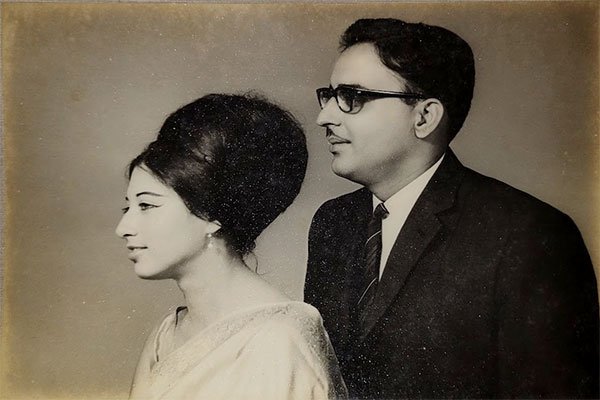
Image and text contributed by Lata Bhasin, New Delhi

I met my husband Anil Bhasin, a business man, on a Blind date in 1966. We got married three years later.

We lived in Calcutta a while, had two daughters and then moved to Delhi in 1985. ‘Bouffants’ hair dos were in great style then, and all of us friends would keep up with trends. Most of our friends moved to other countries, after their respective marriages.