107 – She emerged from a rural home and became a lady endowed with knowledge & charm

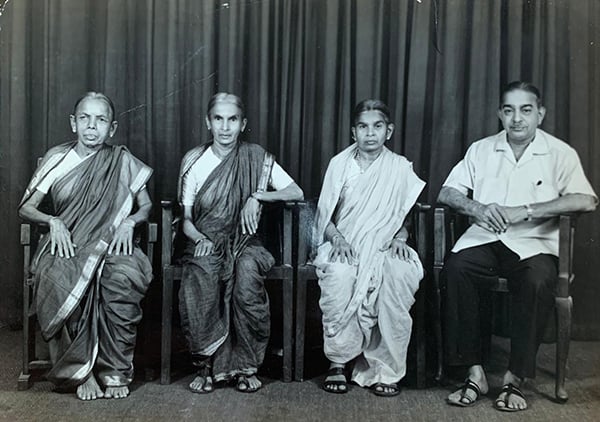
My Parents, K. M. Devaki Amma & Lt. Cdr. P.P.K. Menon. Bombay. Maharashtra. 1941
Image & Text contributed by Radha Nair, Pune
This photograph of my parents K. M. Devaki Amma & Lt. Cdr. P.P.K. Menon was taken at a Photo Studio in Bombay in 1941, soon after they were married. My father was based in the city serving the Naval Force.
My mother, K. M. Devaki Amma belonged to Feroke, a part of Kozhikode in Kerala. Her initials K. M. stood for Kalpalli Mundangad and her family originally belonged to the Anakara Vadkath lineage. The large joint family of more than 25-30 people lived in a house called Puthiyaveedu which still exists in Feroke, however the members are now settled in far flung places and my grand aunts and uncles are no more.
My mother had to give up school very early in life. She came from a large family of 14 brothers and sisters and belonged to an era where a girl’s formal education wasn’t a priority. While they grew up under the tutelage of grand uncles and aunts, they learned to cook, clean, and learnt to make do with and share whatever little they had with their siblings without ever complaining. Congee (Rice Gruel) was what they mostly had for lunch and dinner, supplemented with a little coconut chutney, and may be a side dish of some green banana, but only if they were bestowed with a ripe bunch of plantains available from the kitchen garden.
My mother and her sisters’ daily life entailed preparing food for all members of their very large family. By the light of a wick lamp, sweating by the blaze of crackling coconut fronds they would wash dishes with ash from the kitchen hearth and rinse them with water drawn from the well. My mother in personality was very self-reliant and was happy with whatever little she had.
Arranged by my paternal grandmother, when Amma married my father, a man with an aristocratic lineage and a Naval officer, my father’s cousins would scoff at her and condescendingly regard her as a ‘village girl’. They had been educated in Queen Mary’s Women’s college, Madras (now Chennai) whereas my mother had studied only up to Class IV in a local village school in Karrinkallai.
Undeterred, my father, who knew his wife was a bright and intelligent woman took her under his wing and brought out the best in her. He taught her English and bought her abridged versions of books written by Charles Dickens, Walter Scott and many other great authors. He read out passages to her and patiently explained to her what they each meant.
Thus Devaki, my mother, slowly emerged from her rural background, and became a lady endowed with great poise and charm. Not only did she steal my father’s heart, but even of those who befriended her. She became a much sought after friend by wives of both British and Indian naval officers. She taught them to cook Malayali dishes and stitch & embroider; skills, which were executed by her exquisitely. She wrote and spoke English with such assurance that she could put a present day Post Graduate in English to shame. But despite all these changes, she remained loyal to her roots, proud of her humble origins, and very attached to her siblings.
Sometimes, deep into the night I would catch whispers of my parents’ conversation as they sat and planned the monthly budget, and spoke about their dreams of providing us with the best of every thing. It was my mother who insisted that my sister and I be given the best education they could afford. She firmly refused a State Board SSC education, and insisted on us being admitted into schools which followed a Senior Cambridge syllabus. She was efficient and fiercely independent. By comparison I was a pale shadow. In fact, many times I used to feel very unsure of my self in her presence, intimidated by her indomitable spirit and the complete control she had over any situation.
When my father was suffering Cancer, she stood by him; nourishing him with love and healthy food, while my sister and I watched our father’s condition worsen by the day, helpless and often giving in to tears. My mother always remained calm, but only when he breathed his last in 1977 did she break down completely. He was her life force, and she was his guiding light. Theirs was an extraordinary relationship, always supportive of each other at all times and completely committed to each other till the end.
After I graduated, it was her dream that I put my education to good use. However, a few years after marriage when I was forced to give up my teaching post, she never forgave me till she breathed her last. To make up for it, I began to write and put together a collection of short stories, but the book never got published.
What pained me most was that I was not able to place a copy of my book in my mother’s hands and make my peace with her before she passed away in 2008.
105 – “A friend from my childhood I had never met”

My Letter to Jean Christophes. Bombay. August 10, 1972.
Letter & Text contributed by Denzil Smith, Bombay
This letter carries with it an amazing story that always has me grin ear to ear with joy.
My family are Anglo Indians and until a few years ago lived in a family bungalow in Ville Parle in Bombay. My father Benjamin John Smith was a Customs officer in Bombay and perhaps one of the few honest black sheep amongst the white embroiled in dishonest deeds. To get relief from tough days at the office, my father would find release with music. He was adept at both reading and writing music, played several instruments and when opportunity called he even travelled with the famed Paranjoti Choir all over the world.
At one such opportunity he travelled to Tours in France with the choir in 1966. The members of the choir were usually put up by local classical music aficionados at their homes in each city; and a certain Dr. Boulard and his family were to be my father’s kind hosts in Tours.
The day my father reached the Doctor’s mansion, eagerly awaiting him at the gate was the Doctor’s son, a 6 year old French boy, Jean, who had waited for my father in anticipation of seeing an Indian for three whole days.
At first sight and to his shock the boy ran inside and wept copiously to his father, complaining “Where are his feathers!?” Clearly my brown father in a suit and tie was not the “Indian” he was expecting.
Despite the initial disappointment, my father and Jean became very fond of each other and when he returned to India, dad told me that Jean reminded him of me, that I would really get along with him, and Jean would write to me and I should reply. Jean and I soon embarked on establishing a pen-pal relationship writing letters to each other. I was curious about France and he about India and our lives. He would write me in French and I in English. Finding a french translator in Bombay at the time not an easy task but I had one at home, my father. Later Jean began writing in English which he was learning while studying to become a Doctor.
Over the years we wrote several letters to each other. In some letters I would find that Jean had packed in half used pencils and I always wondered why he would send me those as presents. As time passed, somewhere through those years our letters became infrequent and we lost touch.
Many years later in early 2011, I was travelling with a theatrical production all over Europe and also to Tours. I remembered Jean and pestered my manager to trace his whereabouts. All I knew about him was that he had become a Doctor and his parent’s address that was well etched in my memory.
Before our performance in Tours, my manager took me aside to say he had a surprise. Back stage was not Jean as you would expect but his mother, Mrs. Boulard who spoke with me in French via a translator. I could tell she was cautious about me and wasn’t about to start believing my stories about some letters and my friendship with Jean until I mentioned a family fact that very few people knew about. Astounded, she suddenly broke into English, albeit still a little cautious. She wouldn’t reveal her son’s whereabouts; instead she insisted that I leave my number with her, for her son to return the call.
With no news from Jean, and ready to leave to perform the play in Le Mans, a city 200 Kms away from Paris, I finally received a phone call and was completely overjoyed to hear a voice that said it was Jean. For two whole hours we chatted away excitedly, catching up on our lives and he was going to drive down to Aulnay-Sous-Bois, a suburb of Paris where I was performing two days later, with his girlfriend to meet with me.
It was one the most emotional and joyful moments of my life, to meet a close friend from my childhood I had never met, in our conversations we also discussed our letters and I asked him the question I had wanted to for years. “Why the half used pencils?” His answer was that he was told that India was a very poor country and he sent me the pencils because he assumed I couldn’t afford them! We laughed a lot and recollected much of our childhood and news of our families. It was simply a great great day.
A few months ago, Jean sent me this letter that I had written to him when my father passed away. It immediately reminded me of the time that was indeed very vulnerable, and the person I knew whom I could express it with was Jean.
The personalised letter-head this letter and many others were written on, was an earned luxury. It was a marketing promotion of a very popular chewing gum brand called A1, whose exchange offer was – personalised stationary for filling up an album with their wrappers that had images of country flags, cars, ships and aircrafts. It was a huge rage at the time for children my age in Bombay.
It is incredible how life is dotted with amazing presents, be it with a great father, incredible music, theatre, half used pencils, personalised letter-heads, chewing gums, and most magnificently an unexpected reunion of a grand friendship with Dr. Jean Christophes Boulard; with whom I am in touch yet again, on email.
90 – She swung by the Taj Mahal after returning an abducted girl to her family
Image and text contributed by Vaibhav Bhosle, Mumbai
At the time this photograph was taken, my mother was in her third year of her employment with the State Police of Maharashtra and was on an official trip to Agra. The purpose of this journey was to return an abducted girl, a native of Uttar Pradesh who was found and rescued by the police in Bombay (Mumbai).
After the girl was returned safely to her parents, my mother Meenakshi and a female colleague accompanied by a male senior staff had a few hours to spare before their train’s departure to Bombay. My mother wanted to visit the Agra Fort but her colleague wanted to see the Taj Mahal. Eventually she agreed to visit the Taj Mahal, where this picture was taken by a local photographer.
My mother is the second eldest amongst five siblings, and was born to Yashwant & Shalini Surve in Chiplun, a sleepy village at the time in Ratnagiri, Maharashtra.
When my grandfather Yashwant, a farmer, suffered huge losses in his grocery business, he had no choice but to relocate to Bombay in search for a better job. My grandmother along with all the children moved to her maternal home and took up odd farm jobs to add to the sustenance. After many years of struggling, my grandfather eventually did find a job in Dalda company and could afford a princely sum of Rs 500 to buy an apartment in the suburbs of Bombay, only then he had his family to move to Bombay.
New to a big city, and with five children, my grandparents’ means were limited, so the family set up a Milk delivery service, in which all their children pitched in. My mother too enrolled herself in a Tailoring Institute in hope of finding a job ; and she also applied for Government employment. A few days later, she received a call from the employment agency informing her on an unconsidered avenue, recruitment for the Police Force.
My grandfather accompanied her to the recruitment center. But skeptical of the type of candidates he saw there, he was discouraged and asked her not to give the exam, yet my mother went ahead and also got selected for the Force. At the training camp, she was the only one with her own blanket.
An employment with the State Government was an achievement for the entire family. The nature of the job and the independence it brought with it shaped my mother’s personality. She was the first in the family to travel out of state or to even own a pair of Sunglasses.
While growing up, we would be fascinated by all the stories that she would tell us about her work. On the rare occasions that we were taken to the Police station, seated on the bench for 2 hours my sister and I would gather enough visuals and sounds to boast to our friends, including the Dal and Pao (Lentils & Bread) that was served to the inmates because it looked most delicious. For every mischief that my sister and I got into, my mother had a story equivalent to where mischief makers were eventually put in jail.
No doubt, it was a tough job for my mother. It comprised of long hours, which got longer on festivals. The night shifts sometimes begun by a knock on the door at 3 am in the morning, or the out of town trips which were conveyed hours before they begun.
This is a special photograph to me because it is the most glamorous image of my mom that I can recollect and it is as special to her as well because she thinks the same.
80 – With props and accessories, she indulged her fantasies at a photo studio

My mother, Mohini Goklani. Pune, Maharashtra. Circa 1950
Image and Text contributed by Sunita Kripalani, Goa
In 1947, after partition, when my grandfather Nanikram Goklani and his wife Khemi migrated to India, along with their extended family from Karachi, Pakistan, they settled in Pune, Maharashtra with their 9 children. My mother Mohini, second of seven sisters, was just 16 at that time. Grandpa got a job in the Income Tax department and although times were tough, my grandfather made sure all the children received excellent education.
My mother and her older sister Sheela went to Nowrosjee Wadia College and my grandfather managed to procure admission for some of the younger children in reputed schools such as Sardar Dastur Hoshang Boys’ High School, and St. Helena’s School for Girls. The children studied well, they were voracious readers, and led a simple life.
During the 1950s, the sisters were well versed in household skills, especially the art of stitching and embroidery. They fashioned their own clothes, copying designs from magazines and the displays in the shop windows of Main Street. At home however, they maintained decorum and modesty, but ever so often, Duru, my mother’s younger sister, would coax her to go with her to a photo studio on Main Street called The Art Gallery to get their photographs taken. Duru would pack all kinds of stuff for both of them: ties and beads, scarves and skirts, hats and belts, not to forget some make-up, and the two of them would mount their bicycles and head for the studio where they indulged their fantasies, using studio props and their own accessories.
In the picture my mother is wearing “Awara pants”, a style made famous after the well known actor, Raj Kapoor’s movie by the same name. She is also very nonchalantly holding a cigarette, albeit unlit, between her fingers! The photograph is totally incongruous with her personality, for copying Nargis, the star actress of the time, was more my mom’s style whereas my aunt Duru was bolder and more tomboyish.
I don’t know if my grandfather knew what was going on, or if he approved, but he was not the kind of father who would scold any of his children. If he didn’t like something, he simply wrote a few words on a piece of paper and slipped the little note under that child’s pillow, which was enough to bring the rebellious offspring back on track… but that’s another story.
After college, my mother got a job at the Department of Cooperation, Government of Maharashtra. It was her first and last job. She retired in 1985 as Assistant Registrar of Cooperative Societies, Bombay.
74 – A Partition story from Pakistan

My Father, Syed Ali Mehdi Naqvi, Hyderabad, Andhra Pradesh. 1949
Image and Text contributed by Waqar Ul Mulk Naqvi, Punjab Province, Pakistan
This is the only image of my Late father Syed Ali Mehdi Naqvi I possess. He was born in 1930 in a small district called Beed then in Hyderabad, Andhra Pradesh, India. In 1960, when new states were created on the basis of linguistics, the Marathi dominant town of Beed became a part of Maharashtra.
My father graduated from Usmania University, Hyderabad (now Osmania) in Masters of Persian when he was only 18, in 1949.
My grandfather Hassan Naqvi was a lawyer with the High Court of the Nizam of Hyderabad at the time and also owned a lot of agricultural land in Pimpalwadi (District Beed, Now in Maharashtra). Agriculture was a big part of the family income.
When Partition of India and Pakistan was announced, my grandfather was still very optimistic that Hyderabad will be declared an independent state. The Nizam of Hyderabad was very adamant about that. But the Indian Government did not comply and the Nizam had to surrender in 1948.
With a lot of sorrow, and seeing no other option in a very precarious India, my grandparents along with their children were finally forced to join thousands of others and leave India in 1955. All of our assets, a house at Muhalla Qila as well as the cultivated agricultural land were left behind, abandoned.
They migrated to Karachi via Bombay on a ship. With our roots, and legacies all left behind, my family had to go through a lot of hurt, disillusionment and suffering. Consequences of which can be felt till today. In my family’s words “we were simply plucked and sent into a dark and dangerous journey to Pakistan with no home, no job or even land to call our own.” Many people along with them, never made it to the shores of Pakistan and many were killed right after they landed.
I feel great sorrow when I think about that. Now I work in a financial institution as a manager in a Punjab province of Pakistan with my mother and two siblings. In all these years, I have never stopped thinking about what could have been.
67 – The first Hindu girl student of St. Xaviers, who went on to become an Honorary Magistrate

My mother, Kamini Agaskar, grandmother Kamala Vijaykar, me, Mrudula Joshi and in my lap my daughter, Anupamaa Joshi, Bombay, Maharashtra. Circa 1970
Image and Text contributed by Mrudula Prabhuram Joshi, Mumbai
Kamala Vijayakar, my grandmother (sitting, center) was born in 1890 in a well-to-do Pathare Prabhu family in Bombay. Pathare Prabhus are the original residents of the Bombay Islands along with the Agaris, the Bhandaris and the Kolis since 700 years. They are known to be a small, close-knit, and a 100 % literate community. Kamala was a bright student of the Alexandra Girls’ School. She passed her Matriculation exam in 1910 and joined St. Xavier’s College for higher education the same year. She was ”the first Hindu girl student” of this esteemed college. She excelled in higher studies and was preparing for the First Year Arts examination when she got engaged to Mr. Narayan Vijaykar, who was an artist but non-matriculate. According to the prevalent norms, the wife could never be more educated than the husband, so she had to give up college education, start family life, raising children and fulfilling the duties of a good housewife.
Settled in Malad, a distant suburb in Bombay, she began taking a keen interest in the Local District Board activities and the emancipation of women around her. She was a fluent and forceful speaker in English, and was appointed as the Honorary Magistrate at Malad. A lady Magistrate was a major novelty in those days and people would throng the courts when she delivered her judgments. When she left her home to go to the courts, people would stand on both sides of the road just ”to see ” how a lady magistrate looked. She had long innings at the Malad District Court. Kamalabai Vijaykar was appointed ”Justice of Peace ” (Honorary Magistrate) by the government, and she later became popular as ”J. P. Kamalabai ” all over Bombay. She was also a staunch Congress-woman.
All her life, she held Education dear to her heart. Her own children, 7 in all, fulfilled her own dream of becoming Graduates and Double-graduates. She lived long enough to see even her grandchildren become double graduates. She breathed her last on 8th August, 1972, at the ripe old age of 82, content in the knowledge that she had done her bit to empower at least some women around her by providing for their education.
64 – A movie-isque Love Story

My maternal grandparents, Rukaya and Sultan Dossal at the Taj Mahal. Agra, Uttar Pradesh. 1971
Image and text contributed by Alisha Sadikot, Mumbai
(http://theinheritageproject.wordpress.com/)
This picture of my grandparents was taken on a trip to Delhi, Jaipur and Agra. A route known to tourists as the The Golden Triangle. My grandparents, Rukaya and Sultan Dossal were married in 1949 in the city of Bombay. They had met a few years earlier, when my grandmother Rukaya compelled him to buy a theatre ticket she had volunteered to sell, unaware that this expense of Rs. 10 was one he could then ill afford. The story of their early courtship is one of my favourites. Here it is, recorded in her own words in a memoir she wrote for her grandchildren, 60 odd years later:
‘Needless to say that I was quite struck by Sultan and I remember coming home and telling Saleha (sister) that I had met a very handsome man, but most probably he must be married. I was greatly relieved sometime later when I learnt that he wasn’t. I suppose, Sultan must have been duly impressed as well because he made every attempt to see me. As he told me later, he would leave his office at Flora Fountain at a particular time to catch me walking down from Elphinstone College towards Churchgate Station and to me it seemed that it was just a happy chance. We would then have coffee at Coffee House.
I avoided going to movies with him but one day when we met by chance in a bus and he was getting down at the next stop, I told him I’d like to go to the movies with him and we decided on meeting at Metro the next day to see “Arsenic and Old Lace”. On coming home I was stunned to be told be told by Baba (father) that we would be going to Kihim the next day. I tried to make all excuses to be left behind but Baba would not hear of it, so I could not keep my appointment with Sultan and there was no way of my letting him know. Naturally, he must have thought the worst of me, and naturally I was miserable on this first trip to Kihim. Fortunately, my connection with Sultan as also with Kihim did not end there. In fact, it is in Kihim just now that I am writing this….’
At the very end of her story, when asked to note the most exciting part of her life, she wrote ‘the most exciting thing that happened to me was coming across Sultan’.
62 – English love in the time of War

My Parents Ronald and Beryl Osbourne, at Kohat Pass (NW Frontier Province), Pakistan. April 1946
Image and Text contributed by John Reese-Osbourne, Australia
I first learned of the Indian Memory Project from an article in ‘The Australian’ of May 2011 (a News Ltd daily newspaper). After visiting the website, it occurred to me that others searching the pages might be interested in a brief glimpse of Indian Army life from the viewpoint of a British officer and his family in 1945-46. It may shed a personal light on that brief moment in time just before the watershed of Independence and the bloody shambles the politicians made of partition.
This images is of my parents taken on 23rd April 1946, and it show them at the top of the Kohat Pass, near Tribal Territory. My mother is wearing a revolver!. On the back of some of these photographs, she has captioned them as ‘the gateway to 30 miles of tribal territory’.
My father Ronald Osborne was born in Wales in 1910 and worked as sales manager in London for Geo. Wimpey & Co., then a large builder of houses. He volunteered for the British Army in 1939 just before universal conscription was introduced. He served initially with the Royal Engineers and fought in the abortive Norway campaign before undergoing commando training and going on the far more successful Lofoten Islands raid to destroy an oil refinery held by the German forces. Selected for officer training, he found that the pay in the Indian Army was higher than in the British forces and chose to be commissioned into the Royal Indian Army Service Corps, serving in the North African and Italian campaigns, where he rose to the rank of major, until the Indian Army was repatriated.
My mother Beryl (née Beardsley) was also born in 1910 and grew up in Derbyshire. She moved to London as a young woman where she met and married my father. I was born in 1934. When my father joined the army, we went to live with her parents in Kingston-upon-Thames, where they owned two shops. At some point in 1940 a stray German bomb destroyed the shops and my mother, grandmother and I moved to stay with relations in Derbyshire before settling in a small village called Kirk Hallam. My grandfather stayed in Kingston, continuing to run his shops from two garages.
Understandably impatient after five years of wartime separation, my mother joined the Women’s Indian Voluntary Service (WIVS) as a means of getting out to India. By coincidence, she and my father were on separate ships passing through the Suez Canal at the same time (I think in September 1945). They met briefly when their ships docked in Bombay, before travelling to their respective postings. Initially she worked in the WIVS headquarters in New Delhi, organising the postings of other British volunteers as they arrived. Seeing little point in staying in New Delhi while my father was stationed in Jalandhar, she surreptitiously posted herself there! At some time in 1946, my father’s unit was transferred to Kohat.
In 1945, I was 11 years old, attending a boarding school in Leicester in the UK Midlands and spending school holidays with my maternal grandparents in Kingston-upon-Thames or with my father’s brother’s family in Porthcawl, South Wales. Sadly I no longer have any of the letters from my parents, so the story of their time in Jalandhar and Kohat is based solely on my memory and the scribbled captions on the backs of old, fading black-and-white photographs in the album I began to compile that year.
60 – Winner of the 1970 Miss India crown

My aunt, Veena Sajnani, winner of the Miss India Crown, Bombay, Maharashtra. 1970
Image and Text contributed by Smita Sajnani/Veena Sajnani, Bengaluru
The following text is the story my Bua, (father’s siser) Veena Sajnani narrated to me while flipping through her photo albums.
“I was a fashion model in the year 1970 and toured with the Femina group all over India doing fashion shows for textile firms and others. Our salary was Rs. 150/- per show and after 20 shows we would go home with a princely sum of Rs. 3000/-. We were only 10 models and we knew each other well, we travelled together and had a lot of fun.
One such day that year, when rehearsals for fashion shows had begun, I was told I was no longer required for the show. Very upset and being a newbie with all the hotshot models of Bombay, I presumed it was because I had made a mistake and therefore had been kicked out.
But no. Apparently the call for Miss India 1970 had been announced and I was selected to participate in the Beauty Pageant. Funny part was, I hadn’t even applied for it! I then found out that Meher Mistry and Persis Khambatta (the original Super Models of India) who were close friends, had filled in the Miss India application form for me because they felt I had a chance to win.
Once I accepted the fact that I was in the pageant, I ran home and told my sister to come shopping with me. On a limited budget, we bought a sari, an Emerald green chiffon with gold work and it looked lovely under the stage lights. Bombay, being the cinema city, had tailors stitching sari blouses within hours so while my sister and I shopped around, my blouse was ready.
Before the day of the pageant, we were asked to come to the Times of India office terrace (parent company of Femina) with a swim-suit and be photographed in it, because in those days, judges looked at pictures instead of the actual girls in swim-suits; and we were saved the embarrassment of coming out on stage in swim-suits. Instead, during the interval, the judges came backstage to check us out and since it was dark they had flashlights and our photos in their hands! Yes, it was very funny indeed. We all giggled through the ordeal but in retrospect it was better than walking out half naked under full lights- a very scary prospect to say the least.
Persis and Meher on the other hand, were walking for the fashion show on the contest day and were most enthusiastic about my winning. So much so that Persis decided to do some sleuthing to find out how I was faring with the judges. She was perceptive and sharp, so each time she went out on the ramp she would peek into the judges’ notes! She must have had X-Ray vision because she said she could see the ratings and it was number 6, my number! We all pooh-poohed but sure enough when the winner was announced it was indeed number 6! Me. Veena Sajnani.
Needless to say my two partners in crime were thrilled to bits. After all I had beaten Zeenat Aman (who later became a very famous movie star), whom I think they did not like very much. Whatever the case maybe, I was happy for them and for myself for joining the elite band of Miss Indias. And I will always remember them fondly for this adventure.”
After her stay at Miami for the Miss Universe pageant, my Bua continued with her modelling, then worked at Madura Coats, post which she found her true love – Theatre.
59 – He played the same role as Tagore

My father Prof. RR Kripalani (far right) in Tagore's play "Dak Ghar" (Post Office) staged by the teaching staff of DJ Sind College, Karachi. 1937
Image and text contributed by Mrs. Shamlu Kripalani Dudeja, Kolkata (www.calcuttafoundation.com)
I am a Sindhi and I was born in Karachi in 1938.
This is an image of my father on 20 Jan, 1937, in DJ Sind College, Karachi. The photograph is courtesy the College (which now stands in Pakistan) where my father was a Professor of Mathematics till 1945. It shows a scene from Rabindra Nath Tagore‘s play “Dak Ghar” (Post Office) which was staged by the teaching staff of the College in Karachi in 1937 during their 20 year celebrations. Here my father is in the role of Gaffar. I presume the play was translated in English, because the cast was all non-Bengali, in fact, most of them are Sindhis. In 1930s, Tagore had himself acted in ‘Dak Ghar‘ as Gaffar, the same role that my father played.
My father and his wife, Sushila moved from Karachi to Delhi via Bombay, in September 1947 during partition, with me, my younger sister Indu and youngest brother Gul. We lived there for 10 years. My father got a job in the Ministry of Commerce & Industry due to his mastery in Statistics as in those days Statistics was not a very commonly studied subject. I studied Math, got married, taught Math, and by a string of happenstances got involved in the Kantha revival, 25 years ago. In 2009/2010 I began depicting scenes from Tagore’s pictures through the medium of Kantha, where I sat with my women aritsans and artists from the villages of Bengal. I am now 73 and have lived in Kolkata since 1962.
55 – Six generations of a British Family in India, one of whom was a Photographer for Times of India.

(Left) My Great Great Grandparents Edwin Ebenezer Scott (1850-1931) & Emily Good Andre (1862-1946), Bangalore, 1915. (Right) My Great grandparents, Algernon Edwin Scott & Desiree Leferve with my Grandfather, Bert Scott as a two or three year old boy. Cannanore, Karnataka. 1919
Image and Text contributed by Jason Scott Tilley, Birmingham UK
These are two photographs from My Grandfather Bert Scott’s family photographic archive. The photograph on the left, of my Great Great Grandparents Edwin and Emily Scott was taken on Christmas day in 1925 at 3, Campbell road, Richmond Town, Bangalore, our family’s house which was one of the old British Bungalows and has sadly like many of the rest, been demolished. On the old ground now stands St Philomenas hospital, right in the very heart of Bangalore.
On the right, are my great grandparents Algernon Edwin Scott and Desiree Leferve with my Grandfather, Bert Scott as a two or three year old boy, the image was taken in 1919 in Cannanore, Karnataka. (now Kannur and in the state of Kerala)
My family came to India in 1798 when James Scott Savory joined the East India Company as a writer of the Records of state. He was the second assistant under the Collector of Krisnagearry (Krishnagiri). Edwin Ebenezer (left image) is his great great grandson. From the church death records at St. Marks Cathedral in Bangalore it states that Edwin Ebenezer was the Assistant commisioner of Salt in South India.
Bert Scott, (little boy on the right) was my Grandfather, and he was born in Bangalore in 1915. He went to Bishop Cottons school before he joined the Times of India in 1936 as a press photographer.
Son of Algernon Edwin Scott and Desiree Marie Louise Josephene Leferve, (she was the daughter of a French professor of English from Pondicherry). Algernon Scott (Bert’s father) worked for the ‘Salt and Abkeri’ before he joined the army and went to Mesopatamia region from 1916-1919. After Algernon Scott left Mesopotamia he then went to the North West Frontier province until 1921 when he was discharged as Lieutenant. In 1925 he joined Burmah Oil company until 1933 he worked at Caltex until the out break of War.
My Grandfather Bert Scott, whom I fondly call ‘Grandpa’, was mainly brought up by his Grandparents, this must have been because his parents were away much of the time. He was educated at the famous ‘Eaton of the East’, Bishop Cottons school in Bangalore and then at St. Joseph’s college in Cannanore on the way up to Ooty in the Nilgiri’s. In 1936 he took a job as a press photographer at the Times of India Newspaper in Bombay where he worked until the out break of World War II. He initially joined up as a ‘Gunner’ but soon took the Job as Head photographer for the Indian Army during the second world war where he worked out of GHQ New Delhi (Now Parliament), His duties include photographing ceremonies and Japanese positions behind enemy lines in Burma.
My grandfather married his Bride, Doll Miles at the church of redemption in New Delhi and 1943 and my Mother Anne Scott was born later that year in Amritsar, Punjab, whilst he was away on active duty during the war. He was in position on 14th August 1947 to photograph the hand over of Power and watched as the Mountbattens left Vicregal lodge (now Rashtrapati Bhavan). During the troubles of partition, because my family were Anglo Indian, they fled from Delhi to Bombay, and then took a ship to the new country of Pakistan where in November of that same year they left for a new life in the United Kingdom.
For more images via Jason please click here
49 – The man who sold Polka Dots to the World

The Goregaon Gram Panchayat Ration Staff, on the occasion of Gudi Padwa. Bombay, Maharashtra. 1949
Image and text contributed by Umang Shah, Mumbai
This photograph was taken on the occasion of Gudi Padwa. Sitting left most is my Great Grandfather, Mr. Tulsidas K. Shah. He was born in Mangrol, Saurashtra, near Junagad district, Gujarat. He was brought up by his aunt when his parents passed away. As a teenager, he went to Bombay and started working as a peon in a cloth shop at Mangaldas market, near Princess street. He lived right above the shop. My Great grandfather was sharp & ambitious and he soon became a co-partner of the same shop. Their business was printing ‘Polka Dots‘ on cotton clothes. A style very much in demand world wide at the time. With increasing demands for textile exports during the World War II, their business boomed, they prospered and were hailed as the no. 1 in their business. We are told that his wife and children bought and wore new clothes everyday!
My grandfather tells me that his father were born with a ‘golden spoon’. However, after 2 years the downfall began. Now that the World War II had ended, they suffered huge losses in the business (It had earlier given a huge boost to the sagging textile industry of Gujarat and Maharashtra). His partners fled. But my great grandfather being an honest man, stayed on and paid all the debt by himself. But it wasn’t without problems; the strain had affected him mentally and he went back to Mangrol for some years.
In 1945, he returned to Bombay with his family and started working in the Ration shop of the Goregaon Gram Panchyat. At the time, Goregaon was not a part of Bombay, as it is now. His job was to put stamps on the Ration Cards. He was a very hardworking and principled man his whole life, adds my grandfather.
47 – The extended Indian family at the airport.

My grandfather, T.S Sreekantiya and grandmother, S. Kamlamma with family and staff at the Arrival lounge at the Airport, Bombay, Maharashtra. 1978
Image and text contributed by Prasad Ramamurthy, Mumbai
Both my grandparents’ families were Tamil Palghat Brahmins and migrated from Kerala over generations through Karnataka to finally settle in Bengaluru (Bangalore) . A few years after they got married my grandparents moved from Bengaluru to Bombay in 1932.
In the late 70′s when all you had was a single airline called Air India to fly you out the country to anywhere, you really needed to ‘know’ somebody to help you get Emergency Quota tickets air travel and that was a well and truly a big deal. So when you set off somewhere or returned it meant the entire family, extended family and the house staff turned up to say hello or bid you goodbye. Like, when my grandparents who had gone to Iran to visit an uncle of mine (he worked for the Tata’s and was building power plants for the Iranian government then) returned. We; my parents, the three of us, my uncle, the house staff, my uncle’s office staff and two others I don’t even recognise turned up garlands in hand and with those curious things that every newly married couple was made to hold onto in those days while greeting guests at the marriage reception. I’m sure my uncle was thankful that when he set off a few years later, on what then to us was an epic trip to the US for three whole months, we didn’t do the garland-bouquet routine. But of course there always was a mandatory picture, family, extended family, staff included!
40 – The Wild Parties of JJ School of Art & Architecture

Dance Party. 'Saawan' Architecture festival-C.J. Hall, Colaba, Bombay, Maharashtra. September 25, 1980
Image and text contributed by Charu Walikhanna, New Delhi
This was a hot day with a baking hot floor. I was in 4th yr of Sir JJ School of Applied Art. And the same campus housed disciplines of Fine Arts, Textiles and Interior Designing. This dance party was an event organised by JJ School of Architecture during their annual festival SAAWAN. The dance party in the image was not in our campus but in a hall in Colaba. I wonder if it still exists.
We used to then dance like mad, to songs of Abba and other such english bands. There was no Punjabi rock or rap in those days and there were definitely no intoxicants or alcohol. Nor did anyone have bottles stashed away in their car like today in Delhi. Some people were into soft drugs though no one ever experimented openly and definitely not at college functions. We lived, ate and dreamt Art & Design. Our heroes were Picasso, Salvador Dali and Charles Correa. We were so absorbed in our passion, it was a joke, that whomsoever failed and was yet successful, it was because Charles Correa was a JJ drop out too. In those days, film stars like Parveen Babi flocked to our college to hear J Krishnamurti’s lectures on Philosophy, on campus under the huge banyan tree while the sun was set and the crows cawed.
I was a boarder in Bombay. JJ did not have a girls hostel so we girls stayed at a government hostel called the Women Students Hostel.
The Hostel was started by the Government of Maharashtra in 1952, to accommodate undergraduate girl students of colleges affiliated to the University of Mumbai. The hostel was renamed to Savitridevi Phule Mahila Chhatralaya to honour the memory of – Savitridevi Phule, a pioneer in the education of women. The hostel is situated at the beautiful location of Marine Drive facing the Arabian Sea. I have an aunt who stayed in the same hostel in the 50s and said they were served by waiters in turbans, though we only had barefeet locals in striped underpants and the dining hall was the only place guys were allowed and only as waiters.
39 – For Bachelors only

My grandfather Michael Fernando speaking at the Idinthakarai Villagers Association meet. Bombay, Maharashtra. 1971
Image and text contribution Sebastin Kolman
Mr. Michael Fernando, my grandfather (on the microphone) managed the Idinthakarai Villagers Association in Mumbai. Idinthakarai, my native place, is located near Kanyakumari, Tamil Nadu.
He had helped the village association purchase a two storeyed huge room (similar to a chawl) in Matunga Labour Camp, Mumbai. The room was for anyone from Idinthakarai seeking a job in Mumbai. They could stay in it for free until they found work and then could continue staying on rent. This photograph was taken at the inauguration of that room.
This room still exists and is managed by the said Association. Currently there are about 15 to 20 Idinthakarai bachelors living there.
23 – Felt hats, Chiffons and Pearls

My parents Maya and Lachu Shivdasani (center) with friends, at the Turf Club, Mahalaxmi Race Course, Bombay, Maharashtra.1941
Image and Text Contributed by Usha Bhandarkar
Men and women were always very smartly turned out for the races…”you never repeated a sari!” Men wore full suits and felt hats; women wore Chiffons and Pearls. My mother Maya is appalled at the current dress code at the Races which she finds positively sloppy.
22 – She was the epitome of style and sophistication

My mother (center) Maya Shivdasani, with her parents, Dr Manghanmal Kripalani, an eminent physician and Sarsati Kripalani, Hyderabad Sind, 1939
Image and text contributed by Usha Bhandarkar
My mother Maya Shivdasani is now 90 year old of age. She was born in Hyderabad Sind in 1919 and came to Bombay after her marriage in 1937. After her marriage in 1937 Maya moved to Bombay but would visit her parents in Hyderabad Sind (Now Pakistan) at least twice a year. This photograph was taken on one of her visits to Hyderabad where she was the epitome of style and sophistication: sleeveless sari blouse, short hair, long, painted fingernails.
She has lived in Cuffe Parade all these 73 years, read the Times of India every single day and visits the Cricket Club of India once a week. One of her favourite haunts is the Sea Lounge at the Taj Mahal Hotel. She was truly saddened to see it damaged in the Mumbai attacks of 2008. On the day the Sea Lounge reopened she was there sitting at a window table, sipping their wonderful Viennoise Coffee.
21 – Shanta Bhandarkar as a grown up lady

Shanta Bhandarkar, with her husband Dr. S.S. Bhandarkar, soon after they were married. Bombay, Maharashtra.1935
Image and text contributed by Usha Bhandarkar
Shanta Bhandarkar, my Mother in Law, turned 100 on February 25, 2010. On the occasion of her birthday our family gifted her an album with a collection of these old photographs. See her here as a baby.