107 – She emerged from a rural home and became a lady endowed with knowledge & charm

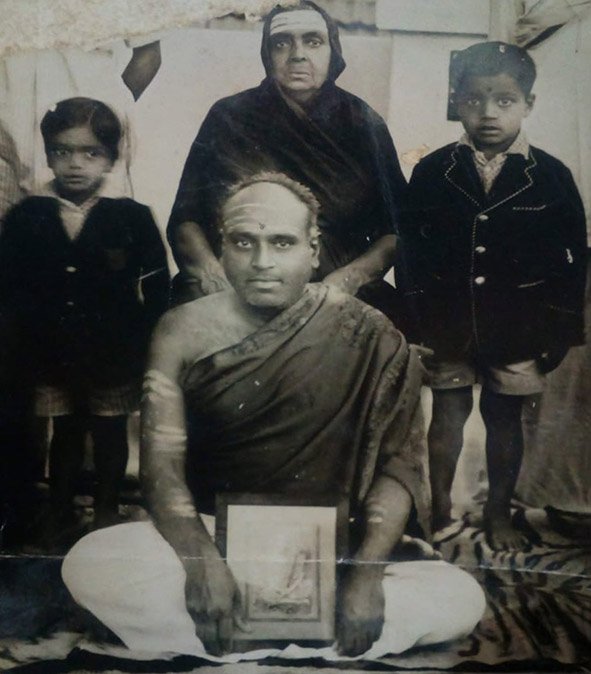
My Parents, K. M. Devaki Amma & Lt. Cdr. P.P.K. Menon. Bombay. Maharashtra. 1941
Image & Text contributed by Radha Nair, Pune
This photograph of my parents K. M. Devaki Amma & Lt. Cdr. P.P.K. Menon was taken at a Photo Studio in Bombay in 1941, soon after they were married. My father was based in the city serving the Naval Force.
My mother, K. M. Devaki Amma belonged to Feroke, a part of Kozhikode in Kerala. Her initials K. M. stood for Kalpalli Mundangad and her family originally belonged to the Anakara Vadkath lineage. The large joint family of more than 25-30 people lived in a house called Puthiyaveedu which still exists in Feroke, however the members are now settled in far flung places and my grand aunts and uncles are no more.
My mother had to give up school very early in life. She came from a large family of 14 brothers and sisters and belonged to an era where a girl’s formal education wasn’t a priority. While they grew up under the tutelage of grand uncles and aunts, they learned to cook, clean, and learnt to make do with and share whatever little they had with their siblings without ever complaining. Congee (Rice Gruel) was what they mostly had for lunch and dinner, supplemented with a little coconut chutney, and may be a side dish of some green banana, but only if they were bestowed with a ripe bunch of plantains available from the kitchen garden.
My mother and her sisters’ daily life entailed preparing food for all members of their very large family. By the light of a wick lamp, sweating by the blaze of crackling coconut fronds they would wash dishes with ash from the kitchen hearth and rinse them with water drawn from the well. My mother in personality was very self-reliant and was happy with whatever little she had.
Arranged by my paternal grandmother, when Amma married my father, a man with an aristocratic lineage and a Naval officer, my father’s cousins would scoff at her and condescendingly regard her as a ‘village girl’. They had been educated in Queen Mary’s Women’s college, Madras (now Chennai) whereas my mother had studied only up to Class IV in a local village school in Karrinkallai.
Undeterred, my father, who knew his wife was a bright and intelligent woman took her under his wing and brought out the best in her. He taught her English and bought her abridged versions of books written by Charles Dickens, Walter Scott and many other great authors. He read out passages to her and patiently explained to her what they each meant.
Thus Devaki, my mother, slowly emerged from her rural background, and became a lady endowed with great poise and charm. Not only did she steal my father’s heart, but even of those who befriended her. She became a much sought after friend by wives of both British and Indian naval officers. She taught them to cook Malayali dishes and stitch & embroider; skills, which were executed by her exquisitely. She wrote and spoke English with such assurance that she could put a present day Post Graduate in English to shame. But despite all these changes, she remained loyal to her roots, proud of her humble origins, and very attached to her siblings.
Sometimes, deep into the night I would catch whispers of my parents’ conversation as they sat and planned the monthly budget, and spoke about their dreams of providing us with the best of every thing. It was my mother who insisted that my sister and I be given the best education they could afford. She firmly refused a State Board SSC education, and insisted on us being admitted into schools which followed a Senior Cambridge syllabus. She was efficient and fiercely independent. By comparison I was a pale shadow. In fact, many times I used to feel very unsure of my self in her presence, intimidated by her indomitable spirit and the complete control she had over any situation.
When my father was suffering Cancer, she stood by him; nourishing him with love and healthy food, while my sister and I watched our father’s condition worsen by the day, helpless and often giving in to tears. My mother always remained calm, but only when he breathed his last in 1977 did she break down completely. He was her life force, and she was his guiding light. Theirs was an extraordinary relationship, always supportive of each other at all times and completely committed to each other till the end.
After I graduated, it was her dream that I put my education to good use. However, a few years after marriage when I was forced to give up my teaching post, she never forgave me till she breathed her last. To make up for it, I began to write and put together a collection of short stories, but the book never got published.
What pained me most was that I was not able to place a copy of my book in my mother’s hands and make my peace with her before she passed away in 2008.
103 – “The only thing that impressed her was a good education”

My grandmother Kanwarani Danesh Kumari, Patiala, Punjab. Circa 1933
Image & Text contributed by Sawant Singh, Mumbai
This is an image of my grandmother Kanwarani Danesh Kumari photographed in Patiala, Punjab around 1933.
She would have been 20 or 21 years old at the time. It was photographed by R.R. Verma, a Photo artist from Cawnpore (Kanpur). Formally, she was addressed as ‘Rajkumari Bibiji Danesh Kumari Sahiba’. This is the only photograph I have of her in my possession, even though my memory of her is vastly different from this.
I remember her as a simply clad, dignified, exceptionally proud woman, who would spend her time gardening, shopping for groceries in the market, or chatting away with the gardener & her domestic staff or entertaining friends from out of town in Dehradun, (now in Uttarakhand); many of whom were people who belonged to royalty or influential circles. Her home “Sawant Villa”, named after my great grand father, was an open house with people constantly streaming in and out.
My grandmother was fondly called ‘Brownie’ by her family and friends. She was the wife of late Maharaja Kumar Aman Singh of Bijawar (now in Madhya Pradesh) and the daughter of Maharaja Bhupinder Singh of Patiala (Punjab) who was known as ‘the proud owner of the world famous “Patiala Necklace” ‘ manufactured by Cartier.
Brownie or as I called her, ‘Dadu‘, was brought up in the lap of great luxury but she understood and adapted to the simple life very well. A beautiful, strong, non-judgmental woman, she wouldn’t suffer fools and was known to never mince her words. The only thing that impressed her was a good education and believed that it was the only way one could change their lives for the better. She thus ensured that all her children and grandchildren would appreciate the value of literacy and education.
Dadu was a very social woman and loved going into the city to meet her friends. Everyone knew her in Dehradun. I remember her dragging me to meet her dear friend, Mrs. Vijaylaxmi Pandit and they would spend hours chatting away while she would keep tucking my hair away from my forehead and eyes. She was as comfortable in a Rolls Royce as she was in a local bus in Dehradun. The latter was how she travelled to visit me when I was studying at the Doon School. She insisted on teaching us how to walk barefoot on Bajri (pebbled) pathways and chew on a Datun (Neem twig commonly used to clean teeth), in retrospect I think it was to prepare us for the real world.
I also remember, a few of her interesting obsessions were collecting imported soaps and canvas shopping bags. Anyone who ever travelled abroad had to bring back bars of soaps, the canvas bags and chocolates. I remember one soap in particular in her bathroom was shaped like a fish. It seems that her quirky fascination with soaps may have passed on to me.
After an accidental fall in the early 90s, her health began to fail and she passed away in her sleep, peacefully in 2005.
This photograph of my grandmother is framed and hung in my dining room. While I never saw her dressed like this, the dignity and pride I see in it is alive and inspiring.
75 – In love till their last day, they passed away within three months of each other

My maternal grandparents, Kali Pada & Sukriti Chakrabertti with their daughters, son and several nephews & nieces. Calcutta, West Bengal. 1970
Image and Text contributed by Anupam Mukerji
This picture was photographed on March 9, 1970 on the occasion of my maternal grandparents Kali Pada and Sukriti Chakrabertti’s 25th marriage anniversary (seated middle), at their home, 63, PG Hossain Shah Road, Jadavpur, Calcutta (now Kolkata). Here, they are with their daughters Sarbari, Bansari and Kajori, their son Sovan, and several nephews and nieces.
After graduating from school with a gold medal in East Bengal‘s Dhaka Bickrampore Bhagyakul district, the young teenager, Kali Pada Chakraberti moved to Calcutta. He began working while continuing his education in an evening college. The office he worked at was also his shelter for the night. Desperate for money to pay his college examination fees, he went to a pawn-shop in Calcutta’s Bow Bazaar to sell his gold medal.
The pawn broker at the shop however was a gentle and generous elderly man. He lent my grandfather the money without mortgaging the gold medal. Years later when my grandfather went back to the shop to return the money, he found that his benefactor had passed away and his son refused to accept the money stating he couldn’t, because his father had left no records of that loan. My grandfather then established a Trust with that money to help underprivileged students with their education.
Bhai, as all his grandchildren fondly called him, graduated from college with distinction and built a successful career in the field of Insurance. He rose to a senior position in a public sector insurance company. He also bought a plot of land in Jadavpur and built the house of his dreams where this photograph was taken. Post partition of Bengal, many of his family members moved to Calcutta and everyone found food on the table and a roof over their heads at his house. Over time, many of them moved out and made their own homes, but 63 PGHS remained the place where everyone congregated for festivals and special occasions.
Sukriti Chakrabertti, my grandmother, was fondly known as Hashu Di. She was raised in Shanti Niketan and learnt Arts & Dance under the guidance of Gurudev Rabindra Nath Tagore and Nandlal Bose. She was part of the first batch of students of Shanti Niketan’s Kala Bhavan and went on to make a name for herself in various classical dance forms.
In love with each other till their last day, they passed away in 2000 and 2001, within three months of each other.
74 – A Partition story from Pakistan

My Father, Syed Ali Mehdi Naqvi, Hyderabad, Andhra Pradesh. 1949
Image and Text contributed by Waqar Ul Mulk Naqvi, Punjab Province, Pakistan
This is the only image of my Late father Syed Ali Mehdi Naqvi I possess. He was born in 1930 in a small district called Beed then in Hyderabad, Andhra Pradesh, India. In 1960, when new states were created on the basis of linguistics, the Marathi dominant town of Beed became a part of Maharashtra.
My father graduated from Usmania University, Hyderabad (now Osmania) in Masters of Persian when he was only 18, in 1949.
My grandfather Hassan Naqvi was a lawyer with the High Court of the Nizam of Hyderabad at the time and also owned a lot of agricultural land in Pimpalwadi (District Beed, Now in Maharashtra). Agriculture was a big part of the family income.
When Partition of India and Pakistan was announced, my grandfather was still very optimistic that Hyderabad will be declared an independent state. The Nizam of Hyderabad was very adamant about that. But the Indian Government did not comply and the Nizam had to surrender in 1948.
With a lot of sorrow, and seeing no other option in a very precarious India, my grandparents along with their children were finally forced to join thousands of others and leave India in 1955. All of our assets, a house at Muhalla Qila as well as the cultivated agricultural land were left behind, abandoned.
They migrated to Karachi via Bombay on a ship. With our roots, and legacies all left behind, my family had to go through a lot of hurt, disillusionment and suffering. Consequences of which can be felt till today. In my family’s words “we were simply plucked and sent into a dark and dangerous journey to Pakistan with no home, no job or even land to call our own.” Many people along with them, never made it to the shores of Pakistan and many were killed right after they landed.
I feel great sorrow when I think about that. Now I work in a financial institution as a manager in a Punjab province of Pakistan with my mother and two siblings. In all these years, I have never stopped thinking about what could have been.
71 – He began as a Trainee and went on to acquire the company he began at.

My grandfather, Satya Deo Singh at the Director's Bungalow of Octavius Steel Company Ltd. Dhanbad, (then Bihar) 1960
Image and text contributed by Raj Rajendra Singh
My grandfather Mr. Satya Deo Singh graduated in B.Sc and thereafter joined the Engineering College at Jadavpur University, Calcutta. As a student, he actively participated in activities of Student Congress and his ability to organise and rally students attracted the attention of the Bihar president of Student Congress, Late. Shri Ambika Saran Singh, a noted freedom fighter who later served as State Minister of Bihar.
However, his interest in mining attracted him to the coal capital of India – Dhanbad (Previously in Bihar, now Jharkhand) and he joined Octavious Steel Company Limited as a trainee. His managerial skills, cool competence and tact in handling industrial workers found him at the helm of the coal-mining industry and within a few years, his knowledge and efficient handling of the industrial management paid him rich dividends when he become one of the top three coal managers of Eastern India. Here he stands in front of the Director’s bunglow of Octavius Steel Company Limited with his car, a Chrysler Dodge Kingsway (1955). A company where he began working at as a trainee & then commanded as Director.
70 – A very fashionable civil surgeon, he was awarded the “Rao Bahadur” medal by the British

My wife’s great great grandfather, Rao Bahadur Pundit Shambhu Nath Misra, Civil Surgeon. Bulandshahr, United Provinces of Agra & Oudh. Circa 1920.
Image and Text contributed by Paritosh Pathak
This image of my wife’s great great grandfather was photographed in a studio in Bulandshahr, then a part of the United Provinces in India. In those days there were only a few trained doctors in a city, and a civil surgeon was considered to be a ‘top medical practitioner’ as well as the last hope of anyone with an ailment requiring surgery.
Shambhu Nath Misra was awarded “Rao Bahadur” medal by the British government, the top civilian award of the time which was an equivalent of “Order of British Empire -OBE”. He wears that medal proudly around his neck in this picture. The medal has the British crown connecting the loop to the neck string. In the centre is a circular portion with etched words Rao Bahadur that is barely legible because of picture quality.
He graduated with a Degree in Medicine in 1899 from The University of Panjab located in Lahore of undivided India. (In 1956, the university was relocated to Chandigarh, Punjab, India). At the time of his graduation the university awarded an all-in-one degree- Medicine, Surgery and Obstetrics. Today the three are considered separate medical specialties.
A very fashionable man, in this picture, he sports a bowtie, very western for an Indian in 1920s. His ’Head Cap’, was common head gear for a man of stature, though unlike the kings and other royalty, it indicated status as a civilian. Completing his attire is a 3 piece suit, a silk vest, and I think a pocket watch which was specifically worn on the left pocket.
He was a very wealthy man, earning a salary of Rs 14,000 a month. And the ‘civil surgeon’ tag was important enough to get a letter delivered to him with only “Shambhu Nath Misra, Civil Surgeon, Bulandshahar” as the address. He supported many families of needy relatives and had significant real estate assets. He fathered 2 daughters and 3 sons, one of whom was the great grandfather of my wife. Two of his other sons emigrated to the United Kingdom. The family prestige and assets, both were gradually lost and it never regained the glory of his achievements. He suffered from diabetes and other common ailments, and passed away around the age of 70.
69 – The Princes and Princess of Wanaparthi, Andhra Pradesh

LEFT IMAGE - My great grandfather, Raja Janampally Rameshwar Rao II, the Raja of Wanaparthy with sons Krishna Dev Rao (left) and Ram Dev Rao (right) RIGHT IMAGE - Krishna Dev Rao (Left) with sister, Janamma, and brother Ram Dev Roa. Wanaparthi, Andhra Pradesh. Circa 1912
Images and Text contributed by Kamini Reddy, USA
My great grandfather Raja Rameshwar Rao II was the ruler and Raja of Wanaparthy, (seated) Hyderabad state, ruled by the Nizam. In 1866, at the request of the Nizam of Hyderabad, my great grandfather fused his army, the Bison Division Battalion with the Nizam of Hyderabad’s army, the Hyderabadi Battalion. He was appointed the Inspector of the Army. Wanaparthi‘s rulers were closely associated with the Qutub Shahi Dynasty. My great grandfather died on November 22,1922 and was survived by two sons, Krishna Dev Rao and Ram Dev Rao.
Ram Dev Rao (the younger boy in the image) was my grandfather. He was the youngest son of the Raja of Wanaparthy, He had an older sister, Janamma, and elder brother Krishna Dev. My grandfather used to say that he didn’t have much interaction with his father – it was quite a formal relationship – and he only replied to him when spoken to.
Raja Rameshwar Rao II and his family strongly believed in education. When his sons were young, they were sent to Hyderabad to attend St. George’s Grammar School (an English medium school). They stayed with a family (the Welingkars) during the school year and would go back to Wanaparthy for their holidays. His daughter Janamma married when she was very young, to the Raja of Sirnapalli. After my great grandfather passed away, his elder son Krishna Dev was still a minor, so the property was managed by the Court of Wards until he came of age. Krishna Dev though passed away when he was only 20 years old and eventually his son Rameshwar Rao III inherited the title.
After the end of the British reign in India, The Nizam wanted to be independent of the Indian government, but the government was determined to have Hyderabad succumb to acceding, with whatever means. Sure enough, the government of India in 1948 launched a police action against Hyderabad, and forced the Nizam to accede to India and surrender. Subsequent to the Hyderabad State’s merger with the Indian Union in 1948, all units of the Hyderabad State Forces were disbanded and only volunteers of the Battalion were absorbed with the Indian Army. Popularly known as the “Hyderabadis” in the Army, the unit had a unique mixed class composition with no rank structure based on class. Troops celebrated both Hindu and Muslim festivals together.
67 – The first Hindu girl student of St. Xaviers, who went on to become an Honorary Magistrate

My mother, Kamini Agaskar, grandmother Kamala Vijaykar, me, Mrudula Joshi and in my lap my daughter, Anupamaa Joshi, Bombay, Maharashtra. Circa 1970
Image and Text contributed by Mrudula Prabhuram Joshi, Mumbai
Kamala Vijayakar, my grandmother (sitting, center) was born in 1890 in a well-to-do Pathare Prabhu family in Bombay. Pathare Prabhus are the original residents of the Bombay Islands along with the Agaris, the Bhandaris and the Kolis since 700 years. They are known to be a small, close-knit, and a 100 % literate community. Kamala was a bright student of the Alexandra Girls’ School. She passed her Matriculation exam in 1910 and joined St. Xavier’s College for higher education the same year. She was ”the first Hindu girl student” of this esteemed college. She excelled in higher studies and was preparing for the First Year Arts examination when she got engaged to Mr. Narayan Vijaykar, who was an artist but non-matriculate. According to the prevalent norms, the wife could never be more educated than the husband, so she had to give up college education, start family life, raising children and fulfilling the duties of a good housewife.
Settled in Malad, a distant suburb in Bombay, she began taking a keen interest in the Local District Board activities and the emancipation of women around her. She was a fluent and forceful speaker in English, and was appointed as the Honorary Magistrate at Malad. A lady Magistrate was a major novelty in those days and people would throng the courts when she delivered her judgments. When she left her home to go to the courts, people would stand on both sides of the road just ”to see ” how a lady magistrate looked. She had long innings at the Malad District Court. Kamalabai Vijaykar was appointed ”Justice of Peace ” (Honorary Magistrate) by the government, and she later became popular as ”J. P. Kamalabai ” all over Bombay. She was also a staunch Congress-woman.
All her life, she held Education dear to her heart. Her own children, 7 in all, fulfilled her own dream of becoming Graduates and Double-graduates. She lived long enough to see even her grandchildren become double graduates. She breathed her last on 8th August, 1972, at the ripe old age of 82, content in the knowledge that she had done her bit to empower at least some women around her by providing for their education.
65 – They committed to exchanged photographs, and were married four years later

My husband, Imam Hadi Naqvi and I, a few days after our marriage. Patna, Bihar. 1958
Image and text contributed by Nazni Naqvi, Mumbai
My name is Nazni Naqvi. This picture of me and my husband Syed Imam Hadi Naqvi was taken on 11thOctober, 1958, five days after our wedding day. It was taken on the terrace of my parents’ home, Sultan Palace in Patna (now the pink painted State Transport Bhawan) by my brother, Syed Quamarul Hasan. An avid photographer, he took this photo as part of a series with his Roliflex Camera.
I came from a family with part royal lineage of Nawabs – My paternal grandfather had established the Patna University and was knighted by the British for his contribution to education. He was thereafter known as Sir Sultan Ahmed, and my grandmother as Lady Sultan Ahmed, customarily called ‘Lady Saheb’.
Hadi was raised in Amroha, Uttar Pradesh. He was a graduate of Aligarh University and then went to study Economics at LSE, London.
In 1954, a Maulana recommended Hadi to my father as a prospective son-in-law. I was 16 years old then and the only daughter in seven sons. I had other considerations for a husband- some cousins (sanctioned under Islamic law) and some other men with royal lineage. Marrying cousins was out of the question, and marrying into a royal family was not a very appealing idea even though my mother belonged to one. Photographs were exchanged and once I saw Hadi’s picture, I was in love. My father however wasn’t sure because the only thing that concerned him was Hadi had to be taller than me.
My father then travelled to London for health reasons and also met Hadi. They began to meet often and became well acquainted. To his relief Hadi turned out to be an inch taller than me, I was 5ft 3, he was 5ft 4. Everyone was happy, the families met and we were declared Engaged. Through the process of the engagement until our marriage, a 4-year gap, we never met or communicated with each other. Although I did sneak a peek from behind the curtains when he was visiting.
At the time of my engagement, at age 16, I was studying in class 9th I think. This might seem strange now but as a generation many of us didn’t have school for almost 2 years, because most educational institutions were closed due to partition issues. But in those days, loss of time in the arena of education wasn’t a big deal, especially for women. Nonetheless, I did complete my matriculation from a private school.
Three years since the Engagement and the Nikah, Hadi returned from London in 1957. Our marriage was fixed for October 1, 1958. That the dates changed is because of an interesting incident. The train that was supposed to bring the groom and his family to Patna never arrived on the date. It was pouring rain so hard in Amroha that the connection bridge from Amroha to Moradabad broke and they had to stop at Moradabad. At the time there were no mobiles, the few telephones that were around too were dead. So we had no clue where anyone was and it seemed the entire groom’s family had vanished!
Zakir Hussain, who was then Governor of Bihar and a family friend came to Hadi’s aid and with the help of the Telephone Exchange enabled a phone call to Patna two days later, informing us of what had happened. Hadi and his family finally did arrive, though four days later.
61 – Larger the nose ring, the more fashionable it was

My father, T. P Pathak with my grandmother, Hira Pathak. Mirzapur, Uttar Pradesh. 1956
Image and Text contributed by Paritosh Pathak.
In this image my father was 6 years old and my grandmother was 34.
My grandmother was a educated woman who had attended high school and could read and write. A rarity in rural Uttar Pradesh’s heartland. She was assertive, fashionable and a strong woman. Notice the large nose ring (Nath) in fashion at the time. She home schooled my father for a while. My father excelled at academics and joined the UP, State Civil Services. He retired recently after his last posting as Commissioner of Jhansi division in UP. He always credited his success to the education he received at home from my grandmother.
My grandfather & his brother were orphans and raised themselves. He was married late in life to my grandmother and his brother never got married.
My grandparents had two children, the older one pictured above is my father. My grandmother is now 95 and suffers from many age related ailments. She cannot recall the picture occasion, most likely it was a village fair where the picture was developed on old plate based cameras in Mirzapur, UP.
56 – They seem like wings at either ends and they both became pilots

My father's family. The Datta family. Delhi. Circa 1940
Image and Text contributed by Saugato Datta, London
This photograph of my father’s family was taken in the courtyard of my grandfather’s government house on Irwin Road (now Baba Kharak Singh Marg,Delhi).
Seated in the middle are my grandparents, Sailendraprasad Datta (1898-1956) and Bibhabati Datta (1906-1977). My grandfather was a civil servant and moved to New Delhi from Calcutta in the early 1920s. My grandmother was a housewife. She grew up in Muzaffarpur, Bihar.
To the left of my grandfather is their eldest child, my aunt Uma Datta Roy Choudhury (1926-2009). She was a statistician, joining the Indian Statistical Service when it was founded after Independence, which was also the year she got her MA from St. Stephen’s College. She later consulted for UNDP and lived for many years in the then Czechoslovakia (Now Czech Republic and Slovakia) and later in Zimbabwe. To the right of the my grandmother, is my oldest uncle, Kalyan Kumar Datta (1928-1998). He was a pilot for Indian Airlines and lived in Calcutta.
The little boy on the left is my father, Kamal Kumar Datta (born 1938). He studied Physics at Presidency College, Calcutta and Brandeis University in the US, and was a professor of Physics at Delhi University till he retired earlier this decade. The other kid on the right is his brother, Saroj Kumar Datta, (born 1936) who was also a Stephanian. He worked for many years in Air India, and has been with Jet Airways since it was founded. he currently works as Jet’s Executive Director. He’s still working, though he recently turned 75.
The two youngest kids are apparently beaming because they were given books to entice them to sit still for the photographer – or so I’ve heard. The others seem to have taken the whole “look serious for the camera” injunction very literally. People didn’t normally smile for photos back in the day, did they? I guess it was considered a formal affair, having a photographer over and all.
50 – The six triple degree holding sisters of Agra

My mother Shalini (middle, bottom) and her six sisters Kusum, Madhavi, Suman, Aruna & Nalini. Agra, Uttar Pradesh. 1961-1971
Image and Text contribution by Anusha Yadav, Mumbai
This is a collective image of my mother and her sisters, photographed holding their degrees with pride, between 1961-1971, as it was the custom at the time for women to be photographed to prove that they were educated. Some of these images were also then used as matrimonial pictures. All the sisters (Left to right) Kusum, Madhavi, Suman, Aruna, Shalini and Nalini were born between 1935 – 1946 and brought up in Raja Mandi, Agra in Uttar Pradesh. There were also four brothers, the eldest of which is Rajendra Yadav, one of the foremost Hindi writers of the country. My grandfather Mishri Lal, was a very well respected Doctor, with a signature white horse which he rode when out on rounds, and my grandmother, Tara, his second wife hailed from Maharashtra with a royal lineage.
My eldest aunt Kusum (left most), passed away in 1967 under mysterious circumstances, some say it was suicide and some that it was food poisoning, and my youngest aunt Nalini, found courage to elope from home to marry, her neighbor in old Delhi, the love of her life at the time, a Punjabi gentleman. A move which was considered extremely scandalous for an highly respected intellectual but a conservative Yadav family. The rest led quieter lives, doing what was prescribed at the time for ‘good’ Indian women to do.
Quite amazingly all sisters were highly educated, triple degree holders, in Bachelors, Masters and Commercial Diplomas in Science, History, Economics, Dance, Arts, Painting and Teaching and each one was formally trained in Tailoring, Embroidery, Shooting, First Aid, Swimming, Horse-riding, Music, Dance, Crafts and Cooking in Delhi, Kota, Mathura and Agra. It still baffles me that, not one sought pro-actively to form careers of their own, and my aunt Madhavi (middle, top) says it was due to the protective brothers, who didn’t think it was appropriate for single women to work before marriage.
Only Aruna Masi (left bottom) and my mother Shalini did continue to work after their marriages. Aruna, with a Masters in History, moved to Oregon, USA after her marriage and still works (out of choice) as a Chartered Accountant and my mother is now retired, but only worked because she had to, after the death of my father.
All sisters still get along, well, more or less, however as all conservative families go, when ambitions in women lie unfulfilled, it channelizes that frustration in different aspects of their lives for years to come, with consequences that are both good and bad. Marriage did offer them security, but the desire to do something with their lives aside from being great home-makers still causes angst.
Having said that, as kids, my sisters, my cousins and I learnt a lot, from each and every one of these women. They were all feisty, fiercely talented and ensured that we received at least some of their knowledge from the time we could walk. We were encouraged to read, Hindi Literature and English, we were trained in classical and folk music & dances, embroidery, painting and cooking – first at home and then some of us were sent to schools to further that knowledge, even if it were private lessons. I do realise, that cultural knowledge like that is now hard to come by, and our own children by virtue of being 21st century products, will never fully have a grasp on such enriching guidance, however domestic it may seem. For which I will forever be grateful.
45 – The first few men trained in Cipher for the Indian Army

My father, late Lt. Col. K Vasudevan Nair (left), then a Major, receiving Lt. Gen. I.D Verma, the Signal Officer in Chief, at the Military College of Telecommunication Engineering, Mhow, Indore, Madhya Pradesh. December 1970
Image and Text contributed by Dev Kumar Vasudevan
This image as my mother Mrs. Ponnamma Vasudevan tells me, is when my father, then a Major & a senior instructor at one of the wings of Military College of Telecommunication Engineering (MCTE), Mhow, was going to deliver a lecture to student officers attending the Higher Command (HC) course at the College of Combat, presently known as Army War College. The Signal Officer in Chief (SO-in-C) Lt. Gen. I.D Verma (right) had also attended this talk along with the then MCTE Commandant Brigadier Pinto. The SO-in-C is the senior most Signals officer and one of the principal staff officers to the Chief of Army Staff (COAS).
My father had enlisted himself in the British Indian Army in 1943 and at the time of Independence, was posted at GHQ Signals which is now a defunct unit. GHQ Signals was also responsible for taking care of communications for the Prime Minister’s Office. This posting enabled him to meet many national leaders at close range.
He was also selected to be a part of the first batch of Indian and Pakistani personnel to be trained in Cipher duties – a department which the British had earlier not permitted Indians into.With Independence inevitable, a group of personnel, my father included, was carefully screened, selected and trained for future Indian and Pakistani armies.
My father passed away in May 2009 at the age of 83. Lt. Gen. Verma, who was commissioned by the Indian Army during the early 40s and served as a Commandant of the School of Signals, Mhow at the time of India’s Independence, also passed away in 2009. As far as I know, very few personnel of the Corps of Signals who served during the pre-independence era, remain alive.
40 – The Wild Parties of JJ School of Art & Architecture

Dance Party. 'Saawan' Architecture festival-C.J. Hall, Colaba, Bombay, Maharashtra. September 25, 1980
Image and text contributed by Charu Walikhanna, New Delhi
This was a hot day with a baking hot floor. I was in 4th yr of Sir JJ School of Applied Art. And the same campus housed disciplines of Fine Arts, Textiles and Interior Designing. This dance party was an event organised by JJ School of Architecture during their annual festival SAAWAN. The dance party in the image was not in our campus but in a hall in Colaba. I wonder if it still exists.
We used to then dance like mad, to songs of Abba and other such english bands. There was no Punjabi rock or rap in those days and there were definitely no intoxicants or alcohol. Nor did anyone have bottles stashed away in their car like today in Delhi. Some people were into soft drugs though no one ever experimented openly and definitely not at college functions. We lived, ate and dreamt Art & Design. Our heroes were Picasso, Salvador Dali and Charles Correa. We were so absorbed in our passion, it was a joke, that whomsoever failed and was yet successful, it was because Charles Correa was a JJ drop out too. In those days, film stars like Parveen Babi flocked to our college to hear J Krishnamurti’s lectures on Philosophy, on campus under the huge banyan tree while the sun was set and the crows cawed.
I was a boarder in Bombay. JJ did not have a girls hostel so we girls stayed at a government hostel called the Women Students Hostel.
The Hostel was started by the Government of Maharashtra in 1952, to accommodate undergraduate girl students of colleges affiliated to the University of Mumbai. The hostel was renamed to Savitridevi Phule Mahila Chhatralaya to honour the memory of – Savitridevi Phule, a pioneer in the education of women. The hostel is situated at the beautiful location of Marine Drive facing the Arabian Sea. I have an aunt who stayed in the same hostel in the 50s and said they were served by waiters in turbans, though we only had barefeet locals in striped underpants and the dining hall was the only place guys were allowed and only as waiters.
32 – A Telugu family

The group photo at my father’s elder brother, Gadepally Suryaprakasam's wedding, Kakinada, Andhra Pradesh. 1913
Image and text contribution by Lt Col (Retd) Dr. G.Kameswararao, Secundarabad
This photograph is a wedding group photo of my father’s elder brother, Gadepally Suryaprakasam (also known as Surya Prakasarao). It was photographed at Kakinada, then known as Coconada, in the East Godavari District of Madras Presidency. He served the Nizam government in the Education Department. My grandmother, my father’s siblings, his paternal, maternal uncles and their children are a part of this group. The famous Telugu poet, Devulapalli Krishna Sastry is seated last on the right (on the chair). He was married to the daughter of my father’s paternal uncle. My paternal grandfather, Gadepally Venkata Sastry was in the service of Pithapuram Raja. He was a Sanskrit Scholar and a Trustee of the famous Sri Kukkuteswara Swami temple in Pithapuram, in which lies an incarnation of the lord Shiva, in form of a Kukkutam, a ‘Cock fowl’. He wrote in Sanskrit a Stotram , in praise of Kukkutam, which my mother got published in 1990. My grandfather passed away by the time this photo was taken and my grandmother is seen herein (middle, standing) as a widow, wearing the traditional white dress covering her hairless head.
- The Contributor is a financial patron of Indian Memory Project
28 – An art directed image of three close friends

My mother Chandan Patel (middle), with her friends, one of whom is Manixi Bhakta (right), Calcutta, West Bengal. 1970
Image and Text contributed by Mitul Patel, Texas
This picture was taken on a school trip to Calcutta in 1970. My mother Chandan Patel’s best friend Manixi (right) suffered cancer and passed away in Memphis a few years ago. My father, mother and I now live in Rockdale, Texas. We now run and own a hotel, Best Western – Rockdale Inn. My mother is the Vice President, my father, Jawahar Patel is the CEO, and I am Director of Operations.
27 – North India’s first girl rock band

My mother Anupa Nathaniel (right) with her closest friend Shalini Gupta, Delhi, Circa 1962
Image and Text contributed by Anisha Jacob Sachdev, New Delhi.
This picture with my mother Anupa Jacob (nee Nathaniel) and her closest friend Shalini was taken when they were in school at Convent of Jesus & Mary in Delhi. They would have been around 15 years old. My mother was a Rajasthani, from the small town of Nasirabad near Ajmer. Her father was orphaned when a plague hit the village, he and many others were then adopted by the British. Everyone adopted was converted to Christianity and given the last name ‘Nathaniel’. From Nathu Singh, my grandfather became Fazal Masih Nathaniel. He went on to become the Head of the English Language Department at Mayo College, Ajmer.
My mother married my father Philip Jacob, in 1968. He is a Syrian Christian - whom she met while she was studying at school around the age of 15, he was studying at St. Columba’s School.
One of the most interesting parts of my mother’s life was that Shalini, some other friends and she, formed the first ever Delhi University‘s Girl Rock Band called “Mad Hatter” in their 1st year of college at Miranda House. My mother was the lead guitarist and singer. Because of that status, when the Beatles performed, albeit privately in Delhi in 1966, the Mad Hatters were given front seats priority.
My mother had four kids. She was also a piano teacher, and her youngest child and my youngest sister Arunima is autistic but an ace piano player and has performed Beethoven Music pieces with complete accuracy.
My mother suffered a cardiac arrest in 1982, and passed away in 1986. Shalini Gupta, my mother’s friend in the photograph (left) is now a psychologist in London.
24 – He was a Ph.d. in Sanskrit and Philosophy

My maternal grandfather Dr Vasudev Sukhtankar (center, with garland & white turban) Director of Education, Indore State. 1926
Image and text Contributed by Ashok Bhandarkar, Mumbai
In this photograph, my grandfather, the Director of Education was on an inspection tour of a school in Tarana (Indore State) on February 6, 1926 with group of boy scouts (probably the entire population of the school!)
‘Ajoba’ as we called him, was a PhD in Sanskrit and Philosophy from Germany and also a staunch Brahmo Samaji.
20 – The 100 years old woman as a baby

Shanta Bhandarkar as a baby with her English Mother Louisa Bishop, and father Dr. Vasudev Sukhtankar (with turban) and her uncle. Bombay, Maharashtra. 1910
Image and text contributed by Usha Bhandarkar
Shanta Bhandarkar, my Mother in Law, turned 100 on February 25, 2010. On the occasion of her birthday our family gifted her an album with a collection of these old photographs, one of which is this as a baby. Shanta Bhandarkar doesn’t have very good short term memory, but her long term memory is sharp. She remembers details like her mother’s Christmas Pudding and the cakes that they used to bake. She studied at Sommerville, Oxford , UK and has travelled the world extensively.
19 – Honeymoon in Simla

My parents, Mr & Mrs Manchanda, on their Honeymoon in Simla, May 1977
Image and Text contributed by Isha Manchanda
My father worked in Central Bank of India and retired as a bank manager a few years ago. My mother taught English & Home Science at a Government School. My parents live in Delhi.
18 – A medical college’s sports committee

The Sports Committee of Grant Medical College, Bombay, Maharashtra. 1935
Image and text contributed by Krishna Algotar and Dr M. J. Algotar, Ex.Professor & Head, Department of Surgery,
& Ex Vice-Dean, Grant Medical College
This photograph is from my collection of the medical college I worked in. The lady sitting in
front is ‘Mai Ambedkar’, Mrs. Savita Ambedkar, wife of Dr. Babasaheb
Ambedkar. Grant Medical College is one of the oldest medical colleges of India and was started in 1845.