
The Khambhaita family photograph. Tanga, Tanzania. Circa 1960
Images and Text contributed by the Khambhaita family, U.K. & Tanzania
Our grandfather, Jagjivan Samji Khambhaita (top row, middle) was born on March 10, 1912 in Kalavad (Gujarat), India and came to Tanzania in 1928 when he was a teenager. He married Jashvanti Ben who was born on August 6, 1915 in Talagana (Gujarat), India and went on to have seven sons and a daughter. The family photograph was taken in the early 1960s in Tanga, Tanzania shortly after an uncle’s marriage during which the family had gathered.
A central pillar to the family, he was also widely known and held in high regard across communities in Tanzania, East Africa, South Africa and India. I witnessed this in 2008 on a visit to Tanzania when I went about purchasing a bus ticket in Dar-es-Salaam’s main bus station and was required to fill in my details. The elderly station clerk instantly recognised my last name and embraced me enthusiastically saying he knew of my grandfather. I was left speechless. I knew I was truly dealing with an individual who left more than just a mere footprint.
Our grandfather had an incredible flair for architectural design and entrepreneurship from a young age. He partnered with his elder brother in Moshi, Tanzania from 1928, building and contracting on various projects. In 1938, with his younger brother he established his own building & civil engineering contractor business under the name of J.S. Khambhaita Limited in Moshi and in 1942 he expanded the company to form branches in Tanga and Arusha.
By the early 1960s, the company employed around 300 Africans and 10 Asians and undertook large projects such as the European quarters for the Public Works Department (PWD) in Tanga and part of a large primary school in Moshi. They were also sub-contractors for the Air Ministry at Tanga and went on to become responsible for more than 150 prominent buildings in Tanga, Moshi and Arusha.
He split his time between businesses, travelling, photographing and participating in religious/social work with a significant contribution to the Hindu community, particularly in Tanga and Moshi. Indeed, in the 1950s his company undertook the task, free of all cost, to construct a Hindu temple in Moshi, against the scenic backdrop of Mount Kilimanjaro. He travelled widely throughout East Africa, India and exactly like Mahatma Gandhi was also told to disembark from a train in South Africa under the apartheid regime.
J.S. Khambhaita was also particularly interested in family matters and genealogy, reaching out to and photographing relatives overseas and later compiling an impressive family tree dating back well over 350 years. He remained an Indian citizen for most of his life until 1964 when he took up Tanzanian citizenship. He passed away on March 10, 1976 battling Leukaemia on the day of his Birthday in Moshi, Tanzania.
Fast forwarding the clock to nearly 75 years to today, the company he founded in 1938 remains a strong concern in Tanzania and is termed a ‘Class 1’ contractor. It is one of a handful of private firms to have survived through early colonial times into modern day Tanzania. More importantly though, his name and legacy will continue to live on in the hearts of his grandchildren, great grandchildren and all those he reached out to during his life.
Dec 10, 2012 | Categories: 1910s, 1960s, Achievements, Apartheid, Architecture, Cancer, Charity, Commerce, Cultural Attire, Dar es Salaam, Dressed for an Occasion, East Africa, Entrepreneur, Founders, Future icons from the Past, Gujarat, Gujarati, Hair Styles, House Wife, India, Men's Clothes, Migration, Mount Kilimanjaro, Noteworthy Journeys, Personal Collections, Photo Collection, Photo Studio, Photography, Previous, Prints & Stitches, Rags to Riches, Relocation, Sarees, Stations & Junctions, Studio Backdrops, Studio Portraits, Tanzania, Western Clothes, Women's Clothes | Tags: Africa, Apartheid, Architecture, Arusha, Builder, Buildings, Charity, Contractor, Dar-es-salaam, East Africa, Gandhi, Gujat, Gujrat, Gujrati, Hinduism, J.S Khambhaita Limited, Khambaitha, Migration, Moshi, Photography, PWD, South Africa, Studio Portraits, Tanga, Tanzania, Temple, travelling | 2 Comments »

My grandfather, Satya Deo Singh at the Director's Bungalow of Octavius Steel Company Ltd. Dhanbad, (then Bihar) 1960
Image and text contributed by Raj Rajendra Singh
My grandfather Mr. Satya Deo Singh graduated in B.Sc and thereafter joined the Engineering College at Jadavpur University, Calcutta. As a student, he actively participated in activities of Student Congress and his ability to organise and rally students attracted the attention of the Bihar president of Student Congress, Late. Shri Ambika Saran Singh, a noted freedom fighter who later served as State Minister of Bihar.
However, his interest in mining attracted him to the coal capital of India – Dhanbad (Previously in Bihar, now Jharkhand) and he joined Octavious Steel Company Limited as a trainee. His managerial skills, cool competence and tact in handling industrial workers found him at the helm of the coal-mining industry and within a few years, his knowledge and efficient handling of the industrial management paid him rich dividends when he become one of the top three coal managers of Eastern India. Here he stands in front of the Director’s bunglow of Octavius Steel Company Limited with his car, a Chrysler Dodge Kingsway (1955). A company where he began working at as a trainee & then commanded as Director.
Feb 15, 2012 | Categories: 1960s, Bihar, Business-man / Business-woman, Cars, College, Corporate Job, Development, Education, Factory & Manufacturing Units, Freedom Fighters, Industrialisation, Jharkhand, Lifestyles, Mining, Vehicles & Transportation, West Bengal | Tags: 1960s, Architecture, Bachelor of Science, Bihar, Bungalow, Business-man / Business-woman, Calcutta, Car, Cars, Chrysler Dodge Kingsway, Coal, Coal Mining, College, Congress, Corporate Job, Development, Dhanbad, Director, East India, Eastern India, Education, Engineering, Factory & Manufacturing Units, freedom fighter, Freedom Fighters, High post, Hinduism, Industrialisation, industry, Intern, Jadavpur University, Jharkhand, Kolkata, Lifestyles, Mining, Octavius Steel Company Limited, Old Car, Politics, Raj Rajendra Singh, Satya Deo Singh, Shri Ambika Sharan Singh, State Minister, Student Congress, Trainee, Vehicles & Transportation, Vintage Car, West Bengal | Leave A Comment »

My wife’s great great grandfather, Rao Bahadur Pundit Shambhu Nath Misra, Civil Surgeon. Bulandshahr, United Provinces of Agra & Oudh. Circa 1920.
Image and Text contributed by Paritosh Pathak
This image of my wife’s great great grandfather was photographed in a studio in Bulandshahr, then a part of the United Provinces in India. In those days there were only a few trained doctors in a city, and a civil surgeon was considered to be a ‘top medical practitioner’ as well as the last hope of anyone with an ailment requiring surgery.
Shambhu Nath Misra was awarded “Rao Bahadur” medal by the British government, the top civilian award of the time which was an equivalent of “Order of British Empire -OBE”. He wears that medal proudly around his neck in this picture. The medal has the British crown connecting the loop to the neck string. In the centre is a circular portion with etched words Rao Bahadur that is barely legible because of picture quality.
He graduated with a Degree in Medicine in 1899 from The University of Panjab located in Lahore of undivided India. (In 1956, the university was relocated to Chandigarh, Punjab, India). At the time of his graduation the university awarded an all-in-one degree- Medicine, Surgery and Obstetrics. Today the three are considered separate medical specialties.
A very fashionable man, in this picture, he sports a bowtie, very western for an Indian in 1920s. His ’Head Cap’, was common head gear for a man of stature, though unlike the kings and other royalty, it indicated status as a civilian. Completing his attire is a 3 piece suit, a silk vest, and I think a pocket watch which was specifically worn on the left pocket.
He was a very wealthy man, earning a salary of Rs 14,000 a month. And the ‘civil surgeon’ tag was important enough to get a letter delivered to him with only “Shambhu Nath Misra, Civil Surgeon, Bulandshahar” as the address. He supported many families of needy relatives and had significant real estate assets. He fathered 2 daughters and 3 sons, one of whom was the great grandfather of my wife. Two of his other sons emigrated to the United Kingdom. The family prestige and assets, both were gradually lost and it never regained the glory of his achievements. He suffered from diabetes and other common ailments, and passed away around the age of 70.
Feb 11, 2012 | Categories: 1800s, 1920s, 1950s, Accolades & Awards, British Reign, Certificates, Chandigarh, Degrees, Doctor, Documents, Elite, Fashion Accessories, Head Gear, Lahore, Landmarks, Medal, Men, Men's Clothes, Now Pakistan, Pakistan, Pre-1947 Indian Regions & States, Pre-Independence, Relocation of Spaces, Studio Portraits, United Provinces of Agra & Oudh, Uttar Pradesh, Western Clothes | Tags: 1800s, 1899, 1920, 1920s, 1950s, 1956, 19th Century, 20th century, Accolades & Awards, Agra, Attire, Bow-tie, British Empire, British Reign, Bulandshahr, Certificate, Certificates, Chandigarh, Civil Surgeon, Civilian, Degree, Degrees, Diabetes, Doctor, Documents, Education, Elite, Fashion & Trends, Fashion Accessories, graduation, Head Gear, Hinduism, Lahore, Landmarks, Medal, Medicine, Men's fashion, Migration, Now Pakistan, Obstetrics, Oudh, Pakistan, Pandit, Panjab University, Paritosh Pathak, Partition, Pocket, Pocket watch, Portrait, Pre Independence, Pre-1947 Indian Regions & States, Pre-Independence, Pundit, Punjab, Rao Bahadur, Relocation of Spaces, salary, Shambu Nath Misra, Silk, Studio Portraits, Suit, Surgery, United Provinces of Agra & Oudh, Uttar Pradesh, Vest | Leave A Comment »

My mother, Kamini Agaskar, grandmother Kamala Vijaykar, me, Mrudula Joshi and in my lap my daughter, Anupamaa Joshi, Bombay, Maharashtra. Circa 1970
Image and Text contributed by Mrudula Prabhuram Joshi, Mumbai
Kamala Vijayakar, my grandmother (sitting, center) was born in 1890 in a well-to-do Pathare Prabhu family in Bombay. Pathare Prabhus are the original residents of the Bombay Islands along with the Agaris, the Bhandaris and the Kolis since 700 years. They are known to be a small, close-knit, and a 100 % literate community. Kamala was a bright student of the Alexandra Girls’ School. She passed her Matriculation exam in 1910 and joined St. Xavier’s College for higher education the same year. She was ”the first Hindu girl student” of this esteemed college. She excelled in higher studies and was preparing for the First Year Arts examination when she got engaged to Mr. Narayan Vijaykar, who was an artist but non-matriculate. According to the prevalent norms, the wife could never be more educated than the husband, so she had to give up college education, start family life, raising children and fulfilling the duties of a good housewife.
Settled in Malad, a distant suburb in Bombay, she began taking a keen interest in the Local District Board activities and the emancipation of women around her. She was a fluent and forceful speaker in English, and was appointed as the Honorary Magistrate at Malad. A lady Magistrate was a major novelty in those days and people would throng the courts when she delivered her judgments. When she left her home to go to the courts, people would stand on both sides of the road just ”to see ” how a lady magistrate looked. She had long innings at the Malad District Court. Kamalabai Vijaykar was appointed ”Justice of Peace ” (Honorary Magistrate) by the government, and she later became popular as ”J. P. Kamalabai ” all over Bombay. She was also a staunch Congress-woman.
All her life, she held Education dear to her heart. Her own children, 7 in all, fulfilled her own dream of becoming Graduates and Double-graduates. She lived long enough to see even her grandchildren become double graduates. She breathed her last on 8th August, 1972, at the ripe old age of 82, content in the knowledge that she had done her bit to empower at least some women around her by providing for their education.
Jan 16, 2012 | Categories: 1800s, 1900s, 1970s, Artist, Bombay Islands, Education, English Medium, Graduation, Hindu, House Wife, Indian Clothes, Indian Politics, Law, Magistrate, Maharashtrian, Malad, Matriculation, Pathare Prabhu, Sarees, St. Xavier's, Studio Portraits, Universities & Colleges, Women, Women Empowerment, Women's Clothes | Tags: 1800s, 1900s, 1970s, Agari, Alexandra Girls' School, Anupamaa Joshi, Artist, Bhandari, Bombay, Bombay Islands, Congresswoman, Education, English Medium, Generations, graduation, Grandmother, Great grandmother, Hinduism, Honorary Magistrate, House Wife, Indian Politics, J. P. Kamalabai, Justice of Peace, Kamalabai Vijaykar, Kamini Agaskar, Koli, Law, Local District Board, Magistrate, Maharashtra, Maharashtrian, Malad, Malad District Court, Matriculation, Mother, Mr. Narayan Vijaykar, Mrudula Prabhuram Joshi, Mumbai, Pathare Prabhu, Pathere Prabhu, Photo Studio, Sarees, St. Xavier, St. Xavier's, Student, Studio Portraits, Universities & Colleges, Women Empowerment | 2 Comments »

Possibly the first photograph of the village, a Kashmiri Pandits Extended Family. My grandmother, Tara Dhar, (second from right in the top row), my grandfather Raghunath Dhar (fourth from right in the same row) Between them is my great grandmother, Sokhmal Dhar. Vicharnag, Srinagar, Kashmir. Circa 1915
Image and text contributed by Anil Dhar, Mumbai
This picture is of a
Kashmiri Pandit family of
Vicharnag, a small village that is situated on the outskirts of Srinagar, Kashmir. Vicharnag, when translated means “the spring of contemplation”, has an ancient centuries-old temple complex and there were at one time several Pandit families living here for many centuries.
The family pictured here is the extended
Dhar family, one of the few Pandit families in this predominantly Muslim neighborhood. Perhaps this is the first photograph ever taken in Vicharnag. The headgear of the senior male members was different from the junior male members. Also, the women were not in purdah, displaying some of the liberal social and cultural aspects of the community at the time. The family does not exist in Vicharnag anymore, after several migrations which took place in 1947 and then again in 1990 because of
mass massacres and murderous assaults by terrorists on the Pandits. Their derelict temple complex and abandoned houses, now occupied by squatters, are the only memory of the community having lived here.
My grandmother, Tara Dhar, is the lady second from right in the top last row. And my grandfather Raghunath Dhar is fourth from right in the same row. Between them is my great grandmother Sokhmal Dhar. Most of the family’s descendants are now all over the globe and today, Vicharnag has no pandits living there anymore.
Apr 21, 2011 | Categories: 1910s, 1940s, Brahmin, Cultural Attire, Ethnic Cleansing, Head Gear, Hindu, India, Indian Clothes, Indian Clothes, Kashmir, Kashmiri, Landmarks, Massacres, Men's Clothes, Migration, Muslim, Pre-Independence, Riots, Women's Clothes | Tags: 1910s, 1915, 1940s, 1947, 1990, Abandoned, Anil Dhar, Assault, Brahmin, Cultural Attire, Descendants, Dhar, Ethnic Cleansing, Family, first photograph, Grandmother, Great grandmother, Group Photograph, Head Gear, Headgear, Hindu Brahmins, Hinduism, India, Kashmir, Kashmiri, Kashmiri Pandit, Landmarks, massacre, Massacres, Men's Clothes, Migration, Murders, Muslim, Neighborhood, Pre Independence, Purdah, Riots, Srinagar, Tara Dhar, Temple, terrorists, Vicharnag, Village, Women's Clothes | Leave A Comment »

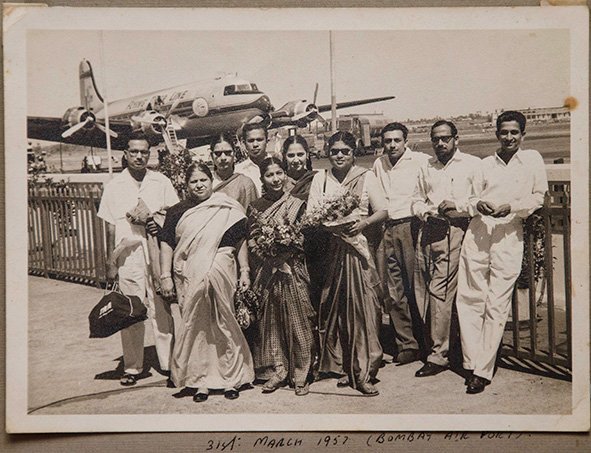
My grandfather, T.S Sreekantiya and grandmother, S. Kamlamma with family and staff at the Arrival lounge at the Airport, Bombay, Maharashtra. 1978
Image and text contributed by Prasad Ramamurthy, Mumbai
Both my grandparents’ families were Tamil Palghat Brahmins and migrated from Kerala over generations through Karnataka to finally settle in Bengaluru (Bangalore) . A few years after they got married my grandparents moved from Bengaluru to Bombay in 1932.
In the late 70′s when all you had was a single airline called Air India to fly you out the country to anywhere, you really needed to ‘know’ somebody to help you get Emergency Quota tickets air travel and that was a well and truly a big deal. So when you set off somewhere or returned it meant the entire family, extended family and the house staff turned up to say hello or bid you goodbye. Like, when my grandparents who had gone to Iran to visit an uncle of mine (he worked for the Tata’s and was building power plants for the Iranian government then) returned. We; my parents, the three of us, my uncle, the house staff, my uncle’s office staff and two others I don’t even recognise turned up garlands in hand and with those curious things that every newly married couple was made to hold onto in those days while greeting guests at the marriage reception. I’m sure my uncle was thankful that when he set off a few years later, on what then to us was an epic trip to the US for three whole months, we didn’t do the garland-bouquet routine. But of course there always was a mandatory picture, family, extended family, staff included!
Jan 27, 2011 | Categories: 1970s, Airport, Arrivals & Departures, Bombay, Brahmin, Corporate Job, Hindu, Indian Clothes, Iran, Karnataka, Kerala, Maharashtra, Men, Men's Clothes, Migration, Sarees, Tamilian, Western Clothes, Women, Women's Clothes | Tags: 1930s, 1970s, Air India, Air tickets, Airport, Arrivals & Departures, Bangalore, Bengaluru, Bombay, Brahmin, Corporate Job, Emergency Quota, Extended Family, Family Photograph, Flight, Garlands, Hinduism, Iran, Karnataka, Kerala, Maharashtra, Men, Men's Clothes, Migration, Power Plants, Prasad Ramamurthy, Sarees, South Indian, Tamil Palghat Brahmins, Tamilian, Tata, Travel | 2 Comments »

My Grandmother Chameli Devi Jain and Grandfather Phool Chand Jain, shortly after their marriage. Delhi. Circa 1923
Image and text contributed by Sreenivasan Jain, Journalist, New Delhi
Some text is paraphrased from a recent Book – Civil Disobedience, by my father Late. Shri LC Jain, noted economist and Gandhian.
This image was photographed in Delhi, shortly after my Paternal grandparents Chameli and Phool Chand, got married. She was 14 and he was 16. It was unusual for couples in our family to be photographed, especially holding hands, which turned out to be an indication of the unconventional direction their lives would take. They were both Gandhians and Freedom fighters.
The prestigious Chameli Devi Jain award for Journalists was named after my grandmother . The only visible reminder of her brush with radical politics of the freedom movement was the milky cornea in her right eye, the result of an infection picked up in Lahore Jail where she had spent 4 months in 1943. Otherwise, she was Ammaji: gentle, almost luminous in her white saris, regular with her samaik (Jain prayer), someone who would take great pleasure, on our Sunday visits, to feed us dal chawal (rice and lentils) mixed with her own hands.
My grandmother grew up in a village called Bahadarpur in Alwar, about 4 hours south of Delhi, in a deeply conservative Jain family. The family was locally influential; they were traders in cotton turbans, woven by local Muslim weavers and sold in Indore, Madhya Pradesh. They also were moneylenders. As with much of rural Rajasthan, the women were in purdah. Within two years of their marriage, their first child, my father, LC Jain was born.
Ammaji moved with my grandfather into the family home in the teeming bylanes of Dariba in Chandni Chowk. But he had developed a growing interest in Gandhi and the nationalist movement and soon broke away from the family business to join the Delhi Congress. In 1929, soon after the call for Poorn Swaraj at the Lahore session, he was arrested for the first time.
My grandfather’s stint in jail exposed him to even more radical politics. Along with his Congress membership, he also became part of the revolutionary Hindustan Socialist Republican Association which counted Bhagat Singh and Chandrashekhar Azad amongst its members. (Azad, in an interview, acknowledged that he received his first revolver from my grandfather). He also became a reporter for the nationalist newspaper at the time, Vir Arjun, whose editor he had met in jail.
In 1932, Gandhi called for a major nationwide satyagraha against foreign goods. It was also the year a bomb was thrown at Lord Lothian,an act in which my grandfather played a role. When he told my grandmother that he was going to jail, she said this time she would go to prison first, by taking part in the swadeshi satyagraha. The household was stunned. Ammaji’s life had revolved around ritual, the kitchen and ghoonghat. Her decision led to the following heated exchange; witnessed by my father, age 7:
Babaji: “You don’t know anything about jail.”
Ammaji: “Nor did you when you were first arrested.”
Babaji: “Who will look after the children ?”
Ammaji: “You will.”
Sensing that things were getting out of hand, my great grandmother, Badi Ammaji locked both of them into a room. But my grandfather apparently fashioned an escape from the window using knotted dhotis and Ammaji, head uncovered, marched with other women pouring out of their homes towards the main bazaar. The crowd had swelled into hundreds. There were cries of ‘Mahatma Gandhi ki Jai’. As they began to move around picketing shops selling foreign goods, they were arrested, taken to Delhi Jail, and charged with 4 and half months of rigorous imprisonment.
Her arrest, not surprisingly, outraged the family in Alwar. Umrao Singhji, Ammaji’s father, came to Delhi and had a big argument with my great grandfather, accusing the in-laws of ‘ruining our princess’. But Ammaji found an ally in her in-laws, who refused to pay her bail out of respect for her satyagraha. Umrao Singhji then tried to talk his daughter out of it when she was being transferred to Lahore Jail. ‘Chameli, apologise, ask for pardon.’ But Ammaji asked him not to worry. ‘Bolo Bharat Mata ki Jai’, she said, as she was being led away in a rickshaw along with the other prisoners. ‘Bharat Mata ki Jai’, responded her father.
She returned from Lahore 4 months later, a minor heroine. But there was also loss. Lakshmi, her daughter, 5 years old, fell from the balcony of the house and died when she was in Lahore jail. And there was the milky cornea – the loss of an eye. But her world had somewhat widened. She wore her ghoonghat a few inches higher. She gave her Rajasthani ghaghra choli away, and wore only handspun. She spun on the charkha. She would attend meetings with other women on matters of community reform, like widow remarriage and also became more involved in the activities of the local sthanak, the Jain community’s prayer and meditation hall. She had, as it turns out, quietly fashioned her own blend of Jain renunciation and Gandhian abstinence.
In the years that followed, my grandfather retained his engagement with the freedom struggle. He would often go to sit in the family’s property agency in Model Town, but his real passion, which consumed most of his last 30 years was compiling a massive index of freedom fighters, a staggering 11 volume chronicle of the stories of countless ordinary men and women, who took part in protests, bomb conspiracies, went to jail, lived and died. For my grandmother, it was a gradual return to a more conventional domesticity.
But, that single action that morning in 1932 had opened up a world: a young woman from a deeply conservative family, who became the first Jain woman in her neighbourhood to go to jail, who was named on the day of her arrest in the Hindustan Times with all the other satyagrahis, who would return home to other freedoms, even if minor, like a ghoonghat that could be worn a few inches back.
And for that, she would one day have an award named after her.
Jan 22, 2011 | Categories: 1920s, 1930s, 1940s, 1947 India Pakistan Partition, Accolades & Awards, Alwar, Arranged Marriage, Assassinations & Attempts, Bomb Blasts, Books, British Reign, Business-man / Business-woman, Chandani Chowk, Child Marriage, Cotton, Cultural Attire, Decor, Delhi, East India Company, Elopement, Freedom Fighters, Future icons from the Past, Gandhian, Head Gear, Hindu, Hindustan Times, House Wife, Imprisonment, India, Indian Clothes, Indian Clothes, Indian Politics, Interiors, Jain, Jewellery, Journalism, Lahore, Love & Romance, Madhya Pradesh, Men, Men's Clothes, Model Town, Pre-Independence, Rajasthan, Research, Revolver, Sarees, Satyagraha, Vir Arjun, Wartime Separation, Women, Women Empowerment, Women's Clothes | Tags: 1920s, 1930s, 1940s, 1943, 1947 India Pakistan Partition, Accolades & Awards, Alwar, Arranged Marriage, Assassination Attempt, Assassinations & Attempts, Bahadarpur, Bhagat Singh, Bomb Blasts, bomb conspiracies, Books, British Reign, Business-man / Business-woman, Chameli Devi Jain, Chandani Chowk, Chandni Chowk, Chandrashekhar Azad, Charkha, Child Marriage, Chronicle, Civil Disobedience, Congress, Cotton, Cotton Turbans, Couple, Cultural Attire, Dariba, Decor, Delhi, Delhi Congress, East India Company, Elopement, Freedom Fighters, Future icons from the Past, Gandhian, Ghoongat, Handspun, Head Gear, Hinduism, Hindustan Socialist Republican Association, Hindustan Times, House Wife, Imprisonment, Independence Struggle, Indian Politics, Indore, Interiors, Jail, Jain, Jain Community, Jains, Jewellery, Journalisim, Journalism, Journalist, Lahore, LC Jain, Lord Lothian, Love & Romance, Madhya Pradesh, Mahatama Gandhi, Men, Men's Clothes, Model Town, Moneylenders, Muslim Weavers, Nationalist Movement, nationalist newspaper, Phool Chand Jain, Poorn Swaraj, Pre Independence, protests, Purdah, Rajasthan, Research, revolver, Rural, Samaik, Sarees, Satyagraha, Satyagriha, Spinning Wheel, Sreenivasan Jain, Traders, Veil, Vir Arjun, Wartime Separation, Widow remarriage, Women Empowerment, Women's Clothes | 8 Comments »

My parents at the Beach Disco in Dar-es-salaam, Tanzania, East Africa. December 1973
Image and text contributed by Sheetal Sudhir, Mumbai
“These were the happiest days” say my mom, Sandhya (nee Parina) and dad, Sudhir Ramachandran, a photographer.
This picture was taken at a beach disco in Dar-es-salaam called Bahari Beach Hotel. These were times of the early 70s floral hippy patterns and elephant pants combined with an Elvis spillover from the late 60s. My dad recalls that they had just finished an engrossing session of ‘soul’ dancing and were moving to the beach to relax and then a friend clicked this picture, with dad’s very first Hasselblad camera and a large Metz flash!
My mom, a Gujrati Muslim and my dad, a Malyali, got married in Tanzania and then moved to Bangalore, India in 1975. I was born in 1976. Lately, they have been visiting Dar-es-salaam more often to see my maternal grandmother, and my uncles & aunts. In my father’s own words, whenever he sees this photograph, he is in “His fav town with his fav girl…and those were the days!!”
Oct 19, 2010 | Categories: 1970s, Bangalore, Beach, Dar es Salaam, Floral patterns, Gujarati, Gujarati Muslim, Hindu, Hippy Movement, Hotel, Inter Caste, Karnataka, Love & Romance, Malyali, Men, Migration, Music, Art, Dance & Culture, Muslim, Parties, Photographer, Tanzania, Tie & Dye, Western Dances, Women | Tags: 1960s, 1970s, Art & Culture, Bahari Beach Hotel, Bangalore, Beach, Couple, Dancing, Dar-es-salaam, Disco, East Africa, Elvis, Fashion & Trends, Floral patterns, Gujarati, Gujarati Muslim, Gujrati, Hasselblad, Hinduism, Hippy, Hippy Movement, Hotel, Inter-caste, Karnataka, Love & Romance, Malyali, Men's Clothes, Metz Flash, Migration, Music, Muslim, Parents, Parties, Party, Photographer, Sudhir Ramachandran, Tanzania, Tie & Dye, Western Dances, Women's Clothes | 14 Comments »

My mother Anupa Nathaniel (right) with her closest friend Shalini Gupta, Delhi, Circa 1962
Image and Text contributed by Anisha Jacob Sachdev, New Delhi.
This picture with my mother Anupa Jacob (nee Nathaniel) and her closest friend Shalini was taken when they were in school at Convent of Jesus & Mary in Delhi. They would have been around 15 years old. My mother was a Rajasthani, from the small town of Nasirabad near Ajmer. Her father was orphaned when a plague hit the village, he and many others were then adopted by the British. Everyone adopted was converted to Christianity and given the last name ‘Nathaniel’. From Nathu Singh, my grandfather became Fazal Masih Nathaniel. He went on to become the Head of the English Language Department at Mayo College, Ajmer.
My mother married my father Philip Jacob, in 1968. He is a Syrian Christian - whom she met while she was studying at school around the age of 15, he was studying at St. Columba’s School.
One of the most interesting parts of my mother’s life was that Shalini, some other friends and she, formed the first ever Delhi University‘s Girl Rock Band called “Mad Hatter” in their 1st year of college at Miranda House. My mother was the lead guitarist and singer. Because of that status, when the Beatles performed, albeit privately in Delhi in 1966, the Mad Hatters were given front seats priority.
My mother had four kids. She was also a piano teacher, and her youngest child and my youngest sister Arunima is autistic but an ace piano player and has performed Beethoven Music pieces with complete accuracy.
My mother suffered a cardiac arrest in 1982, and passed away in 1986. Shalini Gupta, my mother’s friend in the photograph (left) is now a psychologist in London.
Apr 30, 2010 | Categories: 1960s, Achievements, Adoption, Ajmer, Autism, British Reign, Christianity, College, College Fests, Concerts, Convent of Jesus & Mary, Conversion of Faith, Delhi, Delhi University, Friendships, Hair Styles, Heart Attack, Hindu, Indian Clothes, Inter Caste, Love & Romance, Mayo College, Miranda House, Music, Art, Dance & Culture, Musician, Name Change, Plague, Psycho Analyst, Rajasthan, Rajasthani, Rock Bands, Salwar Kurta, Shoes, Singer, St. Columba's School, Studio Portraits, Syrian Christian, Teacher, Western Music, Women Empowerment, Women's Clothes | Tags: 1960s, Achievements, Adoption, Ajmer, Art & Culture, Autism, British, British Reign, Christianity, CJM, College, College Fests, Concerts, Convent of Jesus & Mary, Conversion of Faith, Delhi, Delhi University, Education, Friendships, Hair Styles, Heart Attack, Hinduism, Inter-caste, London, Love & Romance, Mad Hatter, Mayo College, Miranda House, Music, Musician, Name Change, Nathaniel, Piano, Plague, Psycho Analyst, Psychologist, Rajasthan, Rajasthani, Rock Band, Rock Bands, Salwar Kurta, Shalini Gupta, Shoes, Singer, St. Columba’s School, Studio Portraits, Syrian Christian, Teacher, The Beatles, Western Music, Women Empowerment | 11 Comments »

Hand painted in New York (in 2000), my maternal grandparents, Lahore, (Now Pakistan). 1923
Image and text contributed by Dinesh Khanna.
My grandparents, Balwant Goindi, a Sikh and Ram Pyari, a Hindu were married in 1923. She was re-named Mohinder Kaur after her marriage . They went on to have eight daughters and two sons, one of the daughters happens to be my mother.
Balwant Goindi owned a whiskey Shop in Lahore. He was a wealthy man and owned a Rolls Royce. During Indo-Pak Partition, he and his family migrated to Simla, without any of his precious belongings; assuming he would return after the situation had calmed down, however, that never happened. After moving around, and attempting to restart his business with other Indian trader friends, they finally settled down in Karol Bagh. The area was primarily residential with a large Muslim population until the exodus of many to Pakistan and an influx of refugees from West Punjab after partition in 1947, many of whom were traders. It must have been a very sad day when he heard that his home and his shops in Lahore were burnt down.
Feb 23, 2010 | Categories: 1920s, 1947 India Pakistan Partition, Abandonment, Delhi, Furniture, Hand Painted, Head Gear, Hinduism, Indian Clothes, Inter Caste, Lahore, Men, Men's Clothes, Migration, Mustache, Name Change, Now Pakistan, Pakistan, Pre-1947 Indian Regions & States, Pre-Independence, Props, Punjabi, Punjabi, Riots, Rolls Royce, Sarees, Shoes, Shopkeeper, Sikhism, Studio Portraits, Western Clothes, Whiskey, Women's Clothes | Tags: 1920s, 1947 India Pakistan Partition, Abandonment, Bhagwad Gita, Couple, Delhi, Furniture, Hand Painted, Head Gear, Hinduism, Inter-caste, Lahore, Men's Clothes, Mustache, Name Change, Now Pakistan, Pakistan, Pre Independence, Pre-1947 Indian Regions & States, Props, Punjabi, Riots, Rolls Royce, Sarees, Sari, Shoes, Shopkeeper, Sikh, Sikhism, Studio Portraits, Whiskey, Women's Clothes | Leave A Comment »