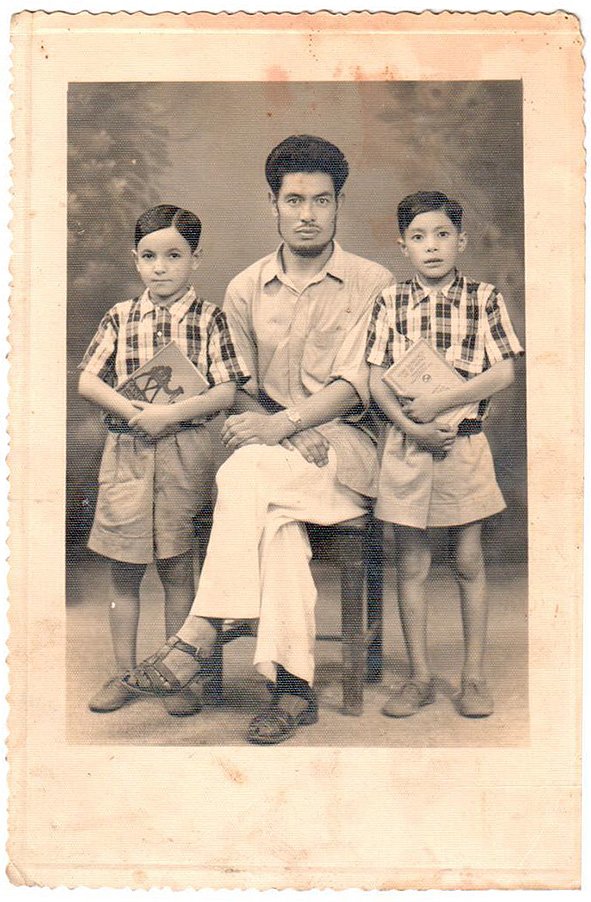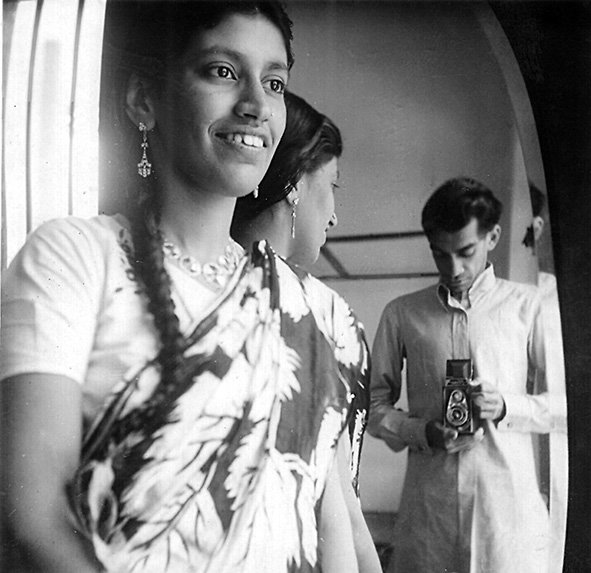
My Parents, K. M. Devaki Amma & Lt. Cdr. P.P.K. Menon. Bombay. Maharashtra. 1941
Image & Text contributed by Radha Nair, Pune
This photograph of my parents K. M. Devaki Amma & Lt. Cdr. P.P.K. Menon was taken at a Photo Studio in Bombay in 1941, soon after they were married. My father was based in the city serving the Naval Force.
My mother, K. M. Devaki Amma belonged to Feroke, a part of Kozhikode in Kerala. Her initials K. M. stood for Kalpalli Mundangad and her family originally belonged to the Anakara Vadkath lineage. The large joint family of more than 25-30 people lived in a house called Puthiyaveedu which still exists in Feroke, however the members are now settled in far flung places and my grand aunts and uncles are no more.
My mother had to give up school very early in life. She came from a large family of 14 brothers and sisters and belonged to an era where a girl’s formal education wasn’t a priority. While they grew up under the tutelage of grand uncles and aunts, they learned to cook, clean, and learnt to make do with and share whatever little they had with their siblings without ever complaining. Congee (Rice Gruel) was what they mostly had for lunch and dinner, supplemented with a little coconut chutney, and may be a side dish of some green banana, but only if they were bestowed with a ripe bunch of plantains available from the kitchen garden.
My mother and her sisters’ daily life entailed preparing food for all members of their very large family. By the light of a wick lamp, sweating by the blaze of crackling coconut fronds they would wash dishes with ash from the kitchen hearth and rinse them with water drawn from the well. My mother in personality was very self-reliant and was happy with whatever little she had.
Arranged by my paternal grandmother, when Amma married my father, a man with an aristocratic lineage and a Naval officer, my father’s cousins would scoff at her and condescendingly regard her as a ‘village girl’. They had been educated in Queen Mary’s Women’s college, Madras (now Chennai) whereas my mother had studied only up to Class IV in a local village school in Karrinkallai.
Undeterred, my father, who knew his wife was a bright and intelligent woman took her under his wing and brought out the best in her. He taught her English and bought her abridged versions of books written by Charles Dickens, Walter Scott and many other great authors. He read out passages to her and patiently explained to her what they each meant.
Thus Devaki, my mother, slowly emerged from her rural background, and became a lady endowed with great poise and charm. Not only did she steal my father’s heart, but even of those who befriended her. She became a much sought after friend by wives of both British and Indian naval officers. She taught them to cook Malayali dishes and stitch & embroider; skills, which were executed by her exquisitely. She wrote and spoke English with such assurance that she could put a present day Post Graduate in English to shame. But despite all these changes, she remained loyal to her roots, proud of her humble origins, and very attached to her siblings.
Sometimes, deep into the night I would catch whispers of my parents’ conversation as they sat and planned the monthly budget, and spoke about their dreams of providing us with the best of every thing. It was my mother who insisted that my sister and I be given the best education they could afford. She firmly refused a State Board SSC education, and insisted on us being admitted into schools which followed a Senior Cambridge syllabus. She was efficient and fiercely independent. By comparison I was a pale shadow. In fact, many times I used to feel very unsure of my self in her presence, intimidated by her indomitable spirit and the complete control she had over any situation.
When my father was suffering Cancer, she stood by him; nourishing him with love and healthy food, while my sister and I watched our father’s condition worsen by the day, helpless and often giving in to tears. My mother always remained calm, but only when he breathed his last in 1977 did she break down completely. He was her life force, and she was his guiding light. Theirs was an extraordinary relationship, always supportive of each other at all times and completely committed to each other till the end.
After I graduated, it was her dream that I put my education to good use. However, a few years after marriage when I was forced to give up my teaching post, she never forgave me till she breathed her last. To make up for it, I began to write and put together a collection of short stories, but the book never got published.
What pained me most was that I was not able to place a copy of my book in my mother’s hands and make my peace with her before she passed away in 2008.
Apr 23, 2013 | Categories: 1940s, Arranged Marriage, Attire, Bombay, Cancer, Condiments, Domestic Skills, Dressed for an Occasion, Education, English, Fashion Accessories, Food & Drink, Fruit & Vegetables, Furniture, House Wife, Illiteracy, India, Interiors, Jewellery, Kerala, Literacy, Material, Men in Uniform, Men's Clothes, Military, Photo Collection, Photo Studio, Picnics & Feasts, Pre-Independence, Previous, Prints & Stitches, Props, Rags to Riches, Royality, Sarees, Specialised Clothing, Studio Backdrops, Studio Portraits, Women Empowerment, Women's Clothes | Tags: 1940s, Anakara Vadkath, Bombay, Budget, Cambridge, Chennai, Couple, Dreams, Education, Hair Styles, House Wife, Indian Navy, Jewellery, Joint Family, K. M. Devaki Amma, Kalpalli Mundangad, Kerala, Literacy, Lt. Cdr. P.P.K. Menon, Madras, Maharashtra, Marriage, Men's Clothes, Naval force, Photo Studio, Props, Puthiyaveedu, Radha Nair, Regret, Sarees, Shoes, Studio Backdrop, Studio Portraits, Syllabus, village girl, Women Empowerment, Women's Clothes | 5 Comments »

My maternal grandfather, Samuel John Souri, Singapore. 1942
Image and text contributed by Sandhya Rakesh, Bangalore
My maternal grandfather, Mr. Samuel John Souri was born to Mr & Mrs Rev. JJ Souri (Reverend) in Ananthapur district of Andhra Pradesh. He had two sisters & three brothers. After he completed his studies in Ananthapur he began working in the Collectorate. At the advise of his cousin’s wife, he learnt Stenography (Short Hand) and found a job with the British as Chief Clerk in Singapore in the late 1930s.
My mother, his daughter, Joyce, tells me that once when he was called out for an urgent meeting, in a hurry he forgot his footwear, but when he went back to collect it, the sentry at the gate refused to allow him in because the British might think him to be a spy.
My grandfather spent many years in Singapore working for the British, during the World War II. He also had six children, all of whom received Singaporean citizenships. After a few years, when the British were defeated at the Battle of Singapore he moved back to India, sending the family ahead by a few months.
A diabetic patient, he passed away very suddenly, failing to eat some food after an insulin shot. My mother remembers that it was when she was in college. I do regret never having the opportunity to see and spend time with this very interesting and great man.
Mar 05, 2012 | Categories: 1940s, Andhra Pradesh, Attire, Battle of Singapore, Christianity, Citizenship, Clerk, Diabetes, Furniture, Hair Styles, Intelligence and Spies, Men's Clothes, Migration, Mustache, Pre-Independence, Professional Training, Props, Singapore, Studio Backdrops, Studio Portraits, Western Clothes, World War II | Tags: 1940s, Ananthpur District, Andhra Pradesh, Attire, Backdrop, Bangalore, Banister, Barefoot, Battle of Singapore, British, Carpet, Chair, Chief Clerk, Christianity, Citizenship, Clerk, Collectorate, Diabetes, Footwear, Furniture, Grandfather, Hair Style, Hair Styles, Insulin, Intelligence and Spies, Man, Maternal, Men's fashion, Migration, Mistaken Identity, Mustache, Nationality, Pants, Pose, Pre Independence, Professional Training, Prop, Props, Samuel John Souri, Sandhya Rakesh, Sentry, Shoes, Short Hand, Singapore, Single Breasted Suit, Spy, Staircase, Stenography, Studio Backdrop, Studio Backdrops, Studio Portraits, Textiles, Tie, western attire, White Socks, World War II | Leave A Comment »

LEFT IMAGE - My great grandfather, Raja Janampally Rameshwar Rao II, the Raja of Wanaparthy with sons Krishna Dev Rao (left) and Ram Dev Rao (right) RIGHT IMAGE - Krishna Dev Rao (Left) with sister, Janamma, and brother Ram Dev Roa. Wanaparthi, Andhra Pradesh. Circa 1912
Images and Text contributed by Kamini Reddy, USA
My great grandfather Raja Rameshwar Rao II was the ruler and Raja of Wanaparthy, (seated) Hyderabad state, ruled by the Nizam. In 1866, at the request of the Nizam of Hyderabad, my great grandfather fused his army, the Bison Division Battalion with the Nizam of Hyderabad’s army, the Hyderabadi Battalion. He was appointed the Inspector of the Army. Wanaparthi‘s rulers were closely associated with the Qutub Shahi Dynasty. My great grandfather died on November 22,1922 and was survived by two sons, Krishna Dev Rao and Ram Dev Rao.
Ram Dev Rao (the younger boy in the image) was my grandfather. He was the youngest son of the Raja of Wanaparthy, He had an older sister, Janamma, and elder brother Krishna Dev. My grandfather used to say that he didn’t have much interaction with his father – it was quite a formal relationship – and he only replied to him when spoken to.
Raja Rameshwar Rao II and his family strongly believed in education. When his sons were young, they were sent to Hyderabad to attend St. George’s Grammar School (an English medium school). They stayed with a family (the Welingkars) during the school year and would go back to Wanaparthy for their holidays. His daughter Janamma married when she was very young, to the Raja of Sirnapalli. After my great grandfather passed away, his elder son Krishna Dev was still a minor, so the property was managed by the Court of Wards until he came of age. Krishna Dev though passed away when he was only 20 years old and eventually his son Rameshwar Rao III inherited the title.
After the end of the British reign in India, The Nizam wanted to be independent of the Indian government, but the government was determined to have Hyderabad succumb to acceding, with whatever means. Sure enough, the government of India in 1948 launched a police action against Hyderabad, and forced the Nizam to accede to India and surrender. Subsequent to the Hyderabad State’s merger with the Indian Union in 1948, all units of the Hyderabad State Forces were disbanded and only volunteers of the Battalion were absorbed with the Indian Army. Popularly known as the “Hyderabadis” in the Army, the unit had a unique mixed class composition with no rank structure based on class. Troops celebrated both Hindu and Muslim festivals together.
Feb 01, 2012 | Categories: 1800s, 1910s, 1940s, Andhra Pradesh, Child Marriage, Education, English Medium, Furniture, Hair Styles, Head Gear, Hyderabad, Hyderabadi, Indian Army, Indian Clothes, Indian Clothes, Indian Politics, Jewellery, Men, Men's Clothes, Mustache, Nizam of Hyderabad, Pre-1947 Indian Regions & States, Pre-Independence, Props, Royality, Shoes, Studio Portraits, Western Clothes, Women, Women's Clothes | Tags: 1800s, 1910s, 1940s, Andhra Pradesh, Bison Division Battalion, British Empire, Child Marriage, Children, Court of Wards, Education, English Medium, Family, Furniture, Hair Styles, Head Gear, Hyderabad, Hyderabadi, Hyderabadi Battalion, Indian Army, Indian Politics, Janamma Rao, Jewelry, Kamini Reddy, King, Krishnadev Rao, Men's fashion, Mustache, Nizam of Hyderabad, Pre-1947 Indian Regions & States, Prince, Princess, Props, Qutub Shahi Dynasty, Raja, Raja of Sirnapalli, Raja of Wanaparthy, Raja Rameshwar Rao II, Ram Dev Rao, Ramdev Rao, Rameshwar Rao III, Royal Family, Royalty, Shoes, St. George’s Grammar School, Studio Portraits, Welingkar, Women's Clothes | Leave A Comment »

My mother's classmate, Sharda Pandit (later Mukherjee), Bombay, Maharashtra. 1935
Image and text contributed by Mrudula Prabhuram Joshi, Bombay
The beautiful woman seen here is Sharda Pandit, a scion of a Maharashtrian aristocratic family in the earlier half of the 20th century. She was born in Rajkot, Gujarat. She was hailed as the ‘Beauty Queen’ of Elphinstone College of Bombay, in fact of all collegians of the city; because Bombay (now Mumbai) had only three colleges at that time – Elphinstone, Wilson and St. Xavier’s. She possessed a kind of serene beauty, singular charm and grace. Her contemporaries from other colleges would drop by just to have a glimpse of this icon of beauty. Not only was she beautiful to look at, she possessed a beautiful heart, too.
At that time, there were only a handful of women students in the colleges, most of whom were from middle class families. Sharda would get along amicably with everyone despite her wealthy family background. She acted as the heroine of several plays during the college years, for the Annual College Day functions.
Sharda and my mother, Kamini Vijaykar were classmates and that is how I came to know about her.
Later on, Sharda married Subroto Mukherjee, the first Air Chief Marshal of the Indian Air Force in 1939. After his untimely death in 1960, she devoted herself to social service and political activism. For some time, she was also the Governor of Andhra Pradesh from 1977-1978 and then the Governor of Gujarat from 1978 to 1983. She kept herself busy with several constructive activities. She was beyond 90 years of age when she passed away, but preserved her inner and outer beauty till the very last.
Sep 28, 2011 | Categories: 1930s, 1970s, Acting, Activist, Andhra Pradesh, Aristocracy, Beauty Icons, Chiffon, College, Elphinstone College, English Medium, Extra Curricular, Governance, Graduation, Gujarat, Indian Air Force, Indian Clothes, Indian Politics, Inter Caste, Lifestyles, Love & Romance, Maharashtra, Maharashtrian, Military, Pre-Independence, Props, Sarees, Studio Backdrops, Studio Portraits, Theatre, Women, Women's Clothes | Tags: 1930s, 1970s, Acting, Activist, Air Chief Marshal, Air Marshall, Andhra Pradesh, Annual Day functions, Aristocracy, Aristocrat, Beauty Icons, Beauty Queen, Bombay, Chiffon, College, Education, Elphinstone, Elphinstone College, English Medium, Extra Curricular, Fashion & Trends, Friendships, Governance, Governor, Governor of Gujarat, graduation, Gujarat, Indian Air Force, Indian Politics, Inter-caste, Kamini Vijaykar, Lifestyles, Love & Romance, Maharashtra, Maharashtrian, Middle Class, Military, Mumbai, Pre Independence, Props, Royal Family, Sarees, Studio Backdrops, Studio Portraits, Subroto Mukherjee, Theatre, Wealth, Wilson and Xavier’s | 2 Comments »

My Paati and Thatha, Lokanayaki and RR Hariharan. My mother's parents from Ravanasamudram, Thirunelveli District, Tamil Nadu. Circa 1920.
Image and text contributed by Vani Subramanian, New Delhi
He worked with the Indian Railways, and she raised her five children between Delhi and Shimla, learning Hindi and the ways of the ‘north’ as she went along. This photograph was probably taken fairly soon after they were married. Even my mum who is now 72 years old doesn’t remember them like this at all. So in a sense, they are both familiar and strangers as they appear in the picture. But I do remember the photograph framed and hanging on the wall in the house that they retired to in the village. A house they moved in to the day I was born: 22 Jan 1965.
My favourite part of the photograph is that Paati is wearing Mary Jane shoes and white socks with her nine yards saree. I never saw her in shoes in real life. As a matter of fact, I never saw my grandfather in a coat and tie, either. Though I am told that he wore a coat, tie, shoes and pants clipped with bicycle clips as he rode to work from Park Lane to the railway boards offices.
Jul 16, 2011 | Categories: 1920s, 1960s, Bicycle, Brahmin, Delhi, Furniture, Government Jobs, Hair Styles, Himachal Pradesh, House Wife, India, Indian Clothes, Jewellery, Men, Men's Clothes, Pre-Independence, Props, Railways, Sarees, Shoes, Simla, Studio Backdrops, Studio Portraits, Tamil Nadu, Tamilian, Western Clothes, Western Clothes, Women, Women's Clothes | Tags: 1920s, 1960s, 1965, Bicycle, Brahmin, Couple, Delhi, Fashion & Trends, Furniture, Government Jobs, Grandparents, Hair Styles, Himachal Pradesh, House Wife, Housewife, Indian Railways, Jewellery, Mary Jane Shoes, Men's Clothes, Nine Yard Saree, Patti, Pre Independence, Props, Railways, Ravansamudram, retire, Sarees, Shoes, Simla, Studio Backdrops, Studio Portraits, Tamil Nadu, Tamilian, Thatha, Thirunalveli District, Traditional Attire, Vani Subramanian, Village, western attire, White Socks | 2 Comments »

My aunt Rashmi and mother Soma, at the annual town fair of Etawah, Uttar Pradesh, 1977
Image and Text contributed by Juhi Pande, Mumbai
This particular photograph was taken in Etawah, Uttar Pradesh in 1977. My mother (right) had finished her graduation and was teaching in a school. My masi, the bike rider, (mother’s sister) was in her 12th standard. They lived in Etawah, a town by the river Yamuna, with their father, Dr. Krishna Kumar, a Chief Medical Officer.
My maternal grandmother, also Dr. Krishna Kumar (yes, they shared the same name) at that time was incharge of the Dufferin Hospital in Raibarreily and they had all come on holiday to Etawah. There used to be a local mela (fair) every year, which the entire city would attend, because that’s what you do when you’re in Etawah. There were food stalls and rides and balloon & air gun shooting galleries. And then there was this photostudio where one could take dashing, avant-garde photographs. So, of course Soma & Rashmi climbed aboard this cardboard bike and posed. I can almost hear Rashmi’s laughter once the picture was developed. I feel you cannot entirely be pretty unless you are a bit silly.
My mother and my masi were born four years apart. But that’s just a technicality. Soulmates is a very vanilla word when it comes to them. Born to doctors, Soma and Rashmi lead a very nomadic life till their twenties. Moving from one city to another every couple of years meant that they mostly had each other for constant company. Growing up from little girls to stunning young women I feel that they started to think alike yet maintained such different personalities that it was remarkable. I genuinely believe that they can read each others minds and I know they have a certain ‘look’ for their children, which not only freezes our blood but also paralyses our bones. I feel I love Dhruv, my brother, just like Soma Loves Rashmi. And I know it’s genetic. My masi Rashmi, now lives in Germany and my mother in Mumbai.
This is one of my most favorite pictures. Ever. For everything that it says and for every thing that I long to have over-heard.
Feb 01, 2011 | Categories: 1970s, Doctor, Fashion Accessories, Friendships, Hair Styles, Migration, Motorcycle, Props, Rivers, Studio Backdrops, Studio Portraits, Town Fairs, Uttar Pradesh, Western Clothes, Women, Women Empowerment, Women's Clothes, Yamuna | Tags: 1970s, Air Gun, Annual Town Fair, Bell Bottoms, Chief Medical Officer, Dhruv Pande, Doctor, Doctors, Etawah, Fair, Fashion & Trends, Fashion Accessories, Friendships, Germany, graduation, Hair Styles, Haircut, Juhi Pande, Krishna Kumar Pande, Mela, Migration, Motorbike, Motorcycle, Moving, Nomadic, Nomadic Life, Photo Studio, Props, Raibarreily, Rashmi, Rivers, Sisters, Soma Pande, Studio Backdrop, Studio Backdrops, Studio Portraits, Teacher, Town Fairs, Uttar Pradesh, Women Empowerment, Women's Clothes, Yamuna | 6 Comments »

My Grandfather (sitting, left) Narasinhbhai Patel with family.. Anand, Kheda District, Gujarat. Circa 1940
Image and text contributed by Sandhya Mehta
My maternal grandfather, Narasinhbhai was a revolutionary man. Records of British India describe him as ‘most dangerous man in Bombay Presidency ‘. He was exiled from British India for writing proscribed books. Though the
Maharaja of Baroda clandestinely supported him. After completing his exile term in Germany and East Africa,
C.F. Andrews persuaded him to join
Ravindranath Tagore in
Shantiniketan . He taught German there for a short time and then returned to his native town Kheda to support
Gandhiji’s Salt
Satyagraha . He became a leader in Kheda district. to mobilise Satyagraha. Standing behind him, first from left is his grandson Dr. Shantibhai Patel who also actively participated in the freedom struggle and later became a successful scientist . Narsinhbhai’s daughter, Shanta Patel (my mother), sits, first from right with my father G.P.Patel, standing behind her. My father, G.P Patel supported Narasinhbhai’s views, work and philosophy. They all were followers of Gandhiji.
Jul 19, 2010 | Categories: 1940s, 1947 India Pakistan Partition, Beliefs & Causes, British Reign, East Africa, Exile, Freedom Fighters, Gandhian, German, Germany, Gujarati, Indian Clothes, Indian Clothes, Indian Politics, Men, Men's Clothes, Pre-Independence, Props, Publications, Sarees, Satyagraha, Scientist, Shantiniketan, Studio Portraits, Western Clothes, Western Clothes, Women, Women's Clothes, Writer | Tags: 1940s, 1947 India Pakistan Partition, Anand, Beliefs & Causes, Bombay Presidency, British India, British Reign, C.F Andrews, Dr. Shantibhai Patel, East Africa, Exile, Family Portrait, Freedom Fighters, Gandhi, Gandhian, German, Germany, Gujarati, Indian Politics, Kheda District, Linguistics, Maharaja of Baroda, Mahatama Gandhi, Mehta, Narasinhbhai Patel, Patel, Props, Publications, Rabindra Nath Tagore, Sarees, Satyagraha, Satyagriha, Scientist, Shantiniketan, Studio Portraits, Writer | Leave A Comment »

My grandmother Vatsala Joshi (extreme right) with her grandmother, parents and siblings. Pune, Maharashtra.Circa 1937
Image and text contributed by Yashoda Joshi.
My Grandmother Vatsala Bhimsen Joshi (nee Mudholkar) was a very beautiful person. She was born in 1928 and was the fifth child of the family. She had 3 elder sisters, an older brother, four younger sisters and 2 younger brothers. She was a great singer as well, and appreciated and encouraged lot of young musicians. She inculcated the love of music and life in all her children, grandchildren, brothers, sisters and nephews/nieces. A very enthusiastic and strong woman she loved travelling. Collecting and wearing beautiful sarees was her passion. She was married to Padmashree awarded, Indian Classical Vocalist Pandit Bhimsen Joshi and had three children.
This photograph of the Mudholkar Family is taken in Pune with her parents Shrikrishna and Saraswati, grandmother Laksmi and brothers and sisters. Two of her younger sisters were not born yet.
Jun 26, 2010 | Categories: 1930s, Hair Styles, Hindustani Classical, House Wife, Indian Clothes, Maharashtra, Maharashtrian, Men, Musician, Padma Shri, Personal Collections, Pre-Independence, Props, Sarees, Singer, Western Clothes, Women, Women Empowerment, Women's Clothes | Tags: 1930s, Collection, Culture, Family Portrait, Grandparents, Hair Styles, Hindustani Classical, Hindustani Classical Music, House Wife, Joshi, Kannada, Kirana Gharana, Maharashta, Maharashtra, Maharashtrian, Marathi, Mudholkar, Music, Musician, Padma Shri, Padmashree Award, Pandit Bhimsen Joshi, Personal Collections, Pre Independence, Props, Pune, Sarees, Sari Collection, Singer, Vatsala Joshi, Women Empowerment, Women's Clothes | 5 Comments »

The Patel Family, Surat, Gujarat. 1978
Image and Text contributed by Mitul Patel, Texas
This picture was taken at a fair in Surat, Gujrat. It was supposed to be only a close family photograph, however, some of our family friends’ and their families joined in and this picture was clicked. I remember it used to be one of the only places where families, who couldn’t afford a camera could get a picture taken. Most of these people you see in the Photograph, all of whom are of the last name ‘Patel’, migrated to USA and New Zealand, including my family. I was around three or four years old in the picture (top left, as a baby). Almost all of the Patels in the picture now own and run businesses like Pizza Parlours, Liquor Stores, Motels, Hotels or work in the IT industry. My parents and I too live in Rockdale, Texas, USA and run a hotel called Rockdale Inn.
May 07, 2010 | Categories: 1970s, Gujarati, Hair Styles, Hotel, Indian Clothes, Indian Clothes, Men, Men's Clothes, Migration, Photographic Techniques, Props, Sarees, Shoes, Shopkeeper, Surat, Town Fairs, Western Clothes, Western Clothes, Women, Women's Clothes | Tags: 1970s, Fair, Family, Gujarati, Gujrat, Gujrati, Hair Styles, Hotel, Mela, Migration, Motel, New Zealand, Patel, Photographic Techniques, Props, Rockdale, Rockdale Inn, Sarees, Shoes, Shopkeeper, Studio Portraits, Surat, Texas, Town Fairs, USA | Leave A Comment »

Shanta Bhandarkar, with her husband Dr. S.S. Bhandarkar, soon after they were married. Bombay, Maharashtra.1935
Image and text contributed by Usha Bhandarkar
Shanta Bhandarkar, my Mother in Law, turned 100 on February 25, 2010. On the occasion of her birthday our family gifted her an album with a collection of these old photographs. See her here as a baby.
Apr 08, 2010 | Categories: 1930s, Bombay, Doctor, Furniture, Hair Styles, Indian Clothes, Inter Caste, Inter Race, Maharashtra, Maharashtrian, Men, Men's Clothes, Mixed, Mixed Marriages, Pre-Independence, Props, Sarees, Studio Portraits, Western Clothes, Women, Women's Clothes | Tags: 1930s, Bhandarkar, Bombay, Couple, Doctor, Furniture, Hair Styles, Inter Race, Inter-caste, Maharashtra, Maharashtrian, Men, Men's Clothes, Mixed, Mixed Marriages, Pre Independence, Props, Sarees, Saris, Studio Portraits | Leave A Comment »

Shanta Bhandarkar as a baby with her English Mother Louisa Bishop, and father Dr. Vasudev Sukhtankar (with turban) and her uncle. Bombay, Maharashtra. 1910
Image and text contributed by Usha Bhandarkar
Shanta Bhandarkar, my Mother in Law, turned 100 on February 25, 2010. On the occasion of her birthday our family gifted her an album with a collection of these old photographs, one of which is this as a baby. Shanta Bhandarkar doesn’t have very good short term memory, but her long term memory is sharp. She remembers details like her mother’s Christmas Pudding and the cakes that they used to bake. She studied at Sommerville, Oxford , UK and has travelled the world extensively.
Apr 08, 2010 | Categories: 1910s, Alive at 100, Bombay, Christmas Pudding, Education, English, Furniture, Hair Styles, Head Gear, Indian Clothes, Inter Race, Maharashtra, Maharashtrian, Men, Men's Clothes, Migration, Mixed, Oxford University, Pre-Independence, Props, Shoes, Studio Portraits, United Kingdom, Western Clothes, Western Clothes, Women, Women's Clothes | Tags: 1900s, 1910s, Alive at 100, Bhandarkar, Bombay, Brahmo Samaji, British, Cake, Christmas Pudding, Education, England, English, English Parent, Family Portrait, Furniture, Hair Styles, Head Gear, Inter Race, Long Life, Maharashtra, Maharashtrian, Migration, Mixed, Oxford University, Pre Independence, Props, Shoes, Studio Portraits, United Kingdom | 4 Comments »

My maternal grandparents, Surat, Gujarat. 1925
“My Grandfather was a very progressive man. Though he married my grandmother very young, 17 or 18 I think, he decided not to have children until she was in her 20s. He understood that she was too young to have kids so early. He was a Chemistry professor in Surat. After being trained in Manchester, he and 2 other professors joined hands and found the Surat University.
The watch that my grandmother proudly wears in this photograph, was a gift bought for her in Manchester.”
Feb 26, 2010 | Categories: 1920s, Fashion Accessories, Founders, Furniture, Gujarat, Hair Styles, House Wife, Indian Clothes, Maharashtrian, Manchester, Marathi, Men, Men's Clothes, Pre-Independence, Props, Sarees, Shoes, Studio Backdrops, Studio Portraits, Surat, Surat University, Teacher, Western Clothes, Women | Tags: 1920s, Chemistry, Couple, Education, Fashion Accessories, Founders, Furniture, Gift, Gujarat, Hair Styles, House Wife, Maharashtrian, Manchester, Marathi, Men's Clothes, Pre Independence, Present, Professor, Props, Sarees, Sari, Shoes, Status Symbol, Studio Backdrop, Studio Portraits, Surat, Surat University, Teacher, watch | 1 Comment »

My maternal grandparents Ahilya & Pandurang Karapurkar with their eldest daughter, my aunt Vijayalakshmi. Allahabad, Uttar Pradesh, 1942
Image and Text contributed by Madhav Pai.
“My grandfather Pandurang Karapurkar was a banker. They belonged to Goa but immigrated to Allahabad in the 1940s. The little girl in the picture is my aunt (mother’s elder sister) and she retired a few years ago after serving as a high court judge.”
Feb 25, 2010 | Categories: 1940s, Allahabad, Banker, Cultural Attire, Furniture, Goa, Hair Styles, Indian Clothes, Judge, Maharashtrian, Men, Men's Clothes, Migration, Pre-Independence, Props, Sarees, Shoes, Uttar Pradesh, Western Clothes, Women, Women's Clothes | Tags: 1940s, Allahabad, Banker, Couple, Cultural Attire, Furniture, Goa, Hair Styles, Judge, Maharashtrian, Migration, Pre Independence, Props, Sarees, Sari, Shoes, Uttar Pradesh | Leave A Comment »

Hand painted in New York (in 2000), my maternal grandparents, Lahore, (Now Pakistan). 1923
Image and text contributed by Dinesh Khanna.
My grandparents, Balwant Goindi, a Sikh and Ram Pyari, a Hindu were married in 1923. She was re-named Mohinder Kaur after her marriage . They went on to have eight daughters and two sons, one of the daughters happens to be my mother.
Balwant Goindi owned a whiskey Shop in Lahore. He was a wealthy man and owned a Rolls Royce. During Indo-Pak Partition, he and his family migrated to Simla, without any of his precious belongings; assuming he would return after the situation had calmed down, however, that never happened. After moving around, and attempting to restart his business with other Indian trader friends, they finally settled down in Karol Bagh. The area was primarily residential with a large Muslim population until the exodus of many to Pakistan and an influx of refugees from West Punjab after partition in 1947, many of whom were traders. It must have been a very sad day when he heard that his home and his shops in Lahore were burnt down.
Feb 23, 2010 | Categories: 1920s, 1947 India Pakistan Partition, Abandonment, Delhi, Furniture, Hand Painted, Head Gear, Hinduism, Indian Clothes, Inter Caste, Lahore, Men, Men's Clothes, Migration, Mustache, Name Change, Now Pakistan, Pakistan, Pre-1947 Indian Regions & States, Pre-Independence, Props, Punjabi, Punjabi, Riots, Rolls Royce, Sarees, Shoes, Shopkeeper, Sikhism, Studio Portraits, Western Clothes, Whiskey, Women's Clothes | Tags: 1920s, 1947 India Pakistan Partition, Abandonment, Bhagwad Gita, Couple, Delhi, Furniture, Hand Painted, Head Gear, Hinduism, Inter-caste, Lahore, Men's Clothes, Mustache, Name Change, Now Pakistan, Pakistan, Pre Independence, Pre-1947 Indian Regions & States, Props, Punjabi, Riots, Rolls Royce, Sarees, Sari, Shoes, Shopkeeper, Sikh, Sikhism, Studio Portraits, Whiskey, Women's Clothes | Leave A Comment »